


What is your asset really worth? Whether it’s a vintage car, a stock portfolio, a real estate property, or even a rare collectable, the number you think it’s worth may be very different from what that asset’s actual monetary value is. The difference, which can span tens of thousands of dollars, comes down to one critical factor: valuation.
According to Investopedia, asset valuation is the process of determining an item's current or projected worth using structured, objective methods. This financial lens turns guesswork into strategy, allowing you to make informed decisions about buying, selling, borrowing, and investing. But valuation isn't just for Wall Street analysts or corporate finance teams; it's a tool every individual should understand.
Knowing the total value of what you own is the cornerstone of smart personal wealth management. Effective wealth management begins with clarity – especially about the worth of your assets. Without that, you risk underutilising, overleveraging, or misallocating your wealth.
In this article, we explore 10 valuation methods you can apply to estimate your asset’s monetary value, depending on context, asset type, and purpose. These valuation techniques range from simple cost or market comparisons to more sophisticated income‑based or option and residual models.
By understanding them, you can be better equipped to manage, protect, and grow your personal wealth.
- Why Choosing the Right Valuation Method for Your Assets Matters
- Top 10 Valuation Methods to Calculate Your Assets' Monetary Value
- Auction Estimation
- Comparable Valuation
- Fair Market Value (FMV)
- Insurance Estimate
- Open Market Value
- Professional Valuation
- Purchase Cost
- Replacement Value
- Secured Loan Valuation
- Self-appraisal
- How MyAssets Can Help You Track the Valuation of Your Assets
- Key Factors to Consider When Selecting a Valuation Method for Your Assets
- Common Mistakes in Choosing a Valuation Approach
- Overreliance on a Single Method
- Misapplication in the Income Approach
- Faulty Market or Comparable Multiples
- Neglecting Non‑operating Assets or Goodwill in the Asset Approach
- Ignoring Taxes, Discounts, and Subjectivity in Adjustments
- Poor Presentation or Documentation of Assumptions
- Using Undervalued or Outdated Valuators
- Frequently Asked Questions: Which Valuation Method Should You Use?
Why Choosing the Right Valuation Method for Your Assets Matters
Valuation is the rigorous assignment of a monetary value to an asset using a consistent and defensible methodology. The importance of doing so lies not only in the number itself but also in its credibility, context, and purpose.
According to Business Case Studies UK, there are multiple valuation approaches, such as income, market, or asset‑based, each suited to different kinds of assets, business situations, or economic environments. Choosing the wrong method risks misvaluing an asset, because assumptions about cash flows, comparables, or costs may misalign with the asset’s nature or market conditions.
This is why it’s essential to avoid using a one‑size‑fits‑all approach, as it can lead to overoptimistic valuations, undervaluation, or misleading comparisons.
In personal finance, applying the right valuation method to your holdings is a cornerstone of long‑term financial success. Measuring key metrics like net worth relies on credible valuations of your assets—only by knowing what’s on your balance sheet can you track your progress, set informed goals, or adjust strategies.
When each asset is measured appropriately, you get a clearer picture of where your wealth truly lies, which assets are underleveraged, and which may be liabilities in disguise.
Selecting the correct valuation method is not only a technical choice but also it’s a strategic one. It ensures that the values you use to guide decisions are as accurate and relevant as possible, laying the foundation for better planning, investment, and ultimately, a more resilient personal balance sheet.
Read more: Why It's Important To Designate Beneficiaries For Your Assets
Top 10 Valuation Methods to Calculate Your Assets' Monetary Value
Understanding the value of your assets is crucial for financial planning, insurance, selling, or securing loans. There are several methods to determine this value, each suitable for different scenarios.
Below are the top 10 valuation methods used to calculate the monetary worth of assets.
1. Auction Estimation
This method determines value based on what an asset would likely fetch in a public auction. This method considers market demand and competition and is often used for art, collectables, or rare items.
2. Comparable Valuation
This involves comparing your asset to similar ones recently sold or listed in the market. This method is commonly used in real estate and vehicle valuations, where similar assets exist in abundance.
3. Fair Market Value (FMV)
This represents the price an asset would get in a standard transaction between a buyer and seller. It is a widely accepted method in areas such as taxation, legal settlements, and estate planning.
4. Insurance Estimate
This valuation method calculates the value based on how much insurance coverage would be required to replace or repair the asset. This method focuses on risk management rather than market value.
5. Open Market Value
This is similar to FMV but reflects the expected price in a free and competitive market, considering current supply and demand.
6. Professional Valuation
This involves certified appraisers or auditors assessing the asset. This method is often required for legal, accounting, or high-value purposes, providing a defensible and credible estimate.
7. Purchase Cost
This calculates asset value based on the original purchase price, adjusted for depreciation. This method is straightforward but may not reflect current market trends.
8. Replacement Value
This valuation method estimates how much it would cost to replace the asset with a new one of a similar kind and quality. This is particularly relevant for insurance claims and business continuity planning.
9. Secured Loan Valuation
This technique assesses how much an asset is worth as collateral for a loan. Lenders use this method to evaluate lending risk.
10. Self-appraisal
This valuation method allows individuals to estimate value based on personal judgment. While subjective, it can be a starting point when no formal valuation is immediately required.
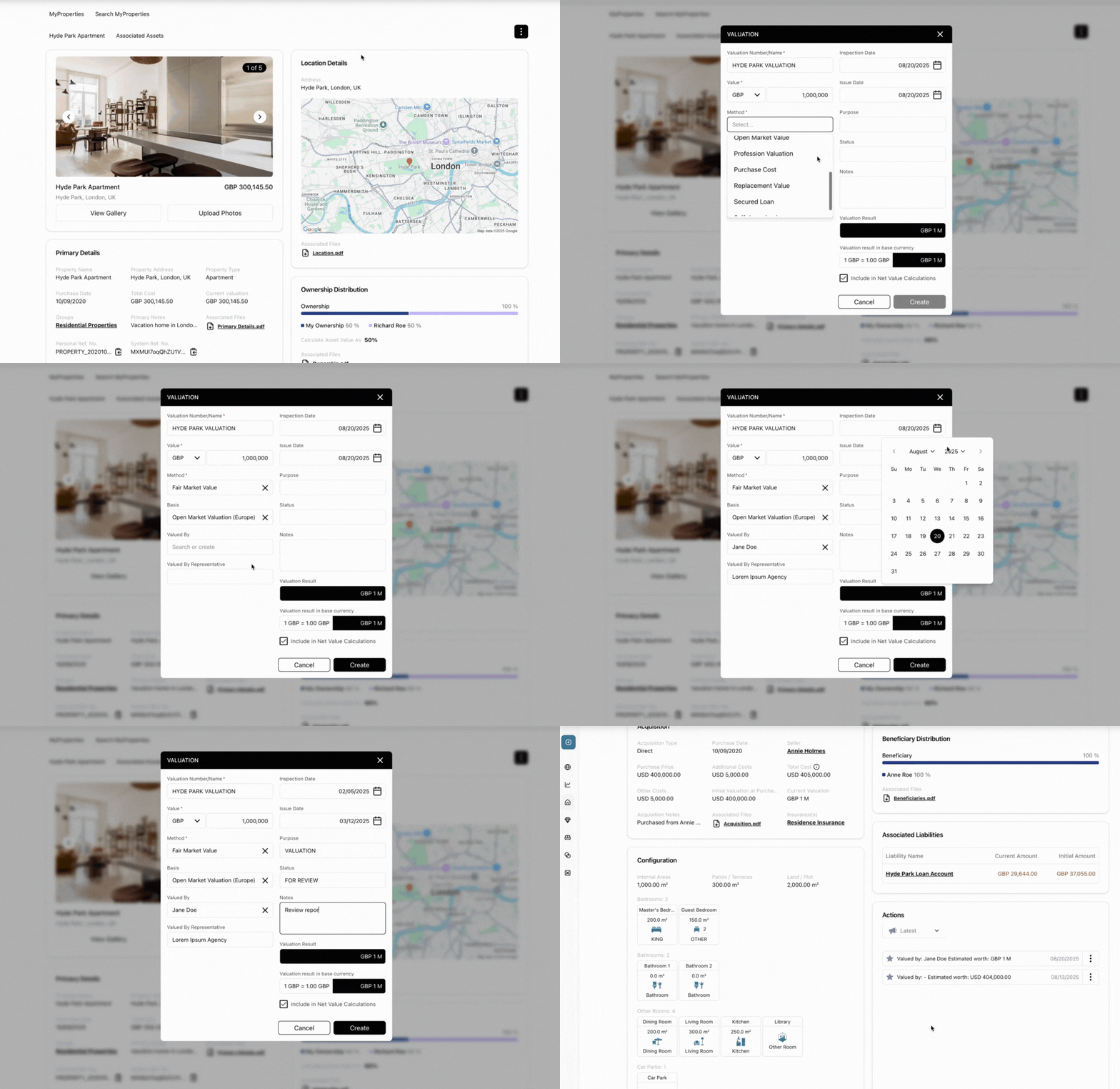
Digital apps and tools like MyAssets make it easy to manage and apply these valuation methods. The platform allows you to record various valuation types for each asset, ensuring a comprehensive financial snapshot and supporting smarter asset management.
How MyAssets Can Help You Track the Valuation of Your Assets
MyAssets is a digital asset management app designed to help you manage your assets efficiently. The platform allows you to record detailed information about your assets, including various valuation types such as fair market value, replacement cost, or professional appraisals.
One of MyAssets’ key features is the ability to consistently update asset valuations. As market conditions change or assets depreciate, you can revise values to maintain accurate records. This is especially useful for insurance, estate planning, financial reporting, or preparing for sales or loans. MyAssets makes this process seamless by providing user-friendly input fields for different valuation types.
By enabling users to track the fluctuating value of their assets over time, MyAssets transforms traditional asset management into an organised, dynamic, and proactive experience—perfect for anyone looking to take control of their financial future.
Key Factors to Consider When Selecting a Valuation Method for Your Assets
When selecting a valuation method for your assets, a few critical considerations will determine not just accuracy, but also the relevance and usefulness in your situation. Corporate Finance Institute (CFI) outlines core valuation approaches (income, market, and cost) and shows that the “right” method depends on how well its assumptions align with your asset’s nature, cash flow profile, and comparable data.
Here are key factors to weigh:
- Income‑generation potential: If your asset produces predictable future cash flows (e.g. rental property, business operations), an income approach (like discounted cash flow) may be appropriate.
- Availability of comparable market data: Some methods, such as market or relative valuation, rely on similar assets or recent sales to benchmark value. If there are many comparable trades, the market approach gains reliability.
- Asset type: For assets that lack income or comparability (e.g. specialised equipment, collectables, or land), cost‑based (replacement or reproduction cost) or adjusted book value methods may be more realistic.
- Risk, discount rate, and growth assumptions: All valuation models depend on assumptions (discount rates, growth rates, margins). The more speculative these are, the greater the margin of error.
- Liquidity, marketability, and time horizon: Assets that are illiquid or hard to sell quickly may require discounts for lack of marketability.
- Purpose of valuation: Different uses (e.g. sale, financing, taxation, wealth planning) may favour different methods or ranges.
On the personal side, applying a coherent valuation method matters because it feeds into your net wealth calculation, which is a central personal finance metric. Calculating your net worth involves summing the fair values of your assets and subtracting liabilities.
Using a consistent valuation approach ensures that the values you plug into that formula are credible and comparable over time.
If you value assets improperly, either overstating or understating their value, your net worth distortion could lead to poor decisions: overconfident borrowing, asset overconcentration, or underinvestment.
In short, the better your valuation method fits the asset, the more reliable your wealth snapshot and financial decisions will be.
Common Mistakes in Choosing a Valuation Approach
When valuing assets, whether a business, a property, or a portfolio, it’s not uncommon for decision‑makers (owners, investors, or advisors) to commit avoidable errors that distort the outcome. The CPA Journal provides a useful structure for understanding common pitfalls with valuation; adapting these lessons to any asset class, the following errors deserve careful attention.
1. Overreliance on a Single Method
One of the most frequent mistakes is to adopt just one valuation approach and ignore others. For example, exclusively using the income approach or a comparable sales method for all your assets. A more robust assessment often arises when income, market, and cost (or replacement) methods are compared and reconciled.
2. Misapplication in the Income Approach
When using cash‑flow or earnings‑based methods, errors creep in by choosing the wrong base (e.g. using accounting profit instead of free cash flow), miscalculating the terminal value, or overestimating growth rates. Each misstep can drastically inflate or deflate the valuation of an asset.
3. Faulty Market or Comparable Multiples
In the market approach, applying mismatched multiples, neglecting shifts in industry dynamics, or cherry‑picking the lowest multiples to appear conservative can skew results unfairly.
4. Neglecting Non‑operating Assets or Goodwill in the Asset Approach
Some valuers omit nonoperating assets (e.g. unused land, investments) or misestimate goodwill and intangible elements, distorting the total value. Meanwhile, assuming blanket goodwill without supporting earnings is another danger.
5. Ignoring Taxes, Discounts, and Subjectivity in Adjustments
Failing to account for built‑in gains tax or applying blanket discounts for lack of control or marketability without empirical support introduces subjectivity that weakens credibility.
6. Poor Presentation or Documentation of Assumptions
Even with accurate modelling, weak or opaque reporting of assumptions and rationale undermines the valuation’s defensibility in negotiations or due diligence.
7. Using Undervalued or Outdated Valuators
Selecting a valuator who does not stay current with evolving norms, regulatory changes, or new methods can lead to obsolete or flawed valuations.
Beyond these technical missteps, it’s important to understand how the broader financial context can influence valuation outcomes. For example, negative net worth arises when liabilities exceed assets, meaning your balance sheet is underwater.
In this situation, the valuation of a given asset may be depressed because creditors’ claims dominate the residual equity. In the extreme, the asset’s full value might be absorbed by liabilities, leaving little to support valuation from the owner’s perspective. Moreover, negative net worth can erode confidence, discourage investment, limit borrowing capacity, and magnify risk perceptions for valuers or buyers.
In summary, avoiding common valuation mistakes—and being mindful of your broader financial position—are essential to deriving credible, useful valuations. The right approach, rigorous adjustments, and transparent assumptions protect you from overpaying, underestimating, or weakening your negotiating position.
Learn more: 10 Best Net Worth Apps to Track Your Wealth
Frequently Asked Questions: Which Valuation Method Should You Use?
1. What is asset valuation?
Asset valuation is the process of determining the fair market value of a company’s assets, such as equipment, real estate, or intellectual property. It's commonly used for financial reporting, investment analysis, or sales.
2. Can I use more than one valuation method?
Yes, applying multiple valuation methods can give a more comprehensive and balanced perspective. This approach helps validate results and accounts for different factors affecting value.
3. How often should I revalue my assets?
Assets should typically be revalued annually or when there are significant market changes. The frequency may also depend on accounting standards, business needs, or regulatory requirements.
MyAssets: Monitor the Value of Everything You Own in One Platform
With MyAssets, you can easily monitor the value of everything you own – from financial assets and real estate to rare collectables and belongings – all in one secure, user-friendly platform. Stay on top of market changes, track asset performance, and make smarter decisions with confidence. Start your 14-day free trial and take control of your financial future with MyAssets.



