


When you think about building a legacy or securing an independent future, what asset comes to mind? For generations, the answer has been a property portfolio. It remains a time-tested investment, widely regarded as an effective hedge against inflation.
Indeed, every property investment delivers a profound purpose. It starts with buying the first family home, which they lovingly pass down and use as a financial foundation for their children in the future. Then, there are those letting properties for a steady income stream. In both ways, building a property portfolio goes beyond structures and space and becomes an instrument for security and wealth creation.
Yet, for all its potential, the path to success is not guaranteed. The reality of investing in real estate for some can be very different. Unprepared investors often fail to build lasting wealth, losing significant capital instead. This is not a theoretical risk; it is a documented reality.
For instance, short-term market shifts, such as sudden spikes in mortgage rates, can swiftly turn profit into loss. According to Redfin News, these pressures led to 13.5% of U.S. investor-owned homes being sold at a loss in a slowing market. This only demonstrates how quickly the foundations can crumble for those without a robust strategy.
This leads to an important question: how can you build a strong investment property portfolio?
Whether as an investor or landlord, solid preparation is essential to secure assets that stand the test of time. The good news? This guide breaks down the process into clear, actionable phases: Providing practical steps to start, grow, and ultimately exit a property portfolio with confidence.
- What is a Property Portfolio?
- How to Build an Investment Property Portfolio
- Phase I: Starting a Property Portfolio
- Phase II: Strategising for Property Portfolio Building
- Phase III: Financing Your Portfolio
- Phase IV: Managing a Property Portfolio
- Phase V: Growing, Optimising, and Exiting Real Estate Investment
- Building a Portfolio That Works for You: Now and Tomorrow
- How to Grow a Property Portfolio: Frequently Asked Questions
What is a Property Portfolio?
A property portfolio, as defined by the real estate agency Hamptons, is a collection of property investments owned by an individual or entity. This investment collection can be strategically composed of various property types, including residential property portfolios (like homes and flats), commercial spaces (such as offices or retail shops), and industrial properties.
Landlord vs. Investor
Generally, property ownership typically involves two roles that define the level of involvement:
- A landlord is the active operator who manages rental properties day-to-day to generate steady cash flow.
- A property investor, however, is in a broader, more strategic role. The investor’s primary focus is on the overall strategy of acquiring, financing, and leveraging a portfolio to build long-term wealth.
Whichever role one might play, mastering how to build an investment property portfolio is relevant to increasing net worth and establishing a source of income.
How to Build an Investment Property Portfolio
Thinking about learning how to grow a property portfolio, but don’t know where to start?
From defining goals to advanced management and scaling, this comprehensive guide breaks the entire process down into five strategic phases.
Phase I: Starting a Property Portfolio
Getting started is often the hardest part of any major investment journey, as every decision carries significant weight. To help individuals lay the groundwork, here are the key steps to take when starting a property portfolio.
Define Your Property Portfolio Goals
The best way to start a property portfolio is for landlords and investors to define their property portfolio goals: Do you want to grow wealth as property values rise? Or earn enough rental income to cover your lifestyle?
Establishing these goals early on is crucial, as they act as your strategic guide to real estate investment decisions, such as the type of property to invest in, the strategies to use, and the level of risk the investor is willing to take. Once individuals define the direction of their property portfolio, they are better positioned to measure success.
Select Your Investment Niche
With property portfolio goals defined, the next agenda is to select the property investment niche. This allows individuals to narrow their focus and concentrate their resources on a specific type of property investment.
This raises the question of: What are the main types of property investment? Here are some options to consider:
- Commercial Real Estate: Investing in non-residential buildings like offices, retail spaces or industrial facilities.
- House Flipping (buy-to-sell): Purchasing a property, renovating it, and selling it for a profit.
- Industrial Real Estate: Investing in properties designed for the production, storage, and distribution of goods, including warehouses, factories, and logistics hubs.
- Real Estate Investment Trusts (REITs): Acquiring ownership in a corporation that oversees income-producing properties, similar to the experience of buying and selling shares of a real estate portfolio on public exchanges.
- Rental Properties: Buying a single-family home, multifamily units, or vacation home, then renting out the property to another party in exchange for regular payment.

At the same time, investors should weigh several critical aspects when identifying the right property investment. Deal Machine emphasises the importance of considering factors such as:
- Available Resources: Evaluate financial position, available time, and professional network. Particular real estate sectors, such as commercial properties, often demand greater capital resources and stronger industry connections compared to others.
- Market Demand and Trends: Study the current market conditions to identify rising demand for property types such as single-family homes, vacation rentals, or student housing. Gaining this insight provides a strategic advantage.
- Risk Tolerance: Assess their acceptable risk threshold. Take the fix-and-flip approach, which promises quick returns but demands higher risk capital, while holding long-term rentals offers a steadier passive income, minimising market volatility and unexpected issues.
- Scalability and Long-Term Goals: Consider their long-term vision, projecting where they want the portfolio to be in five or ten years. Can this niche support fast scaling? Or is it more appropriate for managing a limited, focused portfolio?
By defining property goals and matching them to a suitable investment niche, the investor gains a well-directed start to their property journey.
Phase II: Strategising for Property Portfolio Building
Building a property portfolio requires more than acquiring assets. It demands a strategy that balances growth, risk, and long-term value. Phase II outlines key approaches to help investors and landlords expand their holdings.
Start Small
While a property portfolio is an exceptional strategy for managing wealth, investors and landlords must resist the temptation to grow too quickly.
The lack of a strategic plan and the failure to implement strategies that align with their available financial resources and goals can lead to unsustainable debt and, worse, negative net worth.
As the famous line goes, "Never bite off more than you can chew," in real estate terms, the initial investments should be manageable and within one's financial capacity to absorb unexpected costs. For example, purchasing one small multi-family unit that generates reliable cash flow is far superior to taking on five large renovation projects that drain one's capital reserves.
As recommended by Property Solvers, acquiring only one or two properties and growing the portfolio from that base is the best way to start a property portfolio. This allows them to minimise their initial financial exposure and build a strong foundation of practical experience before accelerating their growth.

Diversify Portfolio
Once the first few properties are generating a good return, it is the perfect time for the investor to consider buying more. Why? As Yield Investing points out, expanding a portfolio brings diversification, a strategy that mitigates the impact of market fluctuations and promotes reliable income generation.
A diversification strategy can involve purchasing property abroad, investing in multiple property types, or striking a balance between risk and reward.
Below are a few more strategies to support portfolio growth through diversification, as highlighted by the property investment firm, Integrity Property Investment.
- Diversify by Geographic Location: Allocating investments across different regions or countries to minimise the impact of local market, economic or political downturns.
- Diversify by Investment Strategy: Leveraging a mix of approaches, including long-term rentals (buy-and-hold), short-term trading (fix-and-flip), and securitised investments (REITs), to remain adaptable and resilient amid market fluctuations.
- Diversify by Property Type: Spreading investments across residential, commercial, and industrial segments to help manage risk, enhance income diversity, and build a portfolio capable of weathering market fluctuations.
With substantial resources and funding to cover unexpected expenses, individuals can leverage these strategies, allowing them to expand their holdings and ensure portfolio stability.
Read more: The Best Places To Buy Property Abroad for Investors
Phase III: Financing Your Portfolio
Exploring financing solutions is a practical way that allows investors to secure the necessary capital to acquire new properties, renovate, expand, or reposition their existing collection of investments.
Here are the top options investors can explore:
Conventional Loans
A Conventional Loan, as defined by Experian, refers to any mortgage that operates outside of government insurance or guarantee programs. They are exclusively originated, backed, and serviced by private entities such as banks, credit unions, and various private mortgage lenders.
This distinction means the investor must meet stricter underwriting standards, such as high credit and qualifying income.
Best for: Investors with good credit, interested in expanding into single-family or small-scale multifamily properties.
Hard Money Loans
Hard Money Loans are short-term, asset-backed loans offered by private lenders or investment firms, with real estate serving as the primary collateral, according to Investopedia. Unlike traditional financing, greater weight is given to the property's value rather than the borrower’s credit profile.

Best for: Real estate investors seeking fast financing for fix-and-flip ventures.
Private Money Loans
The fintech company SmartAsset defines Private Money Loans as funds lent by individual investors or private entities, often secured through existing personal or professional relationships.
Because they bypass traditional institutional requirements, the repayment schedules, interest rates, durations, qualifications, and overall structures are all highly flexible and negotiable.
Best for: Investors with trusted private lender networks capable of offering adaptable repayment arrangements. Also well suited for both flipping and real estate development.
Home Equity Loans
Also known as a second mortgage, a Home Equity Loan (HEL) allows homeowners to borrow against the equity they’ve built in their property. The equity itself is determined by subtracting the outstanding mortgage amount from the home’s present market value.
As U.S. Bank highlights, this loan amount is dispersed as a single, lump sum payment and is repaid by the borrower through fixed monthly instalments. This financing option is used to extract capital from one asset to fund the down payment, renovation, or expansion of another, effectively using their current equity as a source of funds for portfolio growth.
Best for: Property owners seeking to tap into their home’s equity to purchase more real estate.
Ultimately, identifying the most suitable financing solution is key to making informed decisions. Whether the goal is to purchase additional properties or enhance existing ones, the right approach can optimise both cash flow and investment potential.
Phase IV: Managing a Property Portfolio
Property portfolio management is the stage where overseeing and optimising a collection of real estate investments takes place. More than just administration, this discipline empowers landlords and investors to monitor performance, manage risks, and make strategic decisions that enhance overall returns and long-term asset value.
It is indeed a complex task which requires an extra set of hands, or at least, an extra set of tools for individuals managing more than one property.
Since the crucial question for portfolio owners is on how they can achieve scalability and efficiency, this section highlights key approaches to help landlords and investors successfully manage their real estate portfolios.
Utilising Property Management Software
Managing properties requires substantial time and attention, averaging around four hours a month per property devoted solely to daily operations. The solution to this significant time drain is property management software, a digital tool designed to streamline and automate property oversight.
This type of software centralises everything from secure document storage and financial accounting to maintenance management and performance reporting, acting as good tools to boost productivity and eliminate time-consuming manual tasks.
Here are some property management apps to consider:
- Buildium:A multi-property management software that simplifies the entire management process, from attracting tenants to overseeing finances and maintenance, for multiple units across different property types.
- Landlord Studio: A property tracking software designed to monitor rental income, expenses, and other financial aspects of your properties in one place.
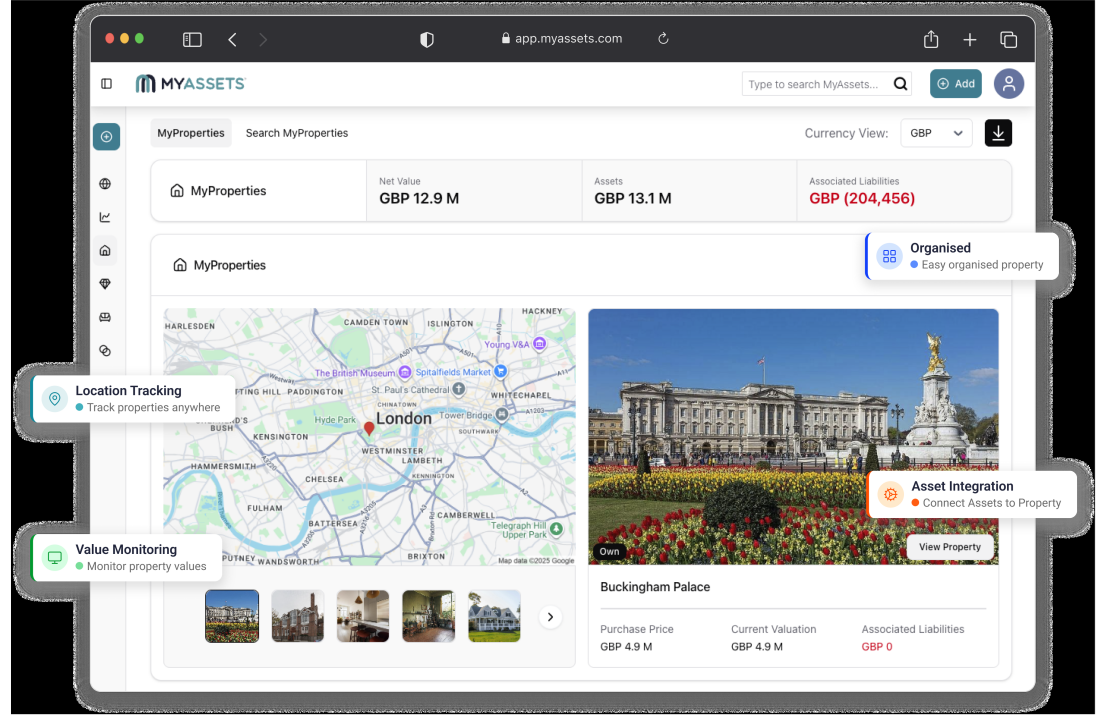
- MyAssets: A property organisation software that lets users catalogue every detail of their holdings, including property values, addresses, contents, key documents, and contact information.
On top of the tools one uses, having a dedicated professional to handle the operational burden is beneficial for investors to focus on accelerating the growth of a property portfolio. This solution involves hiring a professional.
See also: MyAssets: The Digital Asset Management App That Get Things Done
Hiring Property Professionals
Before bringing in outside help, investors should define the exact areas where support is needed. Distinguishing between day-to-day management needs and broader financial strategy is critical to choosing a professional who aligns with the portfolio’s direction.
Looking for the right property experts to match your needs? These are the property professionals that individuals rely on.
- Portfolio Managers: Supports investors in making informed investment decisions by creating and executing strategies while managing the portfolio’s daily trading activities.
- Property Managers: Handles a property’s day-to-day management, from upkeep and tenant relations to ensuring efficient operations.
- Real Estate Agents: Assist clients in buying, selling, and renting real estate properties.
- Real Estate Consultants: Offers professional guidance and tailored recommendations to clients interested in purchasing or developing real estate.
At the end of the day, the most effective path comes down to having a clear, goal-driven strategy that will support building a property portfolio.

Phase V: Growing, Optimising, and Exiting Real Estate Investment
Having successfully built and stabilised the portfolio’s foundation, this stage signifies a transition from management to strategic mastery.
The emphasis shifts toward maximising the overall value of each asset through scaling the portfolio, optimising it, and the deliberate planning of an exit strategy, which ultimately convert potential into realised profit.
Growing Portfolio
Reinvesting profits from existing investments is one effective way to grow the portfolio. When a single vacation rental property generates a surplus of cash, dedicating that excess capital back into real estate is the next logical step.
It’s worth noting that real estate remains a highly regarded asset class for its strong returns and diverse investment opportunities. Hence, successful investors don't limit themselves to traditional residential rentals; they diversify into other real estate sectors.
For instance, they can explore commercial spaces, such as smart offices or retail complexes, which often provide long-term financial stability through triple-net leases. Alternatively, they might invest in raw land in highly competitive or developing locations, focusing purely on capital appreciation over time rather than immediate cash flow.
There are countless real estate investments to choose from, each offering a unique risk and return profile.
Optimising Portfolio
Investors must periodically reassess their goals and review their real estate holdings. Some properties may warrant upgrades to improve profitability, whereas others may be better divested if they no longer serve their purpose.
This is where real estate portfolio optimisation becomes essential. According to Allegro, a real estate services company, it involves evaluating property assets and operations to uncover efficiencies, reduce costs, develop strategic plans, and ultimately maximise the portfolio’s overall value.
Exit Strategy
A core principle of investing is that every beginning leads to an end. This is where an exit strategy becomes essential. It is a deliberate plan outlining how investors intend to sell their property and realise their returns.
One might ask: Why is an exit strategy important? Simply put, it provides a time horizon for the investment and, more importantly, enables investors to capture optimal gains during the sale, said Multifamily Loans.
Interested in knowing how investors plan their exits in real estate? Below are some of the most popular strategies to consider, as highlighted by the property investment agency, CityRise.
- Buy-to-Let Strategy (Renting): Completing the purchase and renting the property out to generate a regular rental income stream.
- Passing Property to Heirs: Retaining ownership and transferring the property asset to future generations, often through trusts or family companies.
- Refinancing: Securing a new mortgage often at a higher valuation, to release the equity accumulated from property growth or repayments.
- Sell Before Completion (Assignment): Selling the purchase contract to another buyer before the property’s development is finished.
- Sell Upon Completion (The Flip/Resale): Completing the purchase (securing financing and paying closing costs and then listing the property for sale on the open market.
Ultimately, a strong start is only part of a successful property investment; an effective exit strategy is equally essential. Investors must remain adaptable to changing market conditions shaped by interest rates, tax policies, and broader economic forces. With multiple exit paths in place, they can protect and optimise returns as the market evolves.
Building a Portfolio That Works for You: Now and Tomorrow
Building a property portfolio combines planning, decision-making, and management. Every phase is vital: from defining goals and choosing the right investment niche, to securing financing and preparing for growth and eventual exit.
But aside from going through those phases, property portfolios also need day-to-day management, which is why most investors often turn to professionals or property management tools to keep operations running smoothly.
With careful planning, disciplined management, and a forward-looking approach, a well-managed property portfolio becomes a strong foundation for lasting wealth.
How to Grow a Property Portfolio: Frequently Asked Questions
1. What are the best property types for good yields?
The property types that tend to deliver strong yields are usually those catering to high-demand niches, often called speciality real estate. Examples include vacation rentals, which can generate significant income in tourist-heavy areas, and commercial properties, such as retail or office spaces, which benefit from long-term leases.
2. Is it better to own property via a company or personally?
The best choice is highly situational: Personal ownership is simpler, easier to finance, and suits basic-rate taxpayers or those with small portfolios. Company ownership offers better tax efficiency (especially full mortgage interest relief) and limited liability, making it ideal for higher-rate taxpayers and those focused on growing a large portfolio.
3. How fast can you build a property portfolio?
How quickly a property portfolio can grow largely depends on an investor’s strategy and access to capital. Rapid expansion is often achieved by leveraging methods like BRRRR (Buy, Refurbish, Rent, Refinance, Repeat) or forming joint ventures to increase purchasing power.
Organise and Grow Your Portfolio with MyAssets
Building a property portfolio demands robust organisation. Rather than relying on scattered spreadsheets and notes, a property organisation tool such as MyAssets allows users to organise, track and manage all their assets in one place.
All Your Property Information in One Place
MyAssets is an asset management platform that provides a dedicated space to digitise their portfolio: from residential rentals, commercial properties, and more. Each property entry captures detailed information, including historical value, repairs or renovations made over time, and property details such as the number of rooms, square footage, and location.
On top of its property management features, MyAssets also accounts for the users’ finances, recording liabilities, such as loans and mortgages, alongside other physical assets (i.e. collectables and belongings). This provides an overview of net worth, making sure that they are getting a complete and accurate financial picture.
Every Property Document in Order
Keep all documents organised and accessible. With MyAssets’ Document Vault, users can upload titles, contracts and insurance policies associated with their properties, ensuring every critical file is neatly sorted and instantly retrievable whenever needed.
A Collaborative Approach to Managing Your Portfolio
As part of managing a property portfolio, primary users can grant access to property managers, real estate agents, or beneficiaries by adding them as delegates. MyAssets Delegates feature allows them to assign specific roles and permissions—such as viewing, creating, editing, or deleting entries—ensuring that each delegate has the appropriate level of access to manage the portfolio effectively.
Experience seamless property organisation today with MyAssets 14-day free trial.



