

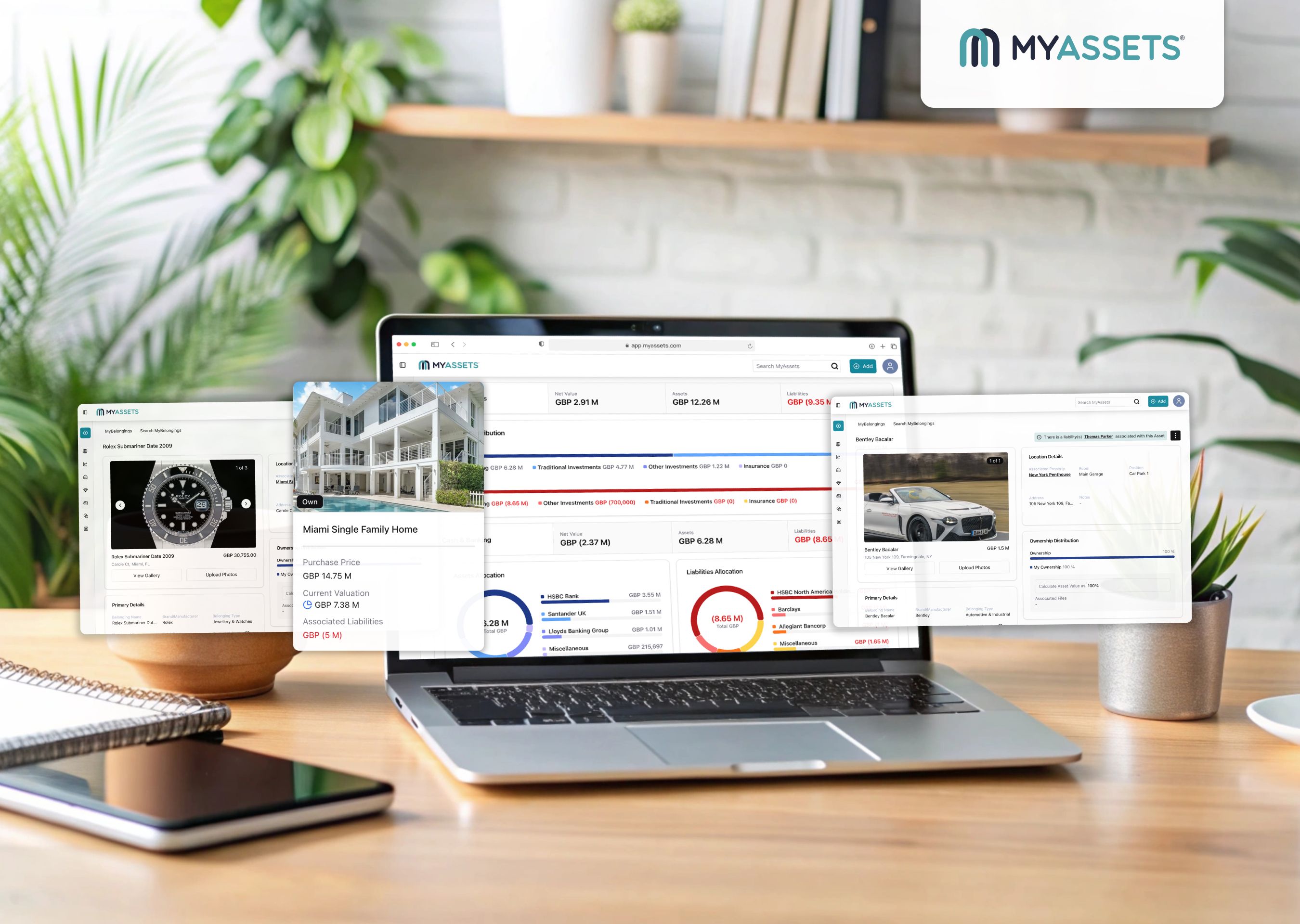
How effective is your data management system for tracking every asset and investment?
Did you know that many individuals and businesses struggle with poor data quality management? According to a recent report by business.com, 91% of organisations experience a negative impact on operations due to data problems. These issues often stem from fragmented storage, inconsistent metadata standards, and a lack of real-time version control. This leads not just to inefficiency, but also to costly errors, redundant purchases, and poor decision-making.
That’s why asset management apps like MyAssets are so valuable: they provide the features needed to keep your asset registry accurate and current. The MyAssets platform supports real-time updates and tracking, so all asset information stays current, which is useful for ownership changes or other status updates. The platform also provides comprehensive auditing features, such as a document vault, enabling you to store and retrieve important documents (e.g. purchase receipts, titles, proofs of ownership) alongside asset records.
MyAssets also allows customisable data fields and supports a variety of asset types, from property and financial accounts to collectables and belongings, giving you a flexible way to categorise and describe each item in detail. With its analytics, reporting, and export capabilities, you get clear overviews of your holdings, leading to better asset utilisation, fewer redundant purchases, and smarter long-term decisions.
By centralising all your assets in a platform like MyAssets, you establish a "single source of truth." This significantly reduces risk, boosts efficiency, and ensures your asset data remains accurate and actionable.
- The Benefits of Maintaining Accurate Asset Data Managements
- Why You Need a Data Asset Management System
- Tips for Keeping Up-to-Date Asset Data Records
- Keep Physical and Digital Records of Asset Data
- Establish a Central Data Management System for Your Assets
- Regularly Review Your Assets' Information and Files
- How to Maintain and Update Your Asset Data inside MyAssets
- Add Important Information about Your Assets
- Create a Document Storage System for Your Assets
- Review Your Assets' Performance and Update Corresponding Data
- The Importance of Data Management for Your Assets: Frequently Asked Questions
The Benefits of Maintaining Accurate Asset Data Managements
Proper data management for your assets is more than just keeping lists. It entails organising every relevant document, file, and detail that defines what you own, how it's used, and its history.
Managing this foundational information is a critical part of life admin, which refers to the many behind-the-scenes tasks of everyday life, such as tracking bills, bank accounts, and crucial documentation like receipts, mortgages, insurance policies, and proofs of ownership.
By using a dedicated asset management tool, you can centralise all elements related to your assets in one secure place.
From a financial perspective, there are several tangible benefits to maintaining accurate records of detailed history, receipts, invoices, and documentation for every asset. These include:
- Streamlined expense tracking and debt management which is beneficial when you need to apply for funding
- Easier tax compliance to prevent penalties or legal complications
- Reduction in accounting costs
- Better financial clarity and decision-making
- Easily assess your net worth, monitor growth or depreciation, and make informed decisions about investments, insurance, or disposal of assets
All these benefits support long-term planning, especially when applying for loans or selling assets. As noted by nibusinessinfo, good record keeping “gives the information you need to manage and grow your business.” It also brings peace of mind, reduces risk, improves financial control, and supports smarter decision-making through clarity and structure.
Why You Need a Data Asset Management System
As your investment portfolio or collection of assets grows, managing information manually becomes unsustainable. That’s where a robust data asset management system becomes vital. Such a system was designed to help individuals and organisations handle diverse assets by consolidating data into a central, structured database.
The key advantages of a centralised, streamlined data asset management system include:
- Improved visibility. By storing all asset information in one place, these tools give you a clear view of your entire portfolio at a glance. It helps you make informed decisions about the maintenance, sale, or acquisition of assets.
- Increased productivity. Instead of wasting time rummaging through spreadsheets, paper files, or multiple tools, you can quickly retrieve any asset’s information. In fact, inefficient asset management often leads to wasted time and information loss.
- Loss prevention and risk reduction. When asset data is properly tracked, the risk of misplacing, losing, or forgetting assets is much lower. This also prevents duplicate purchases or unnecessary spending.
- Organised, lifecycle-aware data management. You can monitor changes over time for each asset, such as when it was purchased, its current state, maintenance events, depreciation, status updates, and eventual disposal or sale. This ongoing tracking helps preserve asset value, optimise utilisation, and plan smarter for the future.
As your holdings expand in number and variety, a dedicated asset management system gives you centralised oversight, saves time, reduces risk, and ensures you manage each asset throughout its full lifecycle with clarity and confidence.
Read more: Best Asset Management Software & Tools (2025)
Tips for Keeping Up-to-Date Asset Data Records
We’ve shortlisted ways you can streamline your data management for investment portfolios and asset collections.
1. Keep Physical and Digital Records of Asset Data
Maintaining both physical and digital records of asset data is a cornerstone of good data management, especially when multiple people or teams are involved.
Physical asset records, such as receipts, certificates, maintenance logs, or inspection sheets, provide tangible backup and a clear audit trail, safeguarding against digital failures or cyber threats.
Meanwhile, digital asset records support scalability, remote access, and efficient retrieval. With well-structured metadata and indexing, digital records of asset data allow you and authorised users to quickly locate relevant information without digging through stacks of paper.
A hybrid approach that unifies physical and digital documentation under a single management system adds resilience. If servers crash or files become corrupted, physical documents remain as a reliable fallback; if physical files are lost, damaged or misfiled, digital backups ensure continuity.
In the context of collaborative asset management, this practice becomes even more critical. For example, MyAssets enables primary users and their authorised delegates to link documents and photos directly to each asset, such as receipts, warranties, condition reports or provenance certificates.
This centralised digital vault ensures that every team member, regardless of location, can access the same up-to-date asset history and easily attach or view related documentation, reducing the risk of miscommunication, lost files, or duplication.
Combining physical and digital record-keeping under a unified system helps preserve integrity, ensures redundancy, and enables efficient collaboration when multiple stakeholders manage diverse assets together.
2. Establish a Central Data Management System for Your Assets
Establishing a central data management system for your assets is a powerful practice for good data management.
Consolidating all asset information into one unified platform reduces fragmentation, improves accessibility, and makes asset tracking more reliable and efficient.
Using an app like MyAssets as your central asset hub illustrates these benefits clearly:
- MyAssets is built to handle diverse asset types, from financial accounts, investments, and real estate to physical belongings and collectables.
- MyAssets gives you a holistic view of your entire asset portfolio, showing asset categories, valuations, locations, and more under the Global Dashboard.
- MyAssets allows you to monitor your net worth and make informed decisions.
- MyAssets also supports custom asset groups, smart asset linking, and a document vault for attaching receipts, deeds, certificates, or warranty documents to each asset.
Having everything in one platform improves data accuracy and integrity.
Rather than juggling multiple lists or manual logs that are prone to errors, duplication, or omission, you maintain up-to-date, consistent records that reflect real-world values and conditions.
This consolidated approach also enhances productivity: updating, retrieving, or analysing asset data becomes quicker and less laborious. For anyone managing dozens or hundreds of assets, a centralised system reduces the risk of loss, duplication, misplacement, or outdated information.
All in all, establishing a central data management system gives you clarity, organisation, accuracy, and control over your entire asset portfolio.
3. Regularly Review Your Assets' Information and Files
Regularly reviewing your assets’ information and files is a fundamental practice in good data asset management. It pays off in clarity, control, and informed decision-making and financial planning over time. A comprehensive financial review involves gathering all relevant statements, from your assets to your liabilities, to get a clear snapshot of where you stand financially.
By periodically revisiting your asset records, you ensure that your financial picture reflects current reality. This helps you monitor progress toward goals such as retirement, savings, or debt repayment, and recalibrate if your situation or priorities change.
For example, if your income increases or you incur new liabilities, a review lets you adjust your savings rate or re-evaluate investments, keeping your financial strategy aligned with your evolving life circumstances.
Regular asset reviews are also a safeguard. By systematically organising and updating financial documents, you reduce the risk of missing outdated or inaccurate information. That clarity can reveal risks that need attention (e.g. high-interest debt) or new financial opportunities, such as reallocating investments or strengthening emergency funds.
Ongoing reviews also encourage discipline and foresight. Just as you revisit goals and adjust plans, you maintain a dynamic, responsive financial strategy rather than a static plan that may become obsolete.
Routinely reviewing your assets and their associated documentation ensures your records are accurate, your financial health stays transparent, and your decisions remain grounded in up-to-date information, all of which are core to effective data asset management.
Learn more: How to Manage Your Physical Assets at Home
How to Maintain and Update Your Asset Data inside MyAssets
Here’s a step-by-step guide on streamlining your data asset management with MyAssets.
1. Add Important Information about Your Assets
Adding detailed information about your personal assets in the platform is essential to maintaining a reliable, holistic view of your financial wealth. The comprehensive categories in MyAssets support a wide variety of asset types, from financial accounts and real estate to collectables and household items.
Within MyAssets, you can sort each asset into its proper category:
- Financial accounts and insurance policies belong in MyFinances
- Real estate, such as homes, land, or rental units, fits under MyProperties
- Art, antiques, and rare objects go in MyCollectables
- Everyday items or other personal possessions can be organised in MyBelongings
MyAssets lets you add basic and complex information about the assets you add. This can include the following information categories:
- Acquisition details
- Attributes
- Location (e.g. which property and which room)
- Ownership details
This level of detail does more than catalogue what you own. It helps you track value, monitor maintenance or depreciation (especially for fixed assets), and gives you clarity on where everything is located.
Because MyAssets unifies all types of assets into a single dashboard, you get a consolidated view of your net worth and how different assets relate or interact. This enables smarter financial decisions, easier planning (for example, for insurance or estate planning), and efficient life administration.
Adding complete and accurate information for each asset in MyAssets transforms scattered documentation into a secure, organised, and actionable asset inventory, giving you a strong foundation for long-term financial and life management.
2. Create a Document Storage System for Your Assets
Creating a well-organised file storage system for your assets helps you categorise and retrieve relevant documents efficiently.
With MyAssets’ offering, you can use the Document Vault to build a digital file management system where you can link documents and images directly to the relevant assets. By attaching files to specific assets, you ensure that all important information stays connected to the correct item, eliminating confusion and disorganisation.
MyAssets also supports several common file types, giving you flexibility in storing various kinds of asset documentation. You also have peace of mind with the platform’s bank-grade encryption, ensuring that your documents remain secure, protected against data loss, and accessible whenever you need them.
Building a document storage system transforms scattered and disconnected files into a centralised, organised, and secure archive. Over time, this helps you maintain accurate asset histories, simplify tasks like valuations or sales, and ensure that you always have the right paperwork at your fingertips.
3. Review Your Assets' Performance and Update Corresponding Data
Maintaining an up-to-date record of your assets in MyAssets is more than just initial setup. It also involves a regular review of your assets’ performance and updating the corresponding data.
When you revisit your assets periodically, you can update their value, condition, location, and relevant documents. More importantly, using a single platform for all aspects of life administration, including assets, simplifies your systems, reduces fragmentation, and helps you stay on top of the changes in your financial and material circumstances.
The Importance of Data Management for Your Assets: Frequently Asked Questions
1. Why is it important to keep my asset data accurate and up to date?
Accurate and current asset data helps you maintain clear visibility into everything you own, avoid duplication, reduce financial risk, and make better decisions. Poor data management often leads to misplaced information, unnecessary purchases, and reduced efficiency.
2. How often should I update my asset information?
You should update your records anytime an asset changes, such as when you purchase, sell, repair, revalue, or relocate it. The MyAssets platform is a tool that can help you stay consistent with updates.
3. How does MyAssets reduce the risk of lost or forgotten assets?
By creating one centralised and searchable database, MyAssets minimises the chances of misplacing documents or losing track of ownership details. Its audit trail and activity logs ensure you know exactly where each asset stands at any time.
MyAssets: The Digital Hub for All Your Assets
MyAssets is a digital asset app for managing all your personal assets and their related data. Its features make it easy to organise, track, and update asset information without juggling spreadsheets, folders, or multiple apps.
Using MyAssets turns asset management from a tedious, fragmented chore into a streamlined, reliable, and secure process, allowing you to maintain an accurate, up-to-date record of what you own, where it is, and how much it's worth.
MyAssets supports this ongoing maintenance through its Global and category-specific Dashboards, enabling you to track net worth, asset locations, inter-asset links, and documentation all in one place. By centralising every asset and allowing seamless edits and updates, MyAssets directly guards against the data inaccuracies and outdated information that easily accumulate with dispersed spreadsheets or manual records.
Start your 14-day free trial to develop an improved data asset management system for everything you own.



