


Investing is generally centred on growing wealth through returns. Still, compound interest investments operate on a different principle –they are designed not just to grow, but to multiply wealth over time. This is where the real power of compounding begins, a process in which an investment generates return on the principal amount and the interest it has earned over time.
In essence, these investments thrive on a simple yet powerful formula: steady contributions, uninterrupted growth, and the patience to let time do the heavy lifting. Therefore, it is not a get-rich-quick scheme; it is a form of investing which rewards patience, consistency and time.
To demonstrate this principle, legendary investor Warren Buffett highlights its transformative potential. He credited that time and compound interest as the primary drivers of his wealth, having begun his investment journey at just 11 years old. This early start allowed his capital to compound and expand through reinvested returns over decades. As a result, more than 99% of his net worth was accumulated after the age of 50, illustrating how compounding intensifies significantly at some point.
While compound interest provides the engine for lasting wealth, its true power depends entirely on the vessel chosen to carry it. This naturally raises the question: What are the best compound interest investments available?
This article explores the top compound interest investments, first explaining how compounding works, then highlighting the best investment options with high returns, and finally sharing practical tips to maximise the power of compounding.
- What is a Compound Interest Investment?
- 5 Best Compound Interest Investments
- High Interest Savings Accounts
- Cash Individual Savings Account (ISA)
- Fixed-Rate Bonds
- Stocks and Shares Individual Savings Account (ISA) with Index Funds
- Self-Invested Personal Pension (SIPP)
- Tips to Maximise Compounding Returns
- Things You Can Invest In To Make Money with Compounding Returns
- Best Compound Interest Investment Accounts: Frequently Asked Questions
What is a Compound Interest Investment?
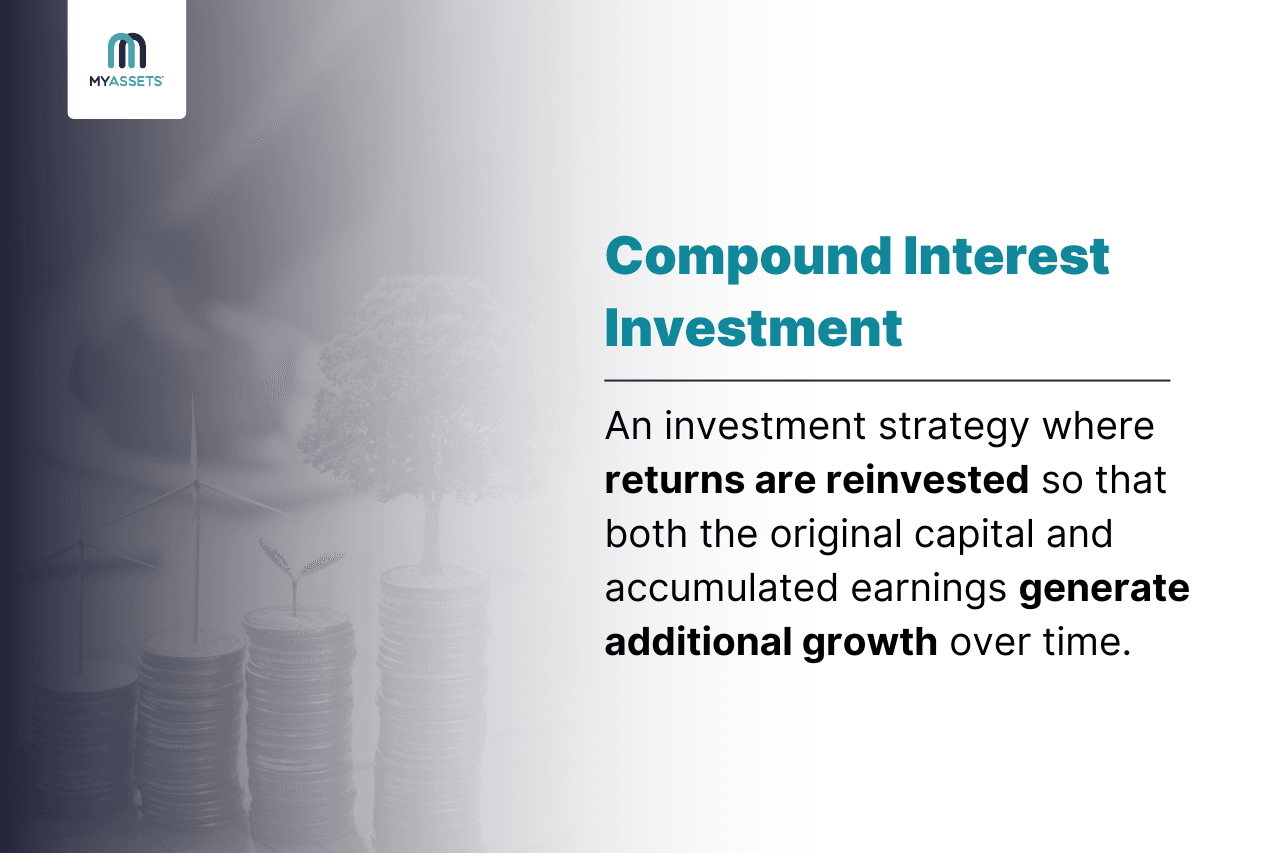
As defined by TD Bank, a compound interest investment is any bank-based account or money market asset that earns interest or capital growth. Their defining feature is compounding, in which returns earned are added back to the principal (starting amount), generating larger, long-term payouts.
In simple terms, it allows money to grow on itself, creating a snowball effect in which earnings generate additional earnings as they are reinvested continuously.
How Compound Interest Works
For example, if £2,500 is deposited into a savings account earning 1.5% Annual Equivalent Rate (AER)/gross, it would generate £37.50 in interest in the first year, bringing the closing balance to £2,537.50 by year-end.
However, in the second year, the interest earned would be slightly higher even if the rate remains unchanged, because the calculation is now based on a larger balance that includes the previously earned interest.
The table below illustrates how compound interest takes effect year after year.
| Year | Opening balance | Yearly interest of 1.5% AER / gross | Closing balance |
|---|---|---|---|
| 1 | £2,500.00 | £37.50 | £2,537.50 |
| 2 | £2,537.50 | £38.06 | £2,575.56 |
| 3 | £2,575.56 | £38.63 | £2,614.19 |
| 4 | £2,614.19 | £39.21 | £2,653.40 |
| 5 | £2,653.40 | £39.80 | £2,693.20 |
| 10 | £2,693.20 | £42.88 | £2,901.35 |
This may seem like a small difference at first, but the effect of compound interest becomes significantly powerful over time. Its impact is even stronger when investing early, because the earlier the start, the greater the compounding effect.
5 Best Compound Interest Investments
While the mechanics of compounding are simple, its real impact is best understood in action. From savings accounts to long-term market investments, different financial instruments showcase this effect in varying degrees.
With that in mind, here are some of the most effective investments that exhibit the best example of compound interest.
1. High Interest Savings Accounts
A savings account is the best compound interest investment option for individuals seeking low-risk growth. It offers a simple and secure way to grow money over time by earning interest on deposits and having little exposure to market risk.
However, for those seeking more meaningful growth, choosing a high-interest savings account with competitive rates is a practical way to put money to work, rather than leaving it idle in a non-interest-bearing savings account.
According to finder.com, among the top savings accounts offering competitive interest rates are:
- Co-operative Bank Regular Saver: 7% AER variable
- First Direct Regular Saver: 7% AER fixed for 1 year
- Zopa Bank Regular Saver Account: Up to 7.10% AER variable
While individuals can benefit from high interest rates, the downside is that savings held outside Individual Savings Account (ISAs) may be subject to tax if the interest earned exceeds the Personal Savings Allowance (PSA). This is £1,000 per year for basic-rate taxpayers, £500 for higher-rate taxpayers, and £0 for additional-rate taxpayers.
2. Cash Individual Savings Account (ISA)
Are you looking for a tax-efficient way to grow your savings? Unlike a regular savings account, a cash ISA is a type of savings account that allows individuals to deposit money and earn interest completely tax-free. This makes it a reliable way for high earners to maximise their money.
Moreover, cash ISAs generally fall into two main categories:
- Easy-Access Accounts: Where funds can be withdrawn when needed
- Fixed-Rate Accounts: Where money is locked in for a fixed period in return for a guaranteed rate
In this case, individuals can select based on how they prefer to manage their money, prioritising either immediate access or committing funds for a period in return for more returns.

So, for those seeking flexible access to funds, below are a few of the best easy-access Cash ISAs available:
- Plum Cash ISA: 4.32% AER
- Tembo Cash ISA: 4.30% AER (with 12-month bonus)
- Trading 212 Cash ISA Promo Rate: 4.51% AER
Contrarily, for savers willing to lock their money away in exchange for higher returns, Moneyfacts Compare lists some of the leading fixed-rate cash ISA rates on the market:
- UBL UK 1 Year Fixed Rate Cash ISA: 4.66% AER
- AlRayan Bank Meteor Savings 2 Year Fixed Rate Cash ISA: 4.65% AER
- Aldermore 3 Year Fixed Rate Cash ISA: 4.60% AER variable
While both provide a tax-free advantage, contributions are capped by an annual ISA allowance of £20,000, which can limit individuals looking to invest larger sums. Nevertheless, within this allowance, cash ISAs still allow compounding to continue uninterrupted, as all interest earned grows free from tax deductions.
3. Fixed-Rate Bonds
Fixed-rate bonds function as loans in which the investor provides capital for a predetermined term in exchange for a guaranteed interest rate, typically paid monthly or annually. Because the rate is fixed, the interest remains shielded from market fluctuations for the life of the bond.
But how does compounding work in a fixed-rate bond? It works through reinvestment. When bond interest payments or maturity proceeds are reinvested in new interest-bearing investments, future returns build on previous earnings. Over extended periods, this repeated cycle can steadily strengthen overall wealth growth.
Fixed-Rate Bond vs Fixed Cash ISA
Fixed cash ISAs are similar to fixed-rate bonds in that they offer a guaranteed interest rate for a set term, providing predictable returns that can be planned for reinvestment.
However, unlike fixed-rate bonds, the interest earned in a fixed ISA is tax-free. Another trade-off is that fixed cash ISA rates are often lower, and the annual cash ISA allowance limits contributions, making fixed-rate bonds a more attractive choice for those seeking fewer contribution restrictions.
Explore the best fixed-rate bond accounts offering high interest rates:
- Kuwait Finance House Raisin UK - 1 Year Fixed Term Deposit: 4.67% AER
- BACB Raisin UK - 2 Year Fixed Term Deposit: 4.67% AER
- RCI Bank UKRaisin UK - 3 Year Fixed Term Deposit: 4.68% AER
Overall, fixed-rate bonds offer stable, predictable returns that remain unaffected by shifting market conditions. While this protects investors from volatility, it also means they cannot pivot to higher-paying options if interest rates rise, potentially locking them into less competitive yields.
Despite this trade-off, these bonds are widely regarded as lower-risk assets due to their guaranteed interest and capital security.
Read More: How To Monitor Your Wealth: A Beginner’s Guide
4. Stocks and Shares Individual Savings Account (ISA) with Index Funds
A Stocks and Shares ISA is a tax-efficient investment account that allows individuals to invest up to £20,000 each tax year into financial markets, such as index funds. These funds pool money from many investors and track a wide range of companies across global markets, offering broad diversification.
Compounding here is simple. By choosing Accumulation (Acc) funds, investors don’t get dividend payouts in cash. Instead, any dividends are automatically reinvested back into the fund for them.
That means:
- Dividends buy more units of the fund
- More units mean the investment size grows
- Earn returns on that larger amount
Over time, this creates a snowball effect where money keeps growing on itself, and it all happens automatically inside the ISA without UK tax reducing the growth (within the annual allowance).
To explore a few index funds available, here are some options within Stocks and Shares ISA:
- Vanguard FTSE Global All Cp Idx £ Acc
- HSBC FTSE All-World Index C Acc
- Fidelity Index World (Accumulation)
All things considered, it is important to remember that Stocks and Shares ISAs invested in index funds are high-risk investments, as returns depend on market conditions. Meaning, investment value can go down as well as up, and unlike a bank account, the original capital is not guaranteed –one may get back less than they initially put in.
Nonetheless, this is one of the best compound interest investments in the UK for long-term investors seeking growth through reinvested returns and market performance over time.
5. Self-Invested Personal Pension (SIPP)
A Self-Invested Personal Pension (SIPP) is a UK retirement savings account that lets individuals choose how their money is invested. This gives individuals full control over which asset they invest in, whether that is company shares, investment funds, or bonds.
In relation to compounding, it is often considered one of the best compound interest investments, because it benefits from two key forces:
- Tax Relief Boosts: When money is paid into a SIPP, the government adds 20% tax relief. For example, if an individual puts in an £80 contribution, the government tops it up to £100. Higher-rate taxpayers may also be able to claim additional relief through a tax return. This means investments start from a higher base, strengthening long-term growth
- Long-Term Investing: A SIPP is designed for retirement, so funds are typically left invested for many years or decades. The longer the money stays invested, the more powerful compounding becomes
For those looking for ideas on what to invest in, here are a few of the best-selling SIPP funds for the first quarter of 2026, as listed by Fidelity:
- Artemis Global Income Fund
- Dodge & Cox Worldwide - Global Stock Fund
- Lazard Emerging Markets Fund
Since a SIPP is a do-it-yourself pension scheme, this means individuals are responsible for choosing and managing their investment portfolio, which requires more knowledge, research, and ongoing attention.
Nevertheless, it remains one of the best investment options for investors focused on building long-term wealth through pensions and maximising compounding growth.
See Also: Net Worth for Retirees: How Retire Comfortably in the UK
Tips to Maximise Compounding Returns
To take full advantage of compounding, a few key strategies can help maximise long-term growth. Here are a few tips to apply:
- Minimise Fees and Taxes. Compounding works against investors when high fees and taxes reduce overall returns. Using tax-advantaged accounts, such as ISAs or pensions, helps minimise costs and protect long-term growth
- Reinvest Earnings. Do not withdraw interest or dividends; instead, leave them invested so they can generate additional returns over time
- Set Clear Financial Goals. Defining clear goals helps guide a compounding strategy, whether prioritising long-term growth, regular income, or both. This, in turn, shapes investment decisions, risk appetite, and asset allocation
- Start Early. Time is the most powerful factor in compounding. The earlier an individual starts investing, the longer their money has to grow and generate additional returns
- Stay Invested. Don’t try to time the market or sell when prices fall, as this can lock in losses

Things You Can Invest In To Make Money with Compounding Returns
Compound interest is a wealth-building force that works by generating returns on initial investment and the returns it has already earned. As shown through the five best compound interest investments:
- High Interest Savings Accounts
- Cash Individual Savings Account
- Fixed-Rate Bonds
- Stocks and Shares Individual Savings Account with index funds
- Self-Invested Personal Pension
Each option demonstrates a different form of compounding, whether through interest payments or reinvested investment returns, while also varying in risk, return potential, and accessibility.
Nevertheless, before making any decisions, investors should have a clear goal to guide their investment choice, risk level, and time horizon. Finally, to effectively maximise compounding, it is important to start investing early and remain invested over the long term, allowing returns to build on themselves over time.
Best Compound Interest Investment Accounts: Frequently Asked Questions
1. Which investment is best for compound interest?
The best investment for compound interest varies depending on the risk level an investor is willing to take, along with their financial goals, time horizon, and need for access to funds.
Generally, higher-growth investments like stocks and shares ISAs or SIPPs offer stronger long-term compounding potential, while cash-based options provide lower but more stable returns.
2. What compound interest will double in 7 years?
An investment earning around 10% interest can roughly double in about 7 years (72 ∕ 10 = 7.2), while a 12% return can double it in around 6 years, based on the Rule of 72 (72 ∕ 12 = 6).
3. What is the 8 4 3 rule of compounding?
The 8-4-3 rule of compounding is a financial guideline that shows how investment growth, particularly through SIPs, starts slowly but becomes increasingly rapid over time across 15 years. It suggests roughly 8 years of steady growth, followed by 4 years of faster acceleration, and then 3 years of strong exponential snowball growth.
MyAssets: The Asset Management Platform for Investment Oversight
How will you know if your investments are compounding over time? One way to understand this is by consistently tracking how returns, reinvested earnings, and overall portfolio value grow year after year. After all, building wealth through compound interest is not only about choosing the right investments, but also about staying organised and monitoring them as they continue to grow over time.
Introducing MyAssets, a complete asset management platform that helps organise and monitor their investments in one centralised platform.
One Dashboard for All Your Wealth
It pulls everything together:
- Bank accounts (checking and savings)
- Investment portfolios (stocks, bonds, and mutual funds)
- Properties (residential, rental, and commercial)
- Valuable assets (family heirlooms, art collection and other collectables)
It gets better. MyAssets doesn’t just show your assets; it also accounts for your liabilities, such as:
- Credit card debts
- Loans
- Mortgages
By consolidating these assets and liabilities, MyAssets functions as a net worth calculator, helping you understand your true financial position and make data-driven decisions.
What’s more? Imagine having all this information presented in a visually appealing dashboard. With MyAssets, monitoring wealth becomes straightforward as the platform transforms raw numbers into dynamic charts, offering a breakdown of how resources are distributed across finances, properties, collectables, and even belongings.
A Shared Access to Your Wealth
Managing wealth is rarely a solitary endeavour, yet sharing sensitive financial data often poses a significant security risk. MyAssets addresses this by providing full control over account permissions, with the Delegates feature allowing them to assign who can view, edit, delete, or create entries within their portfolio.
This granular control enables seamless collaboration without compromising total privacy. For example, an individual can grant:
- View-Only Access to a financial advisor to monitor investment performance and provide strategic guidance
- Edit Permissions to a spouse or partner to ensure household assets and shared liabilities are updated in real-time
In this way, MyAssets ensures that data remains protected when managing sensitive information with others.
Interested to know more? Try MyAssets, free for 14 days.



