


Did you know that nearly 60,000 people control three times as much wealth as the 2.8 billion people?
These are not simply well-off individuals or local business owners enjoying a lavish life. They belong to the world’s Ultra High Net Worth Individuals (UHNWIs) –the top 0.001% of the global wealth percentile. Despite their extremely small numbers, they collectively hold about 6% of global wealth, while the bottom half of humanity owns only 2%.
According to the World Inequality Lab’s World Inequality Report 2026, the wealth share of these rich rich people has expanded significantly over the past decades, rising from nearly 4% in 1995 to over 6% today. This trend highlights how wealth growth has increasingly favoured the world’s most affluent individuals.
But beyond the eye-catching numbers and the image of a rich-rich lifestyle, what does it actually mean to be an Ultra High Net Worth Individual?
Exploring the meaning of UHNWI, this article highlights who they are, where they live, and the personal interests that define them beyond mere wealth.
- What is an Ultra High Net Worth Individual?
- Where Do Ultra High Net Worth Individuals Live?
- Top Countries with the Most Ultra-High-Net-Worth Individuals
- Top Cities with the Highest Ultra Net Worth Population
- Who are Ultra High Net Worth Individuals?
- Individuals with Ultra-High-Net-Worth Defined
- Ultra High Net Worth: Frequently Asked Questions
What is an Ultra High Net Worth Individual?
An ultra-high-net-worth individual (UHNWI) is generally defined as someone whose net worth meets or exceeds $30 million in investable assets. Meaning, assets that can be allocated to investments like stocks, bonds, private equity, or cash, after all liabilities are accounted for.
This threshold sets UHNWIs apart from other wealthy categories, including high‑net‑worth individuals with $1 million or more and very‑high‑net‑worth individuals ranging from $5 to $30 million.
Reaching this level of wealth places individuals in an extremely exclusive global tier, one associated not just with substantial financial resources but with access to the following:
- Custom wealth planning strategies
- Unique investment opportunities
- Significant influence in global markets and philanthropy
Wealth Tiers of Ultra-High-Net-Worth Individuals
Even within the world of the ultra-rich high-net-worth individuals, there are levels to this game. By closely looking at specific wealth percentiles, one can see how the air gets thinner, and the fortunes get larger as one moves from the top 0.01% of the UHNW toward the absolute peak of the 0.000001%.
The following explores the levels of ultra-high net worth percentage at various wealth levels, based on the World Inequality Report 2026:
Top 0.01% (99.99th - 100th Percentile)
The top 0.01% comprises 556,000 individuals, roughly the same as the population of Genoa, Italy.
While small in number, these UHNWI possess a level of financial power that is almost difficult to fathom when compared to the global average. Here’s a closer look:
- Population Size: 556,000 adults.
- Wealth Threshold (Entry Point): To be part of this group, an individual must have a minimum net worth of €38 million ($41.42 million).
- Average Wealth: The average wealth per adult in this tier is a staggering €173 million ($188.57 million).
- Share of Global Wealth: With an 11% share, these 556,000 people own 5.5 times more wealth than the entire Bottom 50% of humanity (2.8 billion people), who share just 2%.
- Income Threshold (Entry Point): Entering this bracket requires a minimum income of €3.7 million ($4.03 million).
- Average Income: On average, an adult in the top 0.01% earns €11.4 million ($12.43 million).
- Share of Global Income: This group captures 4% of global income.
- Income Growth: Income in this tier has increased by 2.5% per year, far faster than the 1% annual growth seen by the bottom 50%.
In summary, the top 0.01% hold an average wealth of €173 million ($188.57 million), far exceeding the €38 million ($41.42 million) threshold to enter this tier. Although few in number, this group holds 11% of global wealth –more than five times the share of the bottom 50% (2.8 billion people), who have only 2%.
Top 0.001% (99.999th Percentile)
The top 0.001% represents the peak of global wealth concentration, consisting of 56,000 adults who could all fit inside a single football stadium.
While the entry threshold to join this percentile is €254 million ($279.4 million), the average wealth within the group is a staggering €986 million ($1.076 billion), placing the average member on the doorstep of billionaire status.
Below is the economic profile of the top 0.001%:
- Population Size: This ultra-exclusive group consists of only 56,000 adults.
- Wealth Threshold (Entry Point): Joining this tier requires a net worth of at least €254 million ($279.4 million).
- Average Wealth: The average wealth in this group reaches a staggering €986 million ($1.076 billion), bringing the typical member close to becoming a billionaire.
- Share of Global Wealth: They own 6% of all global wealth, which is three times more than the share held by the entire bottom half of the world’s population.
- Side Insight: Fewer than 60,000 individuals control three times the wealth of 2.8 billion people combined.
- Income Threshold (Entry Point): The top 0.001% begins at an annual income threshold of €17.7 million ($19.5 million).
- Average Income: Elites in the top 0.001% earn an average of €51.2 million ($56.32 million).
- Share of Global Income: This group accounts for 2% of the world’s total income.
All in all, the 56,000 adults in the top 0.001% possess an average wealth of €986 million ($1.076 billion), owning 6% of global wealth (triple the share held by the bottom 50% combined).
However, their dominance is increasingly capital-driven, as their wealth exceeds their share of income (2%), highlighting how a handful of individuals hold outsized influence over the global economy.
Discover apps to track your wealth: 10 Best Net Worth Trackers
Top 0.0001% (99.9999th Percentile)
The wealth level of billionaires begins with the top 0.0001% (top 1/1 million), representing the richest slice of the global population, consisting of just 5,600 adults. This tier includes well-known figures such as Sam Altman, the CEO of OpenAI, with a net worth of approximately $3.4 billion, and global superstar Taylor Swift, with $1.6 billion.
As the report highlights, these billionaires, small enough to fill a concert arena, hold a disproportionate share of global wealth, far exceeding that of the vast majority of the world’s population.
Here’s a breakdown of their wealth and income to illustrate the scale of their financial dominance.
- Population Size: 5,600 adults globally.
- Wealth Threshold (Entry Point): To be part of this group, an individual must have a minimum net worth of €1 billion ($1.1 billion).
- Average Wealth: The average wealth per adult in this tier is a staggering €5 billion ($5.5 billion).
- Share of Global Wealth: These 5,600 individuals control 3% of all personal wealth on Earth.
- Side Insight: To put it in perspective, this tiny group of billionaires owns 1.5 times more than the 2.8 billion people in the entire bottom half of humanity, who share only 2%.
- Income Threshold (Entry Point): Entering this wealth bracket requires a minimum income of €73.6 million ($80.96 million).
- Average Income: On average, an adult in the top 0.0001% earns €248.1 million ($272.91 million) per year, which is more than €20 million ($22 million) per month.
- By comparison, half of the global adult population lives on less than €500 ($550) per month, the top 10% earn thirty-one times that, and the ultra-elite make almost fifty thousand times more.
- Share of Global Income: This group captures 1% of the world's total annual income.
Ultimately, the top 0.0001% represents wealth mainly built and grown through assets rather than earned from work. While some billionaires are technically self-made, the economic power of this group is increasingly driven by assets.
How so? Their 3% wealth share is triple their 1% income share, proving that their dominance is sustained by the growth of existing holdings, which have grown at 5.3% annually since 1995, rather than new annual earnings (see figure 1).
Figure 1. Global wealth allocation and growth.
| Group | Adult Population (2025) | Share in Total Wealth ( % )(2025) | Avg. Wealth Per Adult (2025 PPP €) | Threshold (2025 PPP €) | Avg. Annual Growth Rate (1980-2025) |
|---|---|---|---|---|---|
| Full Population | 5.6 billion | 100% | 155,500 | 0 | 3.1% |
| Bottom 50% | 2.8 billion | 2% | 6,500 | 0 | 3.4% |
| Middle 40% | 2.2 billion | 24% | 91,700 | 29,200 | 3.5% |
| Top 10% | 556 million | 74% | 1 million | 265,600 | 2.9% |
| Top 1% | 56 million | 37% | 6 million | 2 million | 3.1% |
| Top 0.1% | 5.6 million | 19% | 30 million | 7 million | 3.8% |
| Top 0.01% | 556,000 | 11% | 173 million | 38 million | 4.5% |
| Top 0.001% | 56,000 | 6% | 986 million | 254 million | 4.9% |
| Top 0.0001% | 5,600 | 3% | 5 billion | 1 billion | 5.3% |
| Top 0.00001% | 560 | 0.8% | 12 billion | 4 billion | 8.4% |
| Top 0.000001% | 56 | 0.3% | 53 billion | 22 billion | 8.5% |
Source: World Inequality Report 2026
Essentially, at this level, money no longer just makes money; it scales at a rate that far outpaces the rest of the global economy.
Top 0.00001% (99.99999th Percentile)
The next tier is the top 0.00001% (top 1/10 million), representing the inner circle of the world’s billionaires, comprising just 560 individuals. Among them is Harold Hamm & family, the founder of one of the largest independent oil companies in the US, with a net worth of $16 billion.
Explore the wealth and influence of the world’s top 0.00001%:
- Population Size: 560 adults that would fill a theatre.
- Wealth Threshold (Entry Point): Joining this rank would require a minimum of €4 billion ($4.4 billion) in net wealth.
- Average Wealth: The average wealth per adult in this wealth bracket is €12 billion ($13.2 billion).
- Share of Global Wealth: This tiny group of elites control 0.8% of global wealth.
- Side Insight: For context, this group of 560 individuals possess nearly half the wealth of the bottom 2.8 billion people, who together hold just 2%.
Ultimately, the top 0.00001% represents the most concentrated layer of the global wealth pyramid. Despite numbering only 560 people, their collective fortunes illustrate how economic power at the highest level can rival that of vast populations.
Top 0.000001% (99.999999th Percentile)
When people search for the richest individuals in the world, they are often looking at those in the top 0.000001% (top 1/100 million) of the global population. This ultra-exclusive group includes figures, such as Elon Musk, Mark Zuckerberg, and Jeff Bezos, whose fortunes reach hundreds of billions of dollars.
Beyond recognising these billionaires, the next question emerges: how concentrated is wealth at this level?
Here’s a breakdown of the global wealth distribution within the top 0.000001%.
- Population Size: Consists of 56 adults worldwide, a number small enough to fit inside a single classroom.
- The numbers drop sharply, from 56 million in the top 1% to only 56 individuals in the top 0.000001% (1 in 100 million).
- Wealth Threshold (Entry Point): To belong to this bracket, an individual must have a minimum net worth of €22 billion ($24.2 billion).
- Average Wealth: The average wealth per adult in this tier is a staggering €53 billion ($58.3 billion).
- Share of Global Wealth: These 56 individuals control 0.3% of all personal wealth worldwide.
The most striking finding of the World Inequality Report 2026 is that wealth growth has been steepest at the very tip of the distribution, that is, the Top 0.000001%. Since 1995, the fortunes of these 56 individuals have grown by 9% annually, nearly triple the rate of the average global adult (see figure 2).
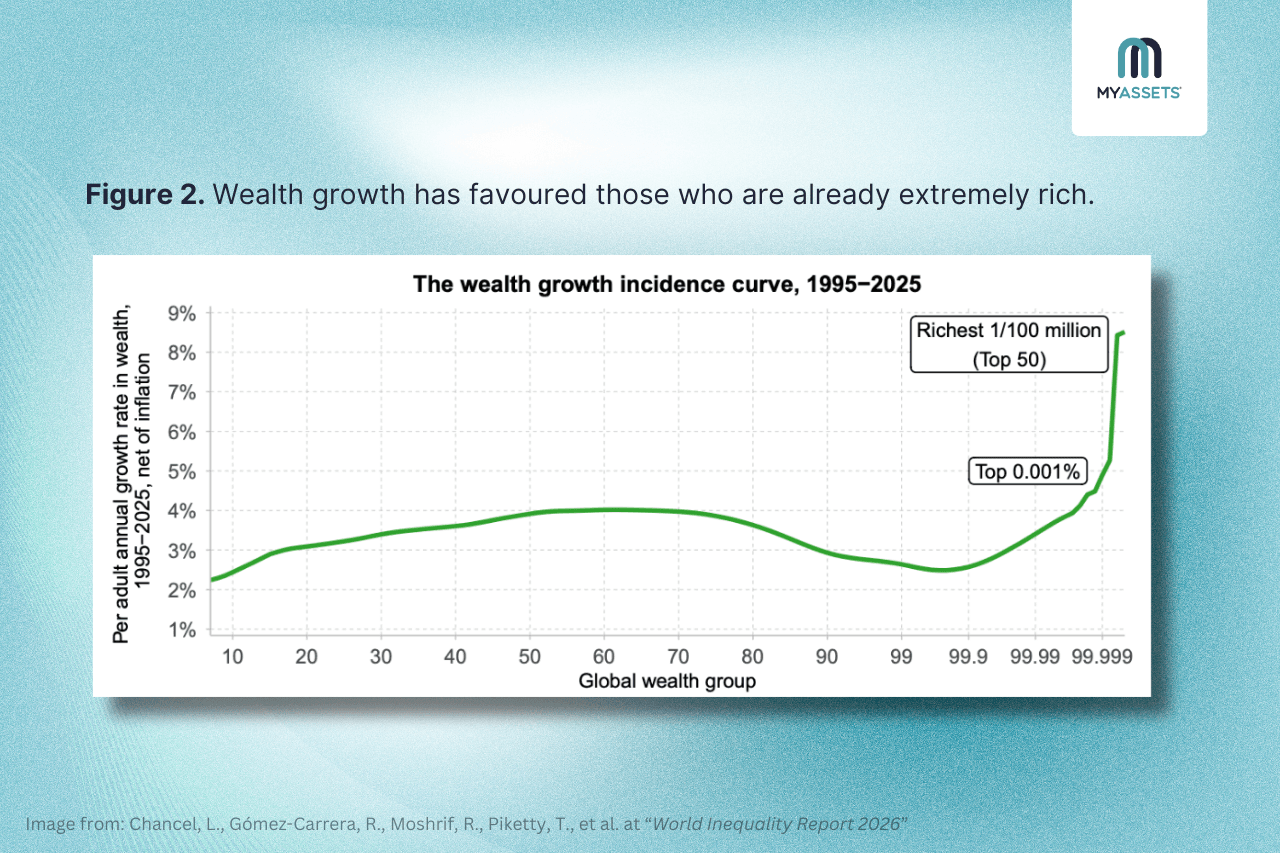
In essence, if one is asking: how rich are ultra-high-net-worth individuals? The answer can reach astonishing heights, averaging up to $50 billion for the top 0.000001% of global wealth holders.
But wealth at this level isn’t just cash; it’s a self-growing powerhouse, with fortunes compounding faster and faster, leaving the rest of the world far behind.
Where Do Ultra High Net Worth Individuals Live?
While the $30 million threshold serves as the standard financial benchmark, wealth at this level is not evenly distributed globally.
This raises an important question: which countries have the most UHNWIs?
Top Countries with the Most Ultra-High-Net-Worth Individuals
According to Altrata’s World Ultra Wealth Report 2025, the geography of the ultra-wealthy is highly concentrated in a few key powerhouses:
Figure 3. Leading Countries with the Most UHNWIs
| Rank | Country | UHNWI Population | Wealth ($) |
|---|---|---|---|
| 1 | United States of America | 192,470 | 23.3 trillion |
| 2 | China | 52,020 | 5.9 trillion |
| 3 | Germany | 26,570 | 3.1 trillion |
| 4 | United Kingdom | 18,785 | 1.9 trillion |
| 5 | Japan | 18,690 | 1.8 trillion |
| 6 | Hong Kong | 17,215 | 2.3 trillion |
| 7 | Canada | 15,620 | 1.7 trillion |
| 8 | France | 14,565 | 1.6 trillion |
| 9 | Italy | 11,950 | 1.3 trillion |
| 10 | India | 11,865 | 1.5 trillion |
Source: Altrata, World Ultra Wealth Report 2025
Based on the latest data, the United States of America (USA) remains the world’s dominant wealth powerhouse, hosting 192,470 ultra-high-net-worth individuals who command a staggering $22.3 trillion in collective wealth (see figure 3).
Figure 4. UHNW Change in Population
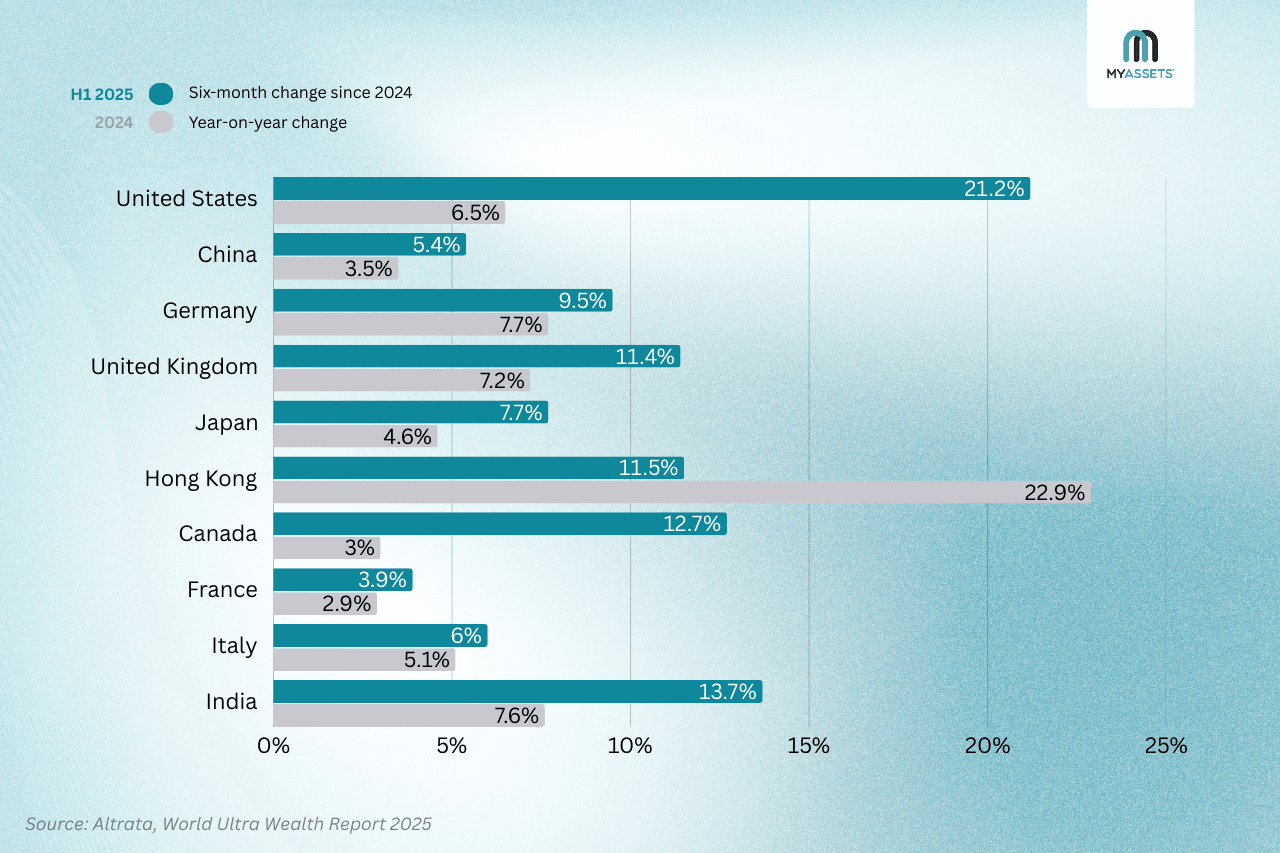
While the USA remains home to the largest UHNWI population, the first half of 2025 saw growth across all major global markets. Hong Kong stood out with a 22.9% increase, the highest among the top ten (see figure 4).
Other significant contributors include China and Germany, which maintain their positions as the second and third largest hubs.
Top Cities with the Highest Ultra Net Worth Population
According to the World Ultra Wealth Report 2025 by Altrata, UHNW individuals are concentrated in a small number of major metropolitan hubs. In fact, around one-fifth of the global UHNWI population resides in the top ten cities, highlighting how the world’s ultra-wealthy tend to cluster in key centres of finance, investment, and global business.
Below are the cities that currently host the largest populations of ultra-high-net-worth individuals:
Figure 5. Cities with the Highest UHNWI Population
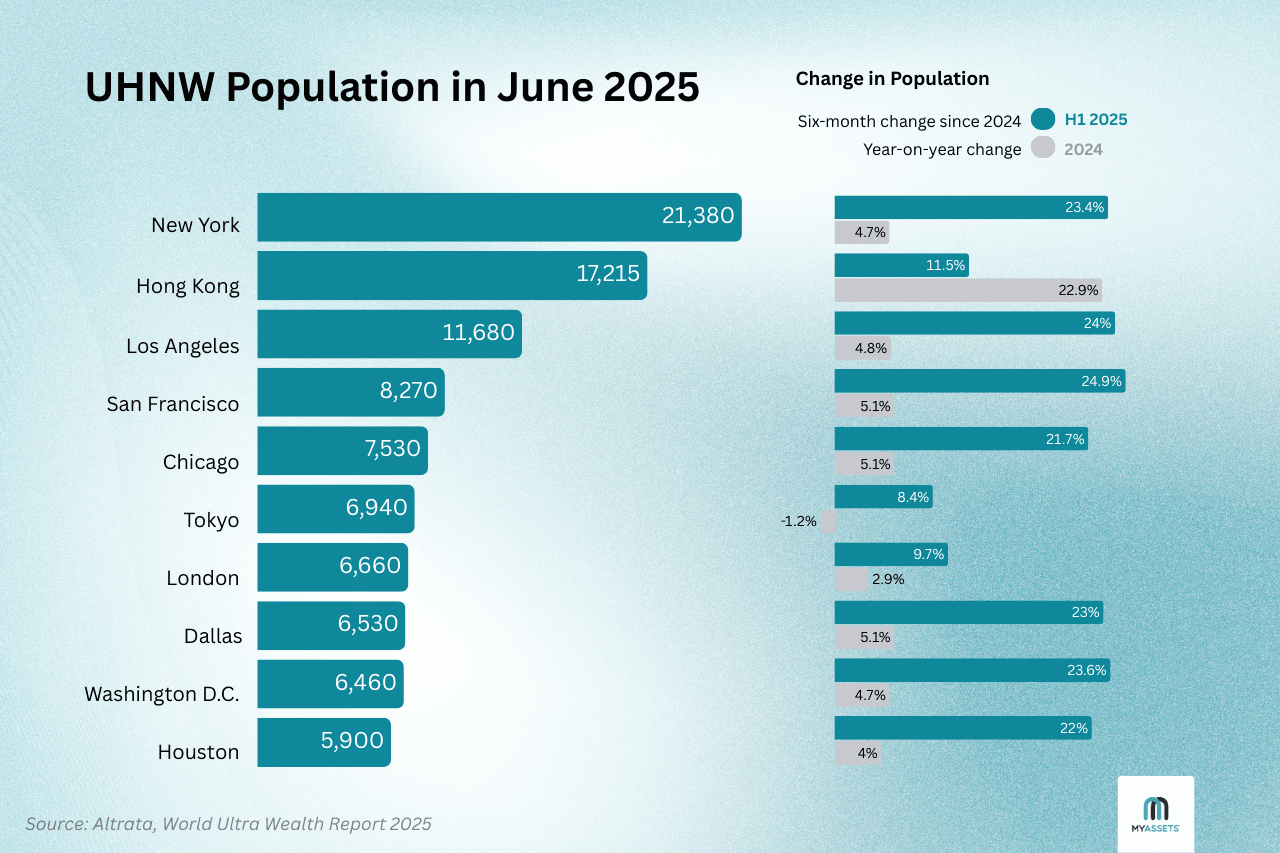
In essence, while American cities like New York and Los Angeles hold the largest populations, Hong Kong is the standout growth story, recording a staggering 22.9% increase in its ultra-wealthy population in just six months (see figure 5).
Who are Ultra High Net Worth Individuals?
The definition of ultra high net worth involves more than just hitting a $30 million net worth. Beyond the threshold, it is their source of wealth, strategic asset allocations, and specific lifestyle choices that truly set them apart.
Wealth Source
One way to truly understand ultra-high-net-worth individuals is to explore the origin of their fortunes. Tracing where their capital comes from helps answer the essential question: How did UHNWIs become wealthy?
Below are the primary ways the ultra-rich build their wealth:
- Self-Made Fortunes: Wealth accumulated through entrepreneurship, business expansion, or strategic investments rather than inheritance.
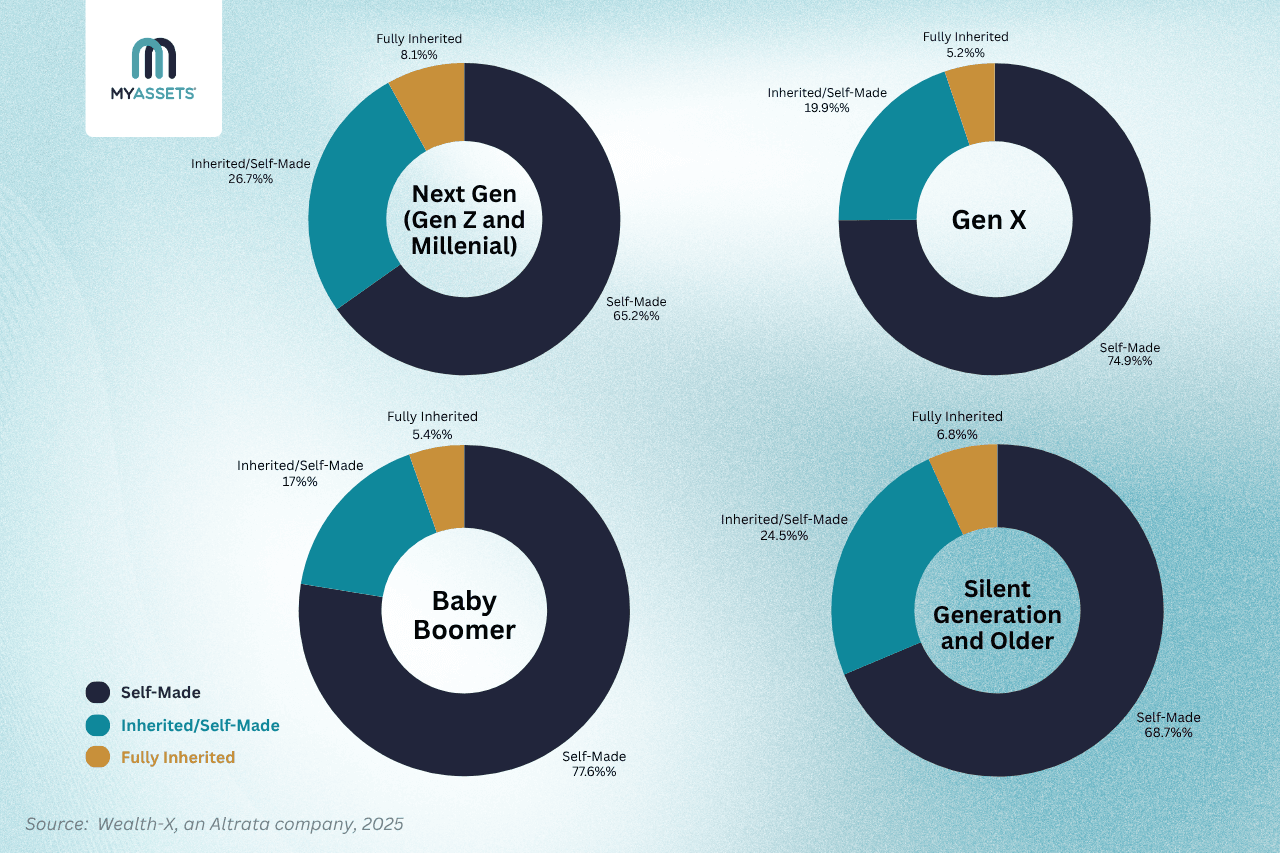
- The baby boomer generation holds the largest share of wholly self-made entrepreneurs at 78% (see figure 6), while the proportion declines among younger cohorts, with around 65% of next-generation UHNWIs, says Altra.
- Inherited Wealth: Assets, money, property, or businesses passed from one generation to the next through inheritance, trusts, or family transfers.
- The report added that purely inherited wealth is relatively rare, reaching 8% among Next Gens, slightly above the 6% global UHNWI average.
Ultimately, whether wealth is self-made, inherited, or a combination of both, its origin plays a key role in shaping how UHNWIs manage, spend, and preserve their fortunes.
Figure 6. Wealth Origins Across UHNW Generations
Learn more: What is a Family Office? Exploring Definitions and Roles
Asset Allocation
UHNWIs spread their wealth across a wide range of assets. The World Ultra Wealth Report highlights distinct allocation patterns among different UHNWI cohorts.
Liquid Assets
Across generations, 35-45% (see figure 7) of UHNWI portfolios are held in liquid assets such as cash, income, and dividends, making this the largest portion of their wealth allocation.
Private Holdings
Nearly 30-33% of total wealth is tied up in private business ownership or direct investment holdings.
Public Holdings
For older cohorts, these assets make up 25–30% of their wealth, compared with just 18% for Next Gens.
Real Estate and Luxury Assets
Younger UHNW individuals direct a greater portion of their wealth (12–24%) toward real estate and luxury assets, such as vehicles, art, and collectable investments, versus 4-6% for older cohorts.
Figure 7. Wealth Allocation of UHNWIs
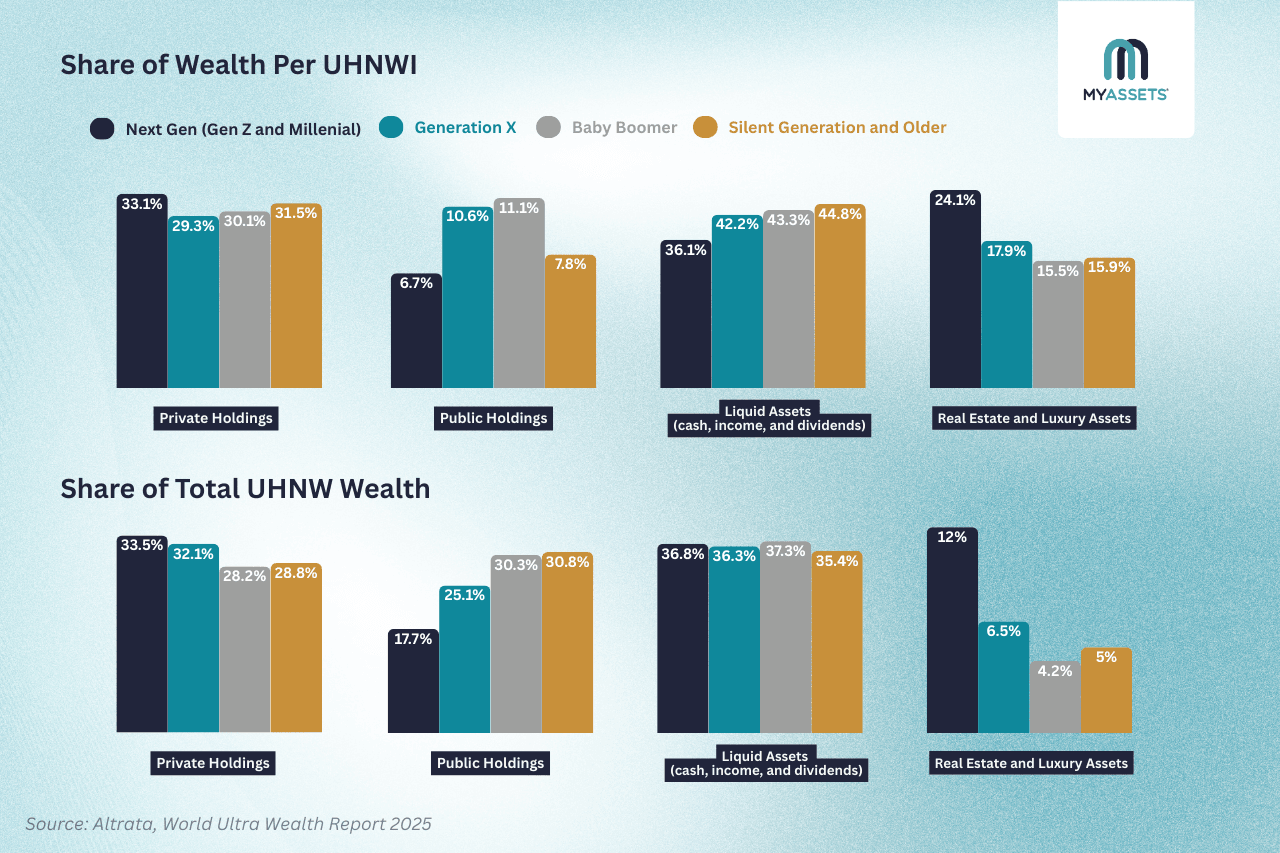
This shift highlights a distinct generational divide: older UHNWIs tend to prioritise stability through public markets, while younger generations are increasingly investing in tangible luxury assets and private ventures.
Interests and Hobbies
Beyond these individuals’ ultra rich net worth, their identity is often found in how they spend their free time. This article delves into the interests and hobbies that shape the world’s elite:
Sports
Sports is the most universally popular interest across all generations, peaking with Next Gens (48.3%) and Gen X (35.9%). Beyond leisure, it has increasingly become a vehicle for investment and ownership prestige through sports franchises.
Philanthropy
Interest in philanthropy rises with age and wealth, making it the leading non-business activity for Baby Boomers (35.3%) and the Silent Generation (36.8%), particularly among women, according to Altrata.
Technology
Technology is a key interest for younger cohorts, ranking as the second most popular passion among Next Gens (26.5%), but it is far less prominent in older generations.
Figure 8. Top interests and hobbies across UHNW generations
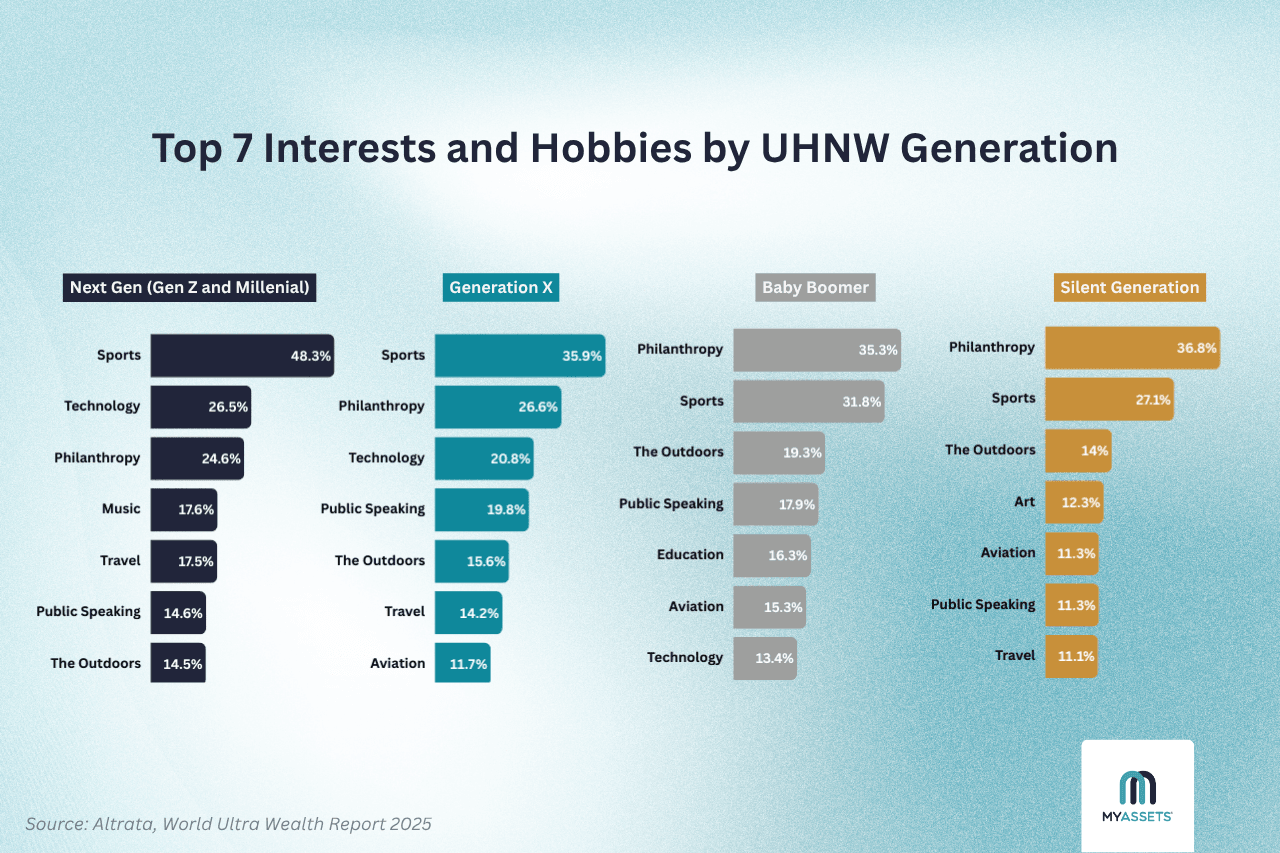
Ultimately, while older cohorts focus on legacy and traditional philanthropy, younger UHNWIs are blending their personal interests with their portfolios, turning hobbies, such as technology and sports, into major investment opportunities.
Individuals with Ultra-High-Net-Worth Defined
Ultra-high-net-worth individuals (UHNWIs) represent the pinnacle of global wealth, defined as net worths starting at $30 million and extending into the tens of billions.
Their wealth is concentrated in the top echelons, from the top 0.01% to the rarefied 0.000001%. It is most heavily concentrated in major financial hubs, such as the United States, China, Germany, and leading cities like New York, Hong Kong, and Los Angeles.
Beyond the numbers, UHNWIs are defined by how they acquire, manage, and enjoy their wealth. Some build fortunes from entrepreneurship and investments, while others inherit generational wealth or combine both.
Their asset portfolios are highly diversified, spanning liquid assets, private and public holdings, real estate, and luxury items. Even their personal interests reflect their unique status, with sports, philanthropy, and technology shaping their lifestyles.
Ultimately, being ultra-high-net-worth goes far beyond a financial threshold. It is a combination of influence, opportunity, and lifestyle –offering insight into how the world’s wealthiest individuals live, invest, and shape both business and culture.
Ultra High Net Worth: Frequently Asked Questions
1. What net worth is considered wealthy?
Households are generally considered wealthy with a net worth of around $3 million, with late-60s households in the top tier averaging about $2.9 million.
2. How much money to be ultra-high-net-worth?
An individual is generally classified as ultra-high-net-worth (UHNWI) with $30 million or more in investable assets.
3. How many UHNWIs exist worldwide
As of mid-2025, there are approximately 510,810 ultra-high-net-worth individuals (UHNWIs) worldwide.
MyAssets: See Your Net Worth Like the Ultra-Wealthy Do
Hitting the next million-dollar milestone is one thing, but monitoring your wealth progress is an entirely different challenge.
Imagine the frustration of tracking a growing portfolio, where one bank holds your cash, another manages your stocks, and yet another handles your mortgage. This leaves your true net worth buried under a mountain of logins and disconnected spreadsheets.
Introducing MyAssets, an all-in-one platform that organises, tracks, and manages assets in one place.
One Dashboard for All Your Wealth
It pulls everything together –from bank accounts (checking and savings), investment portfolios (stocks, bonds, and mutual funds), and properties (residential, rental, and commercial), to valuable assets like family heirlooms, art collection and other collectables.
It gets better. MyAssets doesn’t just show your assets; it also accounts for your liabilities, such as:
- Credit card debts
- Loans
- Mortgages
By consolidating these assets and liabilities, MyAssets functions as a net worth calculator, helping you understand your true financial position and make data-driven decisions.
What’s more? Imagine having all this information presented in a visually appealing dashboard. With MyAssets, monitoring net worth becomes straightforward as the platform transforms raw numbers into dynamic charts, offering a breakdown of how resources are distributed across finances, properties, collectables, and even belongings.
A Shared Access to Your Wealth
Are you tracking your wealth with the help of others? Managing wealth is rarely a solitary endeavour, yet sharing sensitive financial data often poses a significant security risk. MyAssets addresses this by providing individuals with full control over account permissions, with the Delegates feature allowing them to assign who can view, edit, delete, or create entries within their portfolio.
This granular control enables seamless collaboration without compromising total privacy. For example, an individual can grant:
- View-Only Access to a financial advisor to monitor investment performance and provide strategic guidance.
- Edit Permissions to a spouse or partner to ensure household assets and shared liabilities are updated in real-time.
In this way, MyAssets ensures that data remains protected when managing sensitive information with others.
Wealth measured is wealth treasured. Try MyAssets for FREE.



