A family fortune can take a lifetime to build. But how long can it last? Research by Dr John Ward found that only 30% of family businesses survived into the second generation, while just 13% reached the third. These figures highlight a challenge that extends beyond building wealth; it is also about preserving, managing, and successfully passing it on.
As family offices take on the responsibility of overseeing complex, multi-asset portfolios, modernising back-office operations becomes a top priority. However, this remains a weak spot, with technology adoption still lagging at many family offices.
According to Deloitte's 2024 research, nearly three-quarters of family offices report being underinvested (34%) or only moderately invested (38%) in the operational technology they need to run day-to-day.
Fortunately, the tide is turning: 43% are now actively developing or rolling out dedicated technology strategies. This shift reflects a broader role for modern family office solutions beyond tracking investment performance, with features providing the foundation to:
- Govern diverse family assets and financial affairs.
- Manage complex holding structures, administrative processes, and reporting.
- Protect family wealth, ownership records, and long-term legacy.
With these in mind, the question becomes: what family office software options are available today? This article explores family office software solutions, what they offer, key features to consider, and seven platforms worth exploring.
- What is Family Office Software?
- What to Look for in a Family Office Platform?
- 7 Best Family Office Wealth Management Software
- Family Office Solutions: Keeping Family Wealth Organised, Managed, and Protected
- Family Office Software Solutions: Frequently Asked Questions
What is Family Office Software?
Family office software is a platform that brings high- and ultra-high-net-worth families’ investments, accounting, legal entities, and financial reports into one system.
Beyond consolidation, family office technology solutions support daily processes in managing family wealth, including:
- Aggregating data by collecting daily information from multiple custodians, banking platforms, and alternative investments into unified dashboards.
- Managing tax, compliance, and philanthropy by keeping financial records, charitable giving, and grant activity organised in one place.
- Providing shared financial visibility through dashboards and reports that give the family and finance team a consistent view of net worth, allocation, and performance.
- Tracking investments and capital activity across portfolios, accounts, and transactions.
Together, these capabilities give family offices a centralised way to manage complex financial activities while maintaining greater visibility, control, and oversight of family wealth.
What to Look for in a Family Office Platform?
The right family office portfolio management software should provide a centralised view of wealth while assisting the day-to-day management of family assets and financial affairs. To support this, here are the key features to consider:
Access Control
Serving family members, staff, and third-party advisers requires strict, customised access controls to ensure each user can access information relevant to their role. Role-based permissions help achieve this by keeping sensitive data segregated, for example, letting family members review their portfolio without giving them access to financial ledgers.
Access controls are strengthened through audit trails –recording user activity to provide visibility into who accessed or changed sensitive information. Together, these features help protect sensitive family wealth information while providing greater oversight of how it is accessed and managed.
Report Consolidation
How do you make sense of financial data across multiple family entities? Consolidated reporting helps a family office aggregate financial information from multiple accounts, investments, and entities into a single view. It provides a clearer picture of the family's wealth by providing information such as:
- Asset allocation across different asset classes.
- Gains, losses, and changes in asset values.
- Investment holdings and portfolio performance.
- Liabilities, loans, and other obligations.
- Net worth and total assets across entities and accounts.
- Ownership interests in businesses, trusts, LLCs, and other entities.
Beyond a high-level view, the feature’s value extends to detailed reporting, allowing users to trace a consolidated figure back to the relevant entity, account, or transaction. This way, it makes it easier to understand the details behind the numbers, investigate discrepancies, and answer financial questions without piecing together separate family office reports.

Document Management
Managing family wealth involves handling financial, legal, and administrative documents, including:
- Bank and brokerage statements
- Insurance policies and claims records
- Investment statements and reports
- Legal contracts and agreements
- Loan and mortgage agreements
- Partnership and shareholder agreements
- Tax returns and tax documents
- Wills and estate planning documents
Given the volume and variety of these records, family offices need an efficient way to store and retrieve them when required. The best family office software provides a document management solution that keeps records organised and accessible, while linking each document to the relevant asset, entity, or transaction.
This creates a connected record of the family’s financial affairs, helping locate supporting documents when preparing taxes, responding to audits, reviewing investments, or completing routine reporting.
7 Best Family Office Wealth Management Software
The right platform can significantly affect how a family office manages its wealth, coordinates financial activities, and oversees day-to-day operations. To help you find the right fit, here are seven family office solutions to explore.
1. MyFO
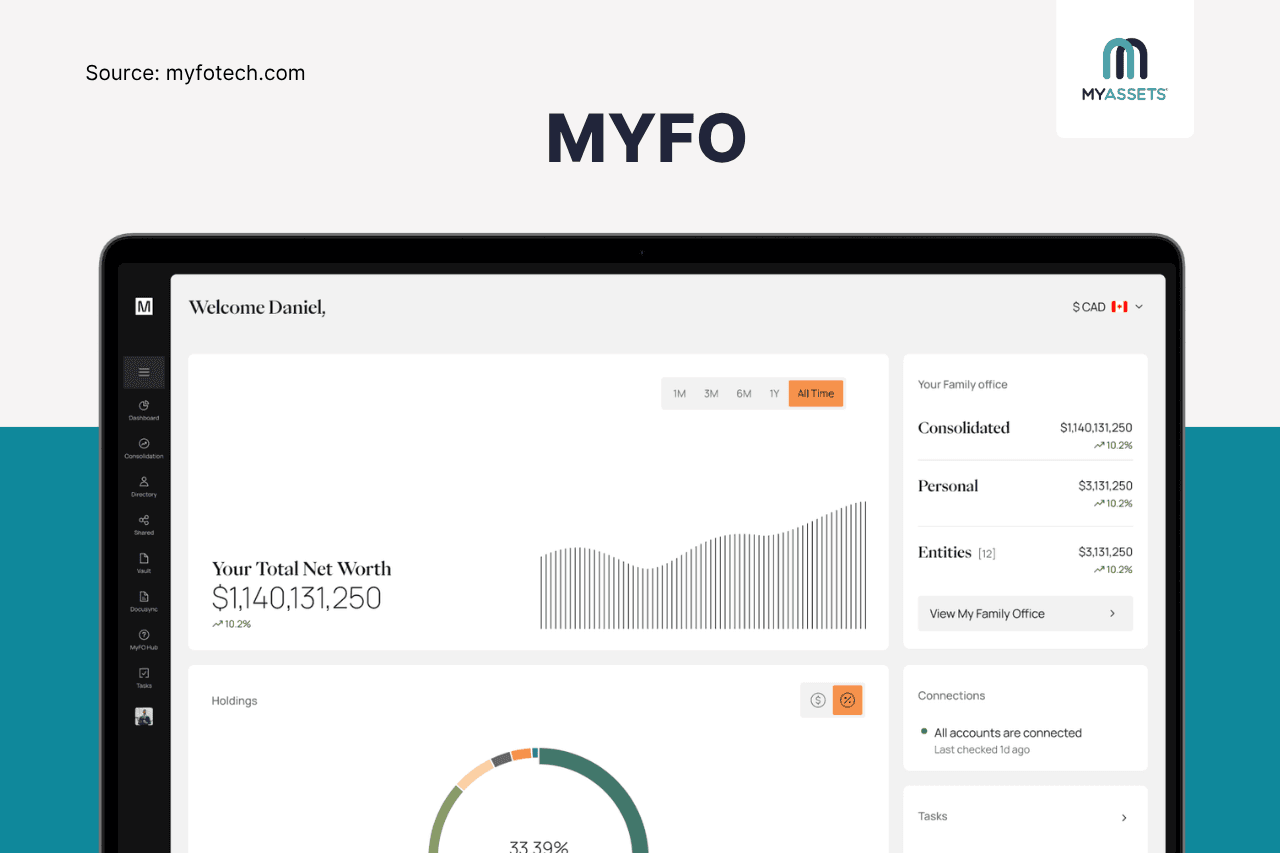
MyFO is a single- and multi-family office software that streamlines wealth management by consolidating data across banks, brokerages, and other financial institutions. It organises financial information, contacts, and documents, keeping records accessible and simplifying admin tasks.
Pros
- Connects to over 20,000 bank and accounting integrations to access financial data.
- Generates consolidated reports and filters financial data by asset class, currency, geography, or entity for a clearer view of family wealth.
- Shows relationships and ownership stakes across family members, stakeholders, and entities through the entity mapping feature.
Cons
- Pricing may be less practical for family offices with smaller operational needs.
- Requires a separate accounting tool to manage bookkeeping and core accounting functions.
Free Plan: No
Starting Price: $850/month
2. MyAssets
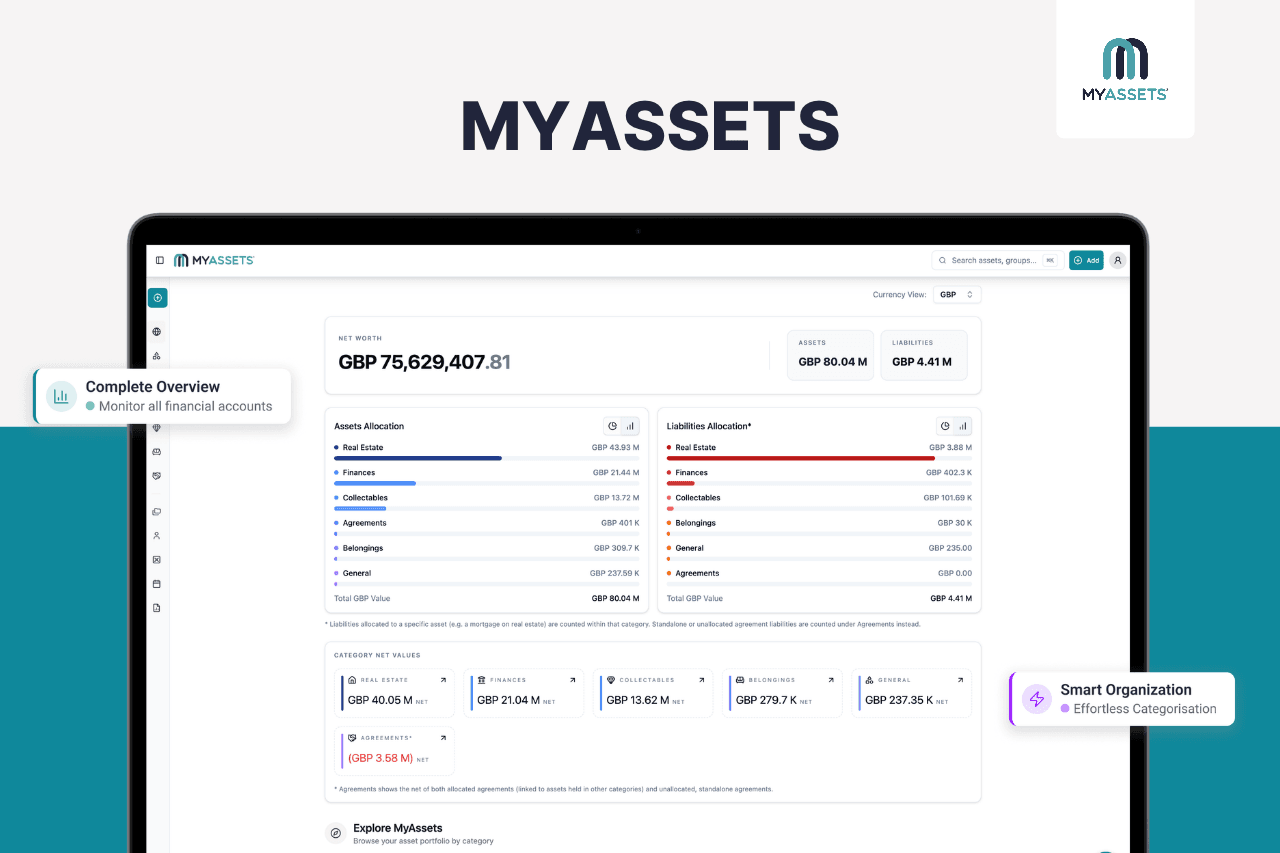
MyAssets is an asset management platform that helps family offices organise and track wealth across financial assets, real estate, collectables, personal belongings, and other holdings.
It also links agreements and supporting documents to individual assets, making it efficient to maintain records, monitor ownership, and manage the practical details of a family’s wealth alongside its investment portfolio.
Pros
- Gives the right people access to relevant asset information and records based on their roles and permissions (admin, viewer, editor).
- Links agreements, valuations, acquisitions, and other supporting documents to individual assets for easier reference.
- Provides a ledger to record income and expenses associated with assets, supporting day-to-day financial oversight.
- Records asset ownership and assigns beneficiaries, helping family offices document how assets are held and who is designated to receive them.
Cons
- Asset details, documents, and valuations require regular manual updates to keep records accurate and current.
- Focuses on asset management rather than general ledger accounting, with no specialised tools for complex partnership allocations or state tax reporting.
Free Plan: Yes
Starting Price: $25/month
3. Addepar
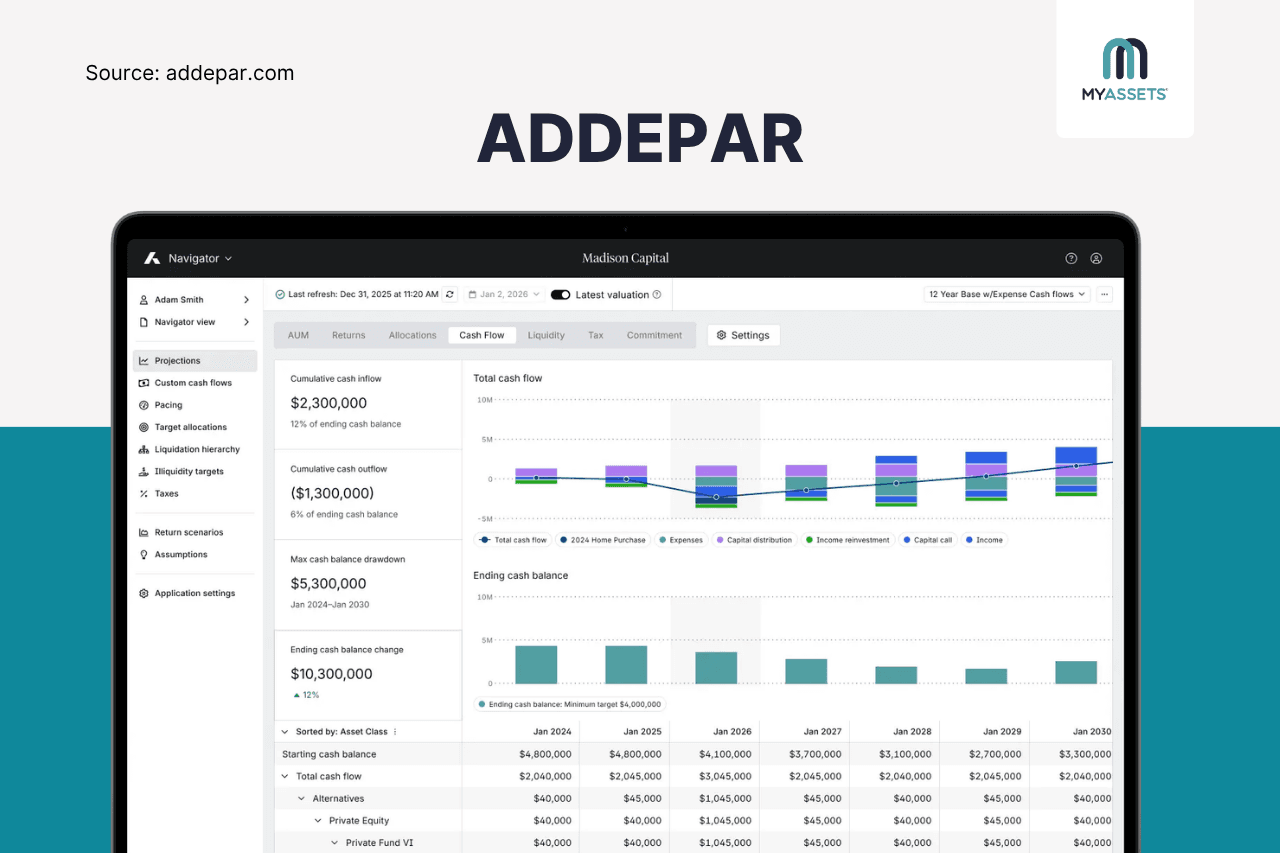
Addepar is a family office software that consolidates financial data across all asset classes, banks and currencies to provide a consolidated view of net worth. It also supports tracking alternative investments and non-traditional assets, helping family offices monitor diverse holdings and assess overall portfolio performance.
Pros
- Automates alternative investment document workflows by collecting files from fund administration portals and inboxes, then processing, validating, storing, and reporting their data.
- Helps analyse portfolio performance, asset allocation, and complex ownership structures, with drill-downs to transaction-level detail.
- Supports existing workflows through pre-built integrations and APIs for connecting in-house or third-party tools.
Cons
- Initial implementation and integration may take longer than expected, depending on data connections and the responsiveness of the integration team.
- Pricing is customised and not publicly listed, making it difficult to estimate costs.
Free Plan: No
Starting Price: Undisclosed
4. Masttro
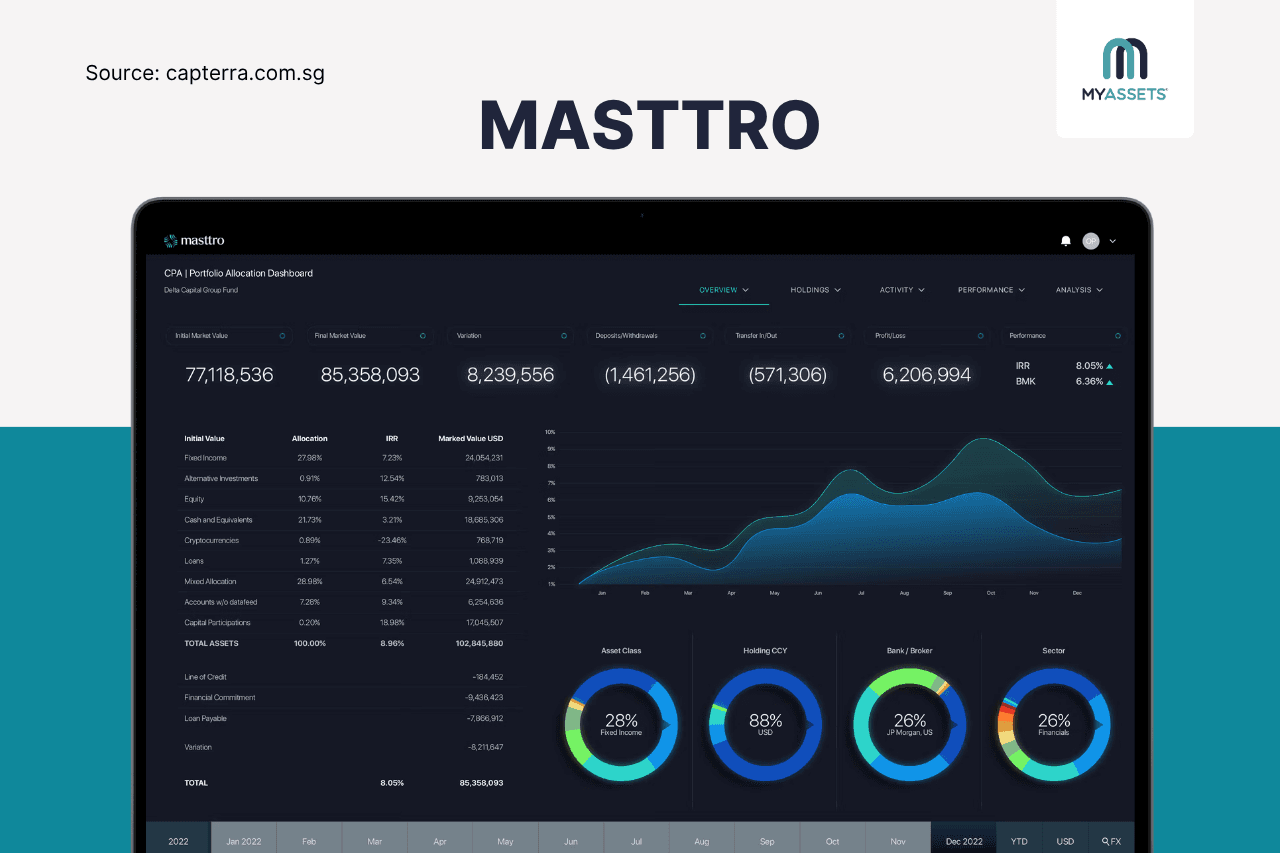
Masttro is a family office solution that brings together data on liquid and illiquid investments, liabilities, and passion assets to give family offices a consolidated view of their wealth. It combines portfolio reporting, AI-powered document processing, and ownership mapping to help family offices oversee complex portfolios and streamline wealth management.
Pros
- Supports estate planning and family governance by providing interactive visualisations of ownership hierarchies, entity relationships, and cross-border holdings.
- Provides a voice- and text-based AI interface for querying wealth data, updating valuations, generating reports, and creating tasks.
- Uses AI to extract and process information from documents such as capital call notices, distribution statements, and K-1s, reducing manual data entry.
Cons
- Connecting financial accounts may take longer than expected, depending on the institution and integration process.
- Setting up the platform and organising data takes time, especially for family offices with complex assets and structures.
Free Plan: No
Starting Price: Undisclosed
5. Asset Vantage
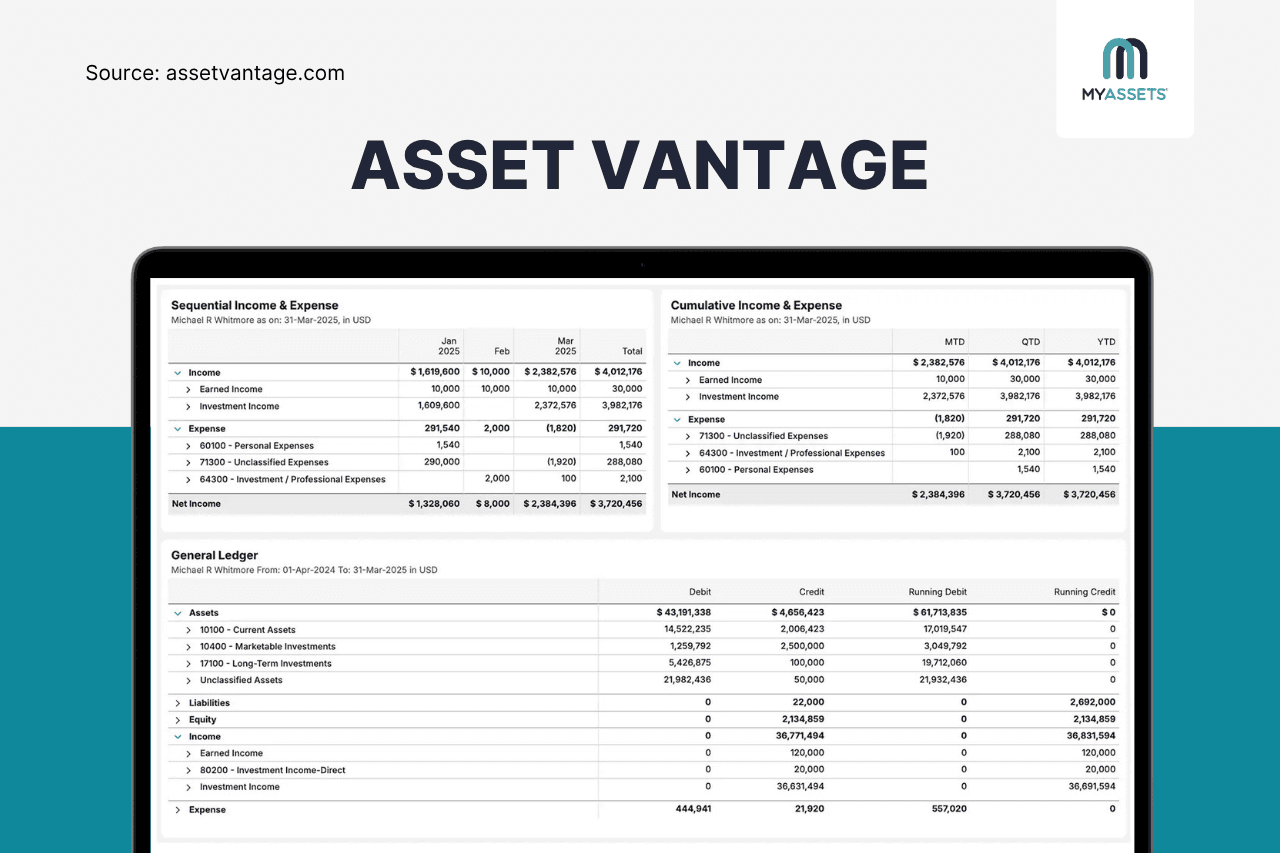
Asset Vantage is a cloud-based family office software that combines general ledger accounting and performance reporting. It records investment transactions directly in the ledger and uses the same data to generate reports.
Pros
- Consolidates financial information across trusts, partnerships, companies, and other entities, with support for inter-entity transactions and multi-currency reporting.
- It includes a full accounting system with a general ledger, income statements (P&L), bank reconciliation, and balance sheets, complemented by investment analytics.
- Offers configurable dashboards and reports that let family offices analyse financial information by entity, asset class, and time period.
Cons
- Its accounting-focused approach may make it less adaptable for family offices with complex alternative asset portfolios or extensive integration requirements.
- Standard licences are billed annually in advance, which is less suitable for those seeking flexible monthly payments.
Free Plan: No
Starting Price: $30,000/year
6. Landytech
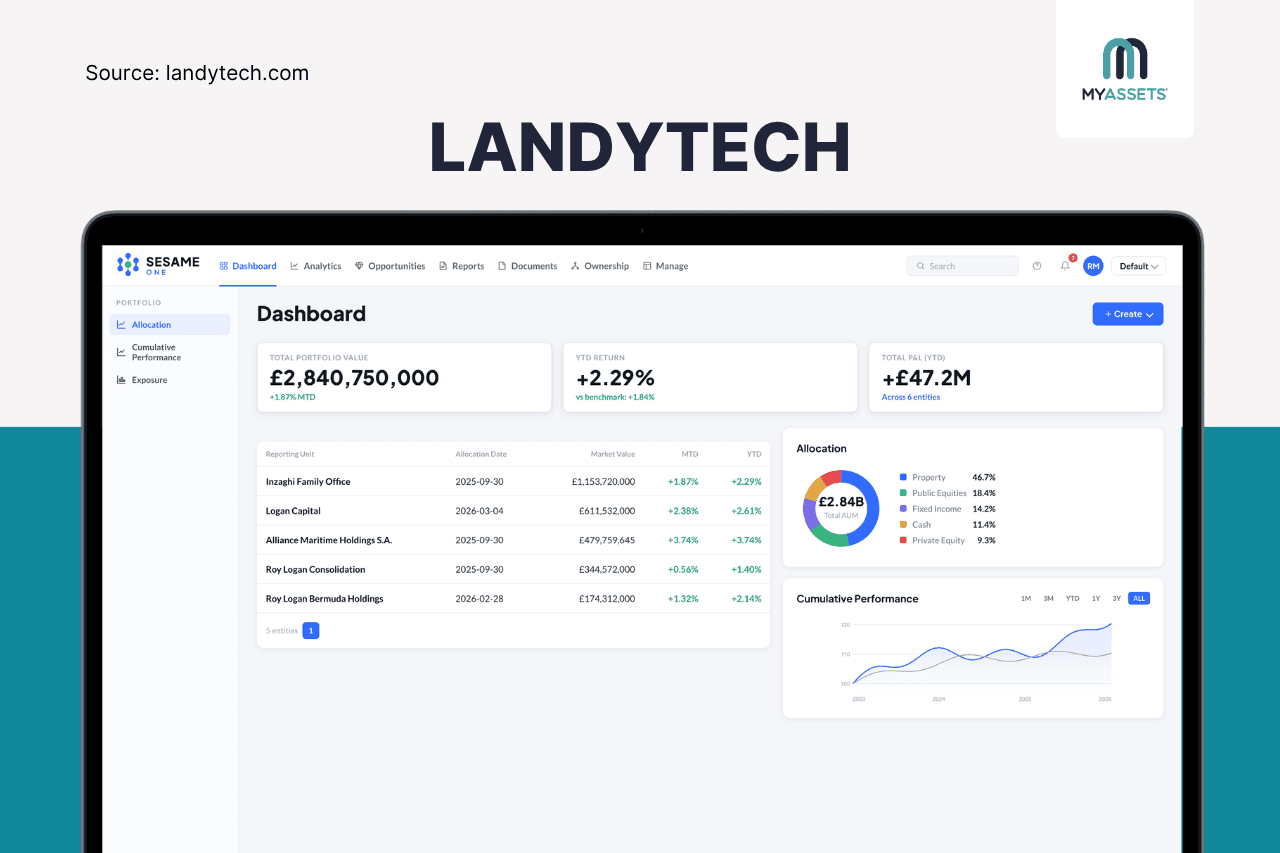
Landytech is a family office investment management software that consolidates investments across banks, custodians, public markets, private equity, real estate, and other alternative assets into one system. With Landytech, users can monitor portfolios, analyse performance, and generate reports to gain a clearer picture of overall wealth.
Pros
- Connects with over 500 global custodian feeds and 10,000 open banking connections to consolidate public and private investment data in one platform.
- Helps users evaluate investment returns, asset allocation, portfolio exposure, liquidity, and risk to support wealth management decisions.
- Its ai assistant can answer questions about portfolio data and help generate insights, charts, and tables.
Cons
- As the platform focuses on investment management and reporting, family offices may need separate general ledger software to handle comprehensive accounting and financial transactions.
- Family offices with smaller portfolios may not need its extensive investment tracking and reporting features, making the cost and setup effort harder to justify.
Free Plan: No
Starting Price: Undisclosed
7. Archway
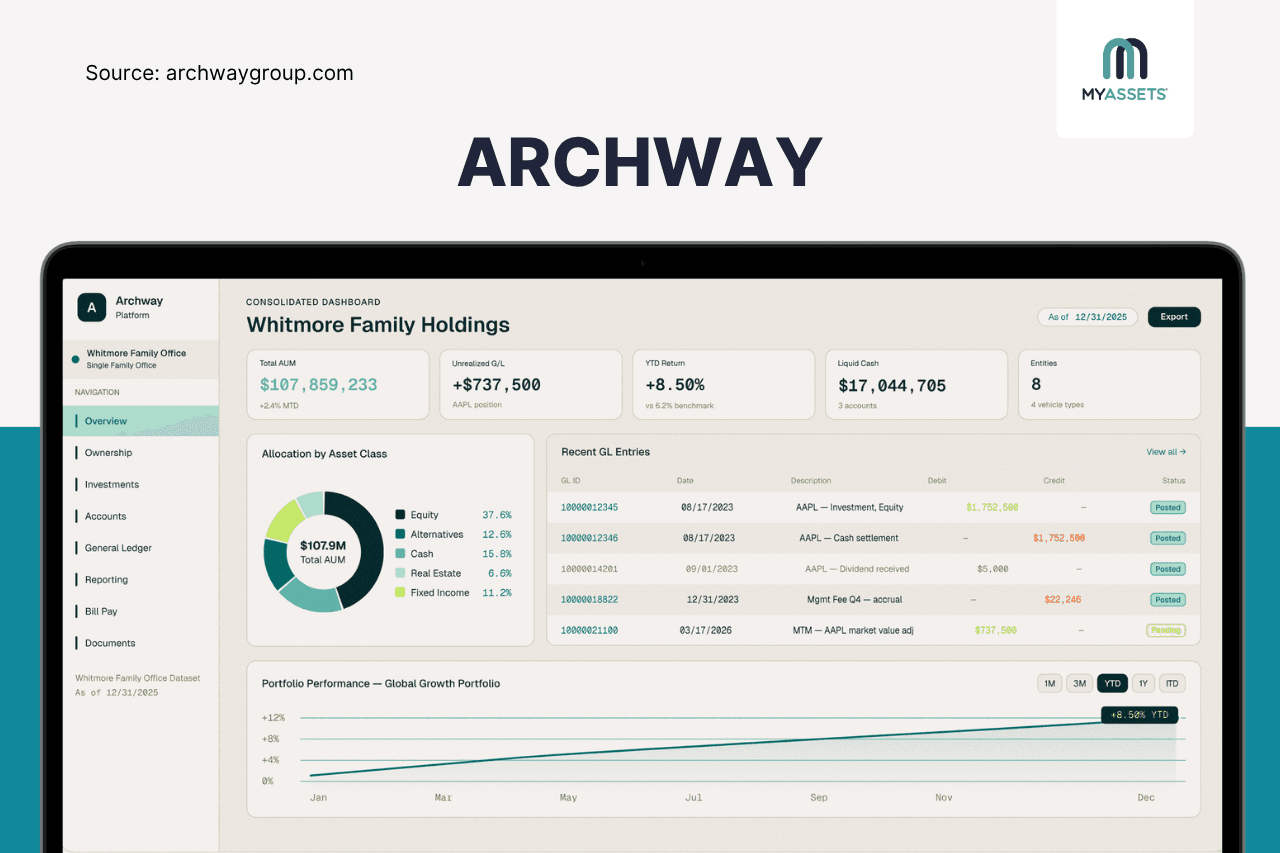
Archway is a family office accounting software designed to manage complex financial structures. It supports accounting across trusts, partnerships, and other entities, while helping family offices monitor investments, reconcile financial data, and prepare consolidated reports for a clearer picture of family wealth.
Pros
- Includes 200+ report templates, performance and attribution analytics, and a custom-branded portal for sharing financial reports with clients.
- Offers technology-plus-services options where Archway’s team can oversee daily bookkeeping, bill payments, and financial transactions.
- Streamlines invoice approvals, payments, and reconciliation for household payroll, property costs, vendors, and personal expenses, with automatic ledger entries and audit trails.
Cons
- Its accountant-focused interface may feel complex for non-technical users accustomed to more intuitive wealth management tools.
- Pricing depends on the engagement scope, service model, number of entities, and investment portfolio complexity.
Free Plan: No
Starting Price: Undisclosed
Family Office Solutions: Keeping Family Wealth Organised, Managed, and Protected
Choosing the right family office solution ultimately comes down to aligning a platform's core strengths with one’s operational priorities. Today, modern family offices rarely suffer from a lack of technology choices; rather, the challenge lies in choosing software built for their specific needs.
Whether the primary focus is streamlining day-to-day administrative collaboration, securing documents, running institutional-grade investment risk analytics, or maintaining an audit-ready financial general ledger, each solution brings a distinct set of trade-offs:
- For Easy Setup & Day-to-Day Use (MyFO, MyAssets): Best for users who want a simple, modern app to track family assets, organise files, and share updates across generations without a painful rollout.
- Institutional Investment Reporting and Analytics (Addepar, Landytech, Masttro): Built for offices managing complex, global multi-asset portfolios needing real-time performance attribution, automated custodian data feeds, and deep risk analysis.
- Comprehensive Accounting and Enterprise Ledger (Archway, Asset Vantage): Essential for single- and multi-family offices that require a formal double-entry General Ledger, native partnership/tax accounting, and integrated operational back-office workflows.
By evaluating platforms against essential requirements, family offices can eliminate manual operational bottlenecks, protect generational privacy, and establish a clear, single source of truth for total family wealth.
Family Office Software Solutions: Frequently Asked Questions
1. What software is best for family offices?
The best software for family offices depends on users’ needs: MyFO supports wealth data consolidation, MyAssets offers broad asset management, Addepar and Landytech focus on investment reporting, while Asset Vantage and Archway provide specialised accounting and financial management capabilities.
2. What net worth is needed for a family office?
A traditional single-family office typically requires at least $100 million in investable assets to justify its operating costs, while families with around $20 million to $100 million may consider a multi-family office that shares staff and services across several clients.
3. How to set up a family office for wealth management?
Setting up a family office involves defining the family’s financial goals, assessing its assets, assembling financial and legal professionals, establishing governance procedures, and selecting software to manage investments, documents, and financial reporting.
MyAssets: Every Family Asset, All in One Platform
Managing family wealth means tracking everything a family owns, not just the money in the bank. From real estate and collectables to personal belongings and agreements, each asset comes with its own records, valuations, and ownership details that need organising.
MyAssets brings these assets and their records together in one platform, helping families keep wealth information organised. No fragmented files. No missing records. Just absolute clarity over every family asset, all in one platform.
With MyAssets, users can:
- Track diverse assets: Record financial assets, real estate, collectables, personal belongings, and other holdings.
- Track income and expenses: Document asset-related financial activity through a ledger.
- Monitor valuations: Keep valuation records to track changes in asset values over time.
- Organise important documents: Link agreements and supporting documents to relevant assets for easy access.
- View overall family wealth: See net worth, total assets and liabilities, asset allocation, and net values by category in Global Dashboard.
Essentially, MyAssets helps families gain a clearer picture of what they own, how much their assets are worth, and how their wealth is distributed –all in one accessible platform.
Want to see how it works? Explore MyAssets and try it for FREE.