

Have you ever felt the urge to buy stocks when markets are booming or sell them the moment they start losing value?
The numbers reflect this dilemma. According to a MarketWatch report, 56% of investors say their emotions and personal experiences influence their investment decisions.
- A market downturn can spark fear, making even temporary losses feel permanent and causing investors to sell prematurely.
- Soaring markets can fuel excitement, leading investors to buy at elevated prices.
While these emotional reactions are understandable, acting on them can lead to impulsive decisions that derail long-term investment strategy.
Fortunately, there's a better approach. Instead of reacting to every market swing, investors can rely on objective data to make more informed decisions. The best portfolio tracker apps provide that clarity, helping investors monitor performance, track progress toward their goals, and stay focused on long-term outcomes instead of short-term emotions.
Whether you're tracking a few investments or a large, diversified portfolio, this article explains why a portfolio tracker app can be a valuable investing tool. It also compares the best apps for tracking portfolio, highlighting their key features, advantages, and the factors that matter most when selecting the best solution for your investment goals.
- What is a Portfolio Tracker?
- What are the Features Look for in an Investment Tracking App?
- Best Portfolio Tracker Apps: 5 Tools Compared
- The Best Way to Track Investments Starts with the Right App
- Best Apps for Tracking Portfolio: Frequently Asked Questions
What is a Portfolio Tracker?
A portfolio tracker is a financial tool that consolidates all investments into a single dashboard. Depending on the platform, it can track a wide range of assets, including:
- Bonds
- Cryptocurrency
- Exchange-traded funds (ETFs)
- Mutual Funds
- Other Investment Accounts
- Stocks
Instead of manually updating spreadsheets or logging into multiple brokerage accounts, a portfolio tracker brings investment data together in one place, allowing users to:
- Analyse asset allocation and diversification
- Calculate total asset value
- Gain insights into portfolio’s overall health
- Monitor gains and losses
- Track portfolio performance over time
With all this information in one investment portfolio tracker app, investors can spend less time managing scattered data and more time making confident, data-driven investment decisions.
What are the Features Look for in an Investment Tracking App?
Market volatility can cause investment values to rise and fall unexpectedly, making it difficult to stay on top of portfolio performance. To help investors stay informed, here are some of the key features to look for in an investment tracking app.
Multi-Account Aggregation
Switching between platforms or manually consolidating investment data can make it challenging to maintain a complete view of one’s portfolio.
An investment portfolio app with multi-account aggregation solves this by gathering data from multiple financial institutions into a single dashboard. This gives investors a unified view of their holdings – from brokerage and retirement accounts to cryptocurrencies and other investments – making a seamless decision making process.
Performance Analytics
Are your investments generating returns or simply moving with the market? A portfolio's current value only shows where it stands today; it doesn't reveal how effectively investments are performing over time.
Performance analytics provide insights through time-weighted returns, daily profit and loss, and historical performance trends. This enables investors to accurately assess portfolio performance, identify underperforming assets, and evaluate whether their investment strategy is on track.

Asset Allocation Breakdown
A portfolio can become unintentionally concentrated in a single asset class, sector, or region, increasing its exposure to market volatility and unnecessary risk. Without a clear breakdown of holdings, investors may find it challenging to determine whether their portfolios remain properly diversified.
The best portfolio tracker app addresses this through an asset allocation breakdown that shows how a portfolio is distributed across:
- Asset classes
- Geographic regions
- Industries
- Sectors
These insights help investors identify concentration risks and make informed rebalancing decisions aligned with their investment objectives.
Best Portfolio Tracker Apps: 5 Tools Compared
The best app for tracking a portfolio is one that aligns with your investment goals and tracking needs. To narrow down your options, here is a comparison of five apps and software, covering their features, advantages, limitations, and pricing.
1. Sharesight
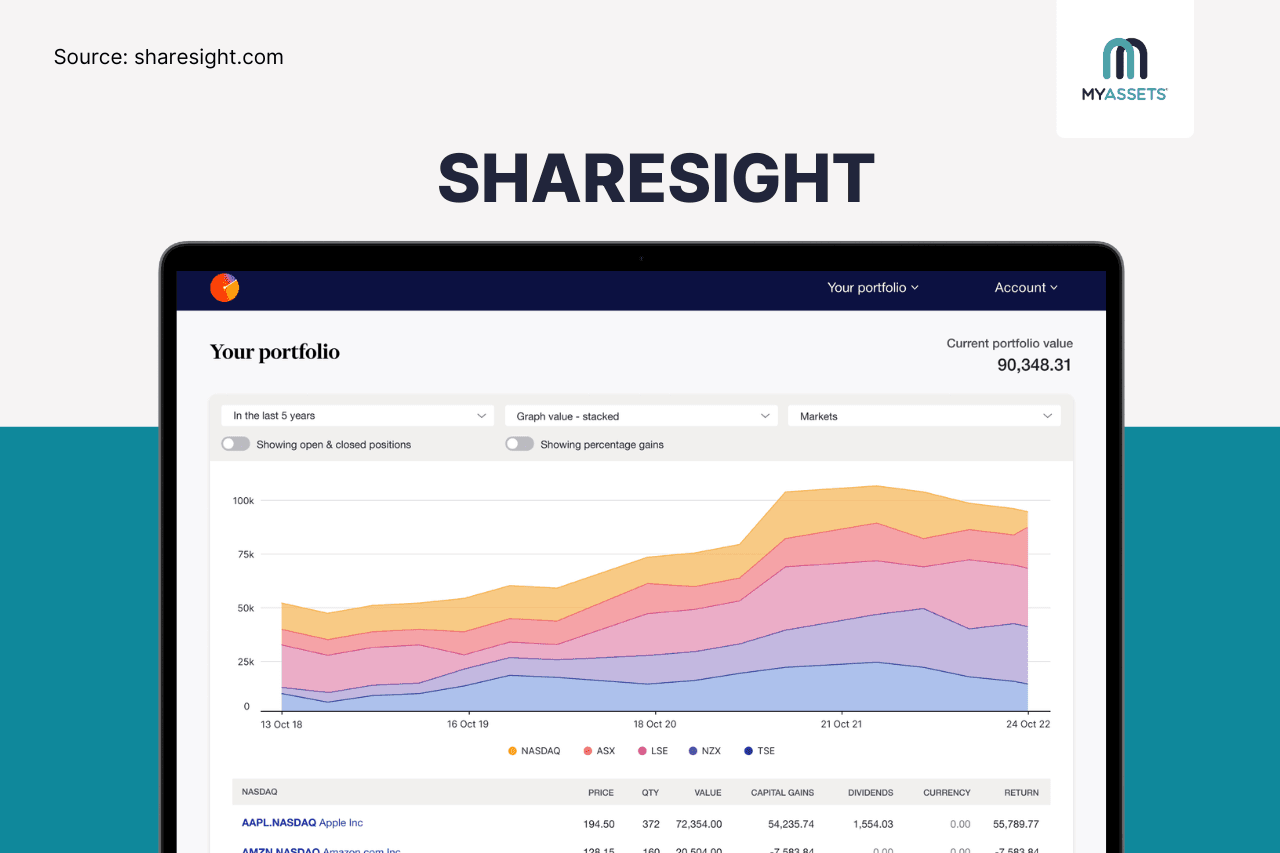
Sharesight is an investment portfolio tracker that enables users to monitor stocks, ETFs, funds, and cryptocurrencies from a single dashboard. It also tracks portfolio performance, dividends, and capital gains, while generating localised tax reports to simplify investment reporting and tax preparation.
Pros
- Integrates with over 200 global brokers, reducing the need for manual updates and human error.
- Generates localised Capital Gains Tax (CGT) and taxable income reports, helping investors simplify tax reporting in countries such as Australia, New Zealand, Canada, and the UK.
- Provides a Diversity Report that gives investors a clear breakdown of portfolio holdings by market, industry, country, and other key categories.
Cons
- Does not support tracking of short positions or Contract for Difference (CFDs).
- The mobile app is read-only, requiring the desktop platform for portfolio edits, trade management, and report generation.
Free Trial: None, but it offers a free version
Starting Price: £8/month
2. Snowball Analytics
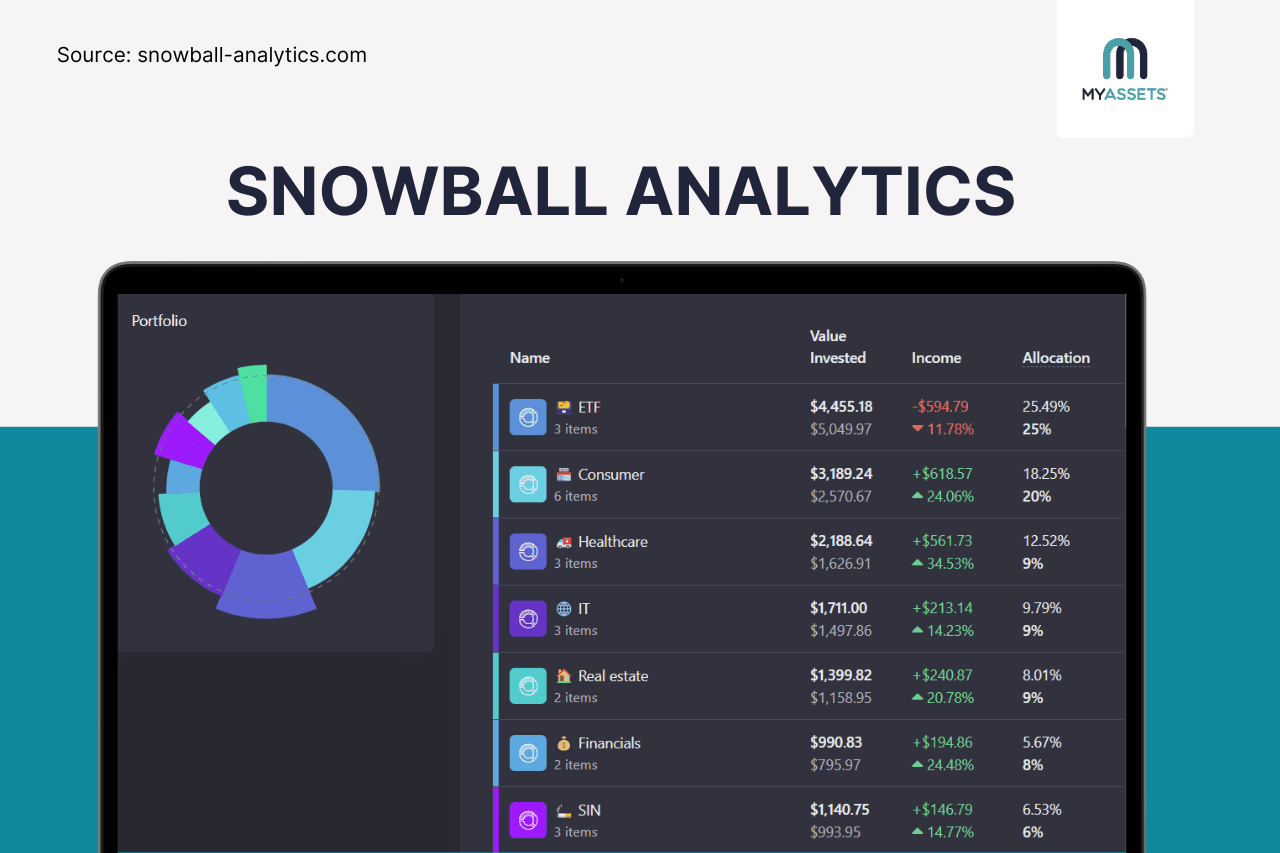
Snowball Analytics is a portfolio tracker that combines investment planning, brokerage account consolidation, and dividend tracking, helping investors make data-driven investment decisions in one platform.
Pros
- Enables investors to benchmark portfolio growth against major market indices, including the S&P 500 and Nasdaq.
- Provides a dividend calendar that projects future income, tracks expected payouts, and rates the safety of dividend-paying companies.
- Supports brokerage account syncing and CSV imports to consolidate holdings and transaction history.
Cons
- Broker integrations may vary by region, with some institutions requiring manual CSV imports.
- Supports real estate and private equity only as custom asset entries.
Free Trial: Yes - 14 days
Starting Price: $7.99/ month
3. MyAssets
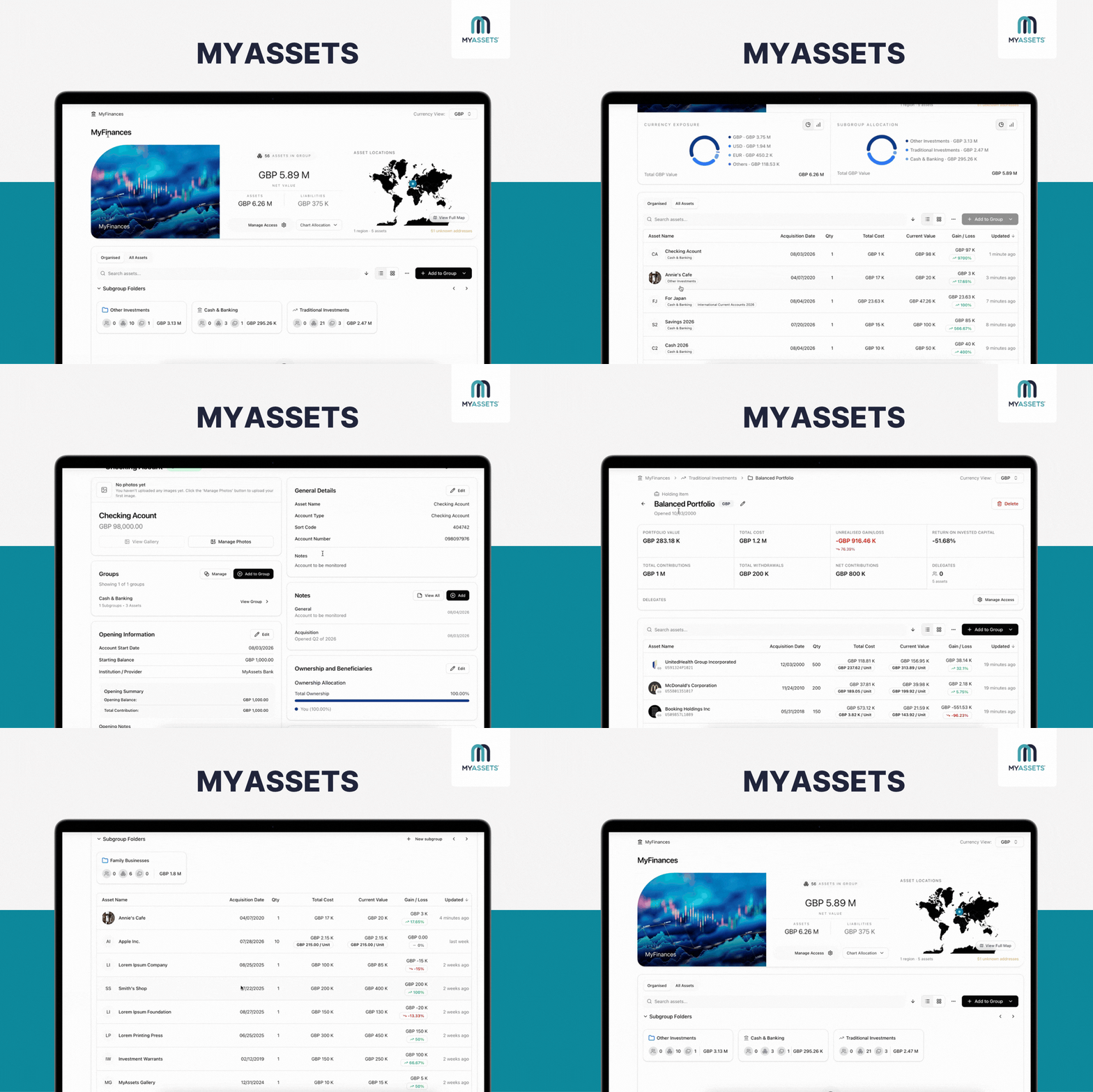
Primarily designed for asset management, MyAssets streamlines tracking all investments in one place. It consolidates stocks, ETFs, shares, and other assets into a single dashboard, giving users a comprehensive overview of their portfolio and total wealth.
What sets MyAssets apart is its ability to go beyond investment tracking by allowing users to:
- Monitor investment performance and returns.
- Record ownership details.
- Store valuations, annual reports, and other supporting documents.
In this way, MyAssets centralises both investment data and related records, making it efficient to organise, monitor, and manage an entire investment portfolio from a single platform.
Pros
- Allows collaboration with financial advisors through delegated access, while maintaining control over confidential asset information.
- Displays gains and losses for each investment, giving users visibility into portfolio performance over time.
- Enables users to record investment ownership using shares, warrants, options, or percentage ownership.
Cons
- Focused on asset management rather than active investing or stock trading.
- Lacks advanced stock research and technical analysis tools found in other investment tracking platforms.
Free Trial: No, but offers a free version.
Starting Price: $25/month
4. Ziggma
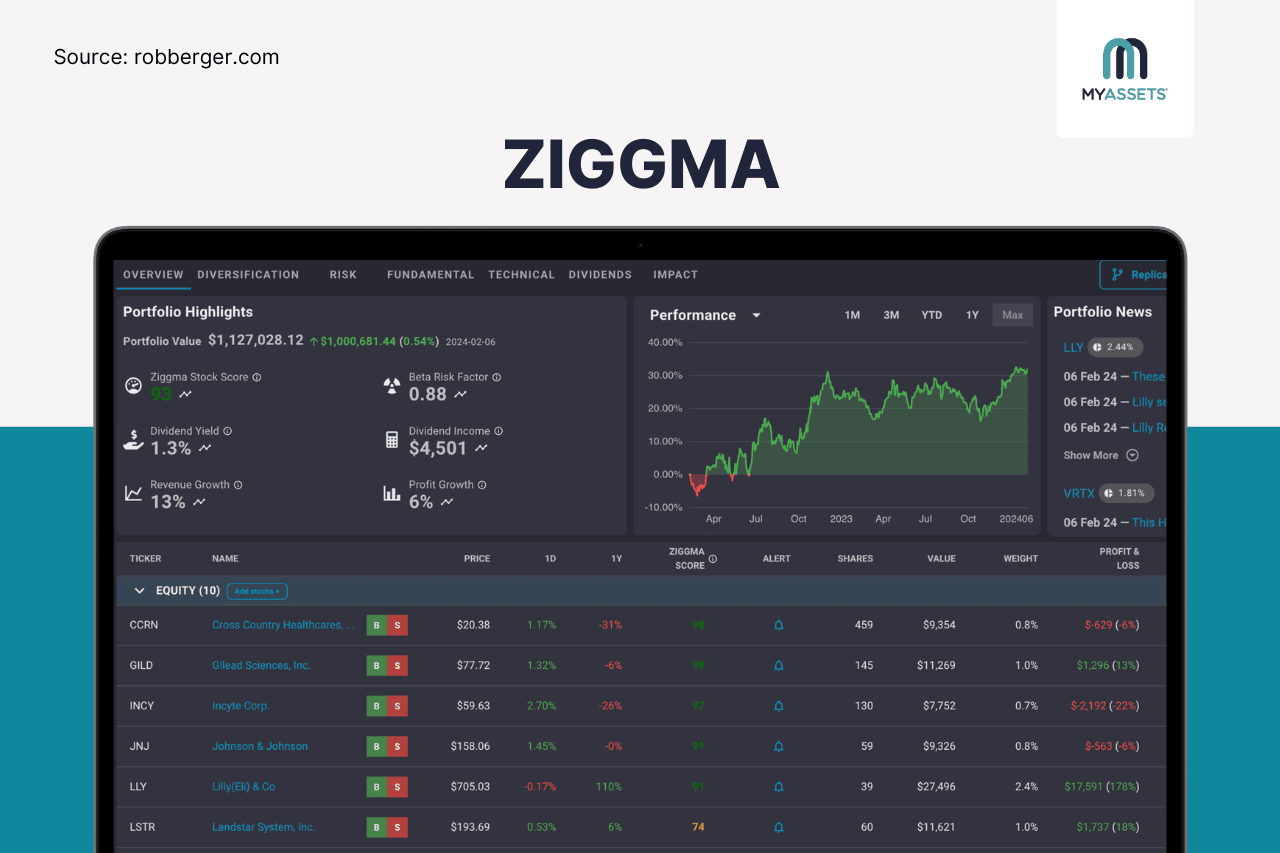
Ziggma is a personal portfolio management software that helps investors track portfolio performance, analyse portfolio quality, and identify opportunities to improve diversification and risk. It also combines stock and ETF research tools, helping investors evaluate holdings and base investment decisions on objective data.
Pros
- Features an algorithm-based Ziggma score, which evaluates stocks using metrics like profitability, growth, and financial strength.
- Includes Ziggma Model Portfolios, allowing investors to explore the holdings and asset allocations of leading investors and hedge funds.
- Offers a screener that filters stocks, ETFs, and funds by growth, valuation, income, and impact metrics.
Cons
- Global market coverage is limited outside major US and European exchanges.
- Primarily supports stocks, ETFs, and mutual funds, with limited support for options, bonds, and cryptocurrencies.
Free Trial: Yes - 7 days
Starting Price: $6.99/month
5. TradingView
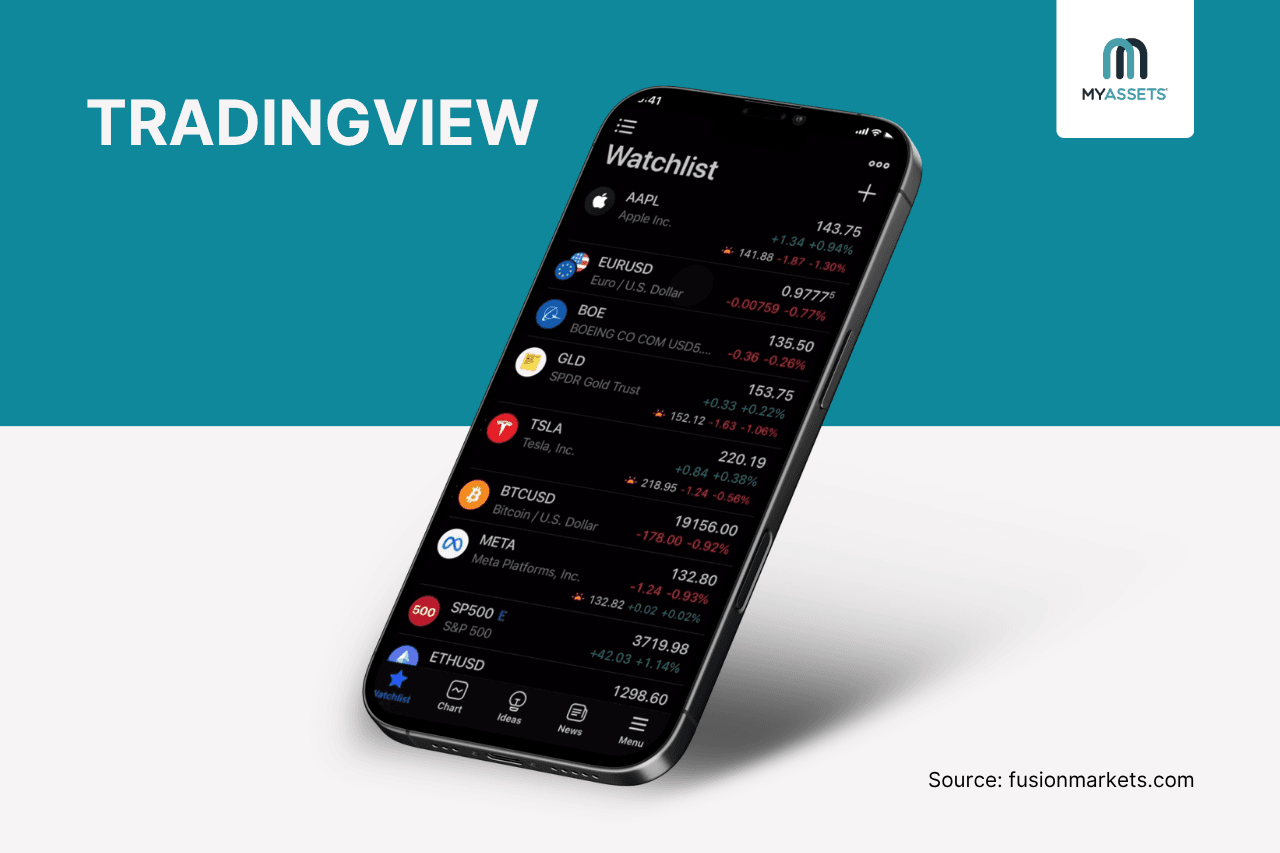
TradingView is one of the best stock tracking apps for investors and traders looking to monitor global financial markets in real time. It enables users to track stocks, ETFs, indices, cryptocurrencies, and other assets through interactive charts, customisable watchlists, price alerts, and advanced screening tools, helping them optimise investment decisions.
Pros
- Includes a built-in social network where investors exchange market insights and user-created trading strategies.
- Offers charting tools with over 400 technical indicators and more than 110 drawing tools for in-depth market analysis.
- Supports broker integration, allowing investors to execute trades directly from the charting interface.
Cons
- Its extensive features and tools can present a steep learning curve for beginners.
- The free tier is ad-supported and offers limited indicators and chart layouts.
Free Trial: Yes - 30 days
Starting Price: $14.95/month
The Best Way to Track Investments Starts with the Right App
Finding the best way to track investments begins with choosing an app that matches an investor's needs. Whether the priority is consolidating multiple accounts, analysing portfolio performance, monitoring diversification, or researching investment opportunities, the right platform can make portfolio management more efficient and data-driven.
Fortunately, there is no one-size-fits-all solution. Different investment tracking apps are designed to address different investing needs, with each excelling in a particular area:
- Best for sorting investment tax: Sharesight
- Best for dividend investing: Snowball Analytics
- Best for all-in-one wealth tracking: MyAssets
- Best for portfolio analysis and stock research: Ziggma
- Best for real-time market tracking and technical analysis: TradingView
By understanding each platform's strengths and matching them with one’s investment objectives, investors can choose a solution that helps them stay organised, monitor performance with confidence, and remain focused on achieving their long-term financial goals.
Best Apps for Tracking Portfolio: Frequently Asked Questions
1. How do I choose a good portfolio tracker?
The best portfolio trackers support diverse asset classes, from stocks and bonds to cryptocurrencies, real estate, and cash. By consolidating these assets into one platform, investors gain a comprehensive view of their portfolio and total wealth.
2. Can trackers track multiple portfolios?
Yes, many portfolio trackers can monitor multiple portfolios, although the level of support varies by platform.
3. Do portfolio tracker apps calculate gains and losses?
Yes, most investment portfolio tracker apps calculate realised and unrealised gains and losses, helping investors monitor portfolio performance and evaluate investment returns over time.
Track Your Portfolio and All Your Assets with MyAssets
Consistently tracking portfolio performance helps investors base decisions on historical trends instead of reacting to daily market volatility or hype. To support this, MyAssets provides a centralised platform for tracking all investments, giving users detailed insights into each holding. With MyAssets, users can:
- Track acquisition dates, total cost, current value, and per-unit prices for every holding.
- Include a searchable asset list for quickly locating individual holdings.
- Support multi-currency portfolios with a dedicated currency exposure breakdown.
More Than a Portfolio Tracker
Beyond traditional investment tracking, MyAssets also addresses another common challenge: fragmented financial data.
Many investors rely on multiple apps to manage different asset types, making it difficult to maintain a complete view of their wealth. MyAssets solves this by centralising traditional investments and other assets into one platform, with dedicated groups:
- MyFinances - Monitors financial accounts, including cash, bank accounts, and investments, and connecting them to related assets for a complete view of overall net worth.
- MyProperties - Maintain a digital record of each property, including historical values, renovation history, and related assets stored within each property, including art collections and appliances.
- MyCollectables - Create a digital inventory of collectables, from art and trading cards to action figures and movie memorabilia, to keep ownership records, valuations, and supporting documents.
With everything connected in one place, investors can spend less time organising financial information and more time making informed decisions.
Take the first step toward complete financial clarity. Try MyAssets for FREE.



