


Financial markets are inherently complex, making their behaviour harder to interpret, let alone predict. For investors, navigating today's landscape is likened to solving a puzzle while the pieces are constantly changing shape. Yet, amid the unpredictable market, one timeless strategy remains the ultimate defence against volatility: portfolio diversification.
The relevance of a diversified portfolio became especially clear during a volatile first quarter. According to Hymans Robertson Investment Services, investors navigated a series of geopolitical, economic, and technological developments –from growing concerns about how artificial intelligence could reshape industries to the ongoing conflict in the Middle East. As uncertainty weighed on markets, global equities fell by around 1.2% in sterling terms.
Yet, the overall decline tells only part of the story. Market performance varied significantly across regions, with some markets, including Asia and the UK, delivering positive returns despite broader market weakness. This contrast highlights an important investing principle: while some investments struggle during periods of uncertainty, others can remain resilient, reinforcing the value of a well-diversed investment portfolio.
Nevertheless, investment diversification is far more than a random collection of financial assets –it is not about simply gathering eggs in different baskets and hoping for the best. Instead, it is a deliberate diversification strategy built around an individual's financial goals, time horizon, and risk tolerance.
To help you navigate this process, this article explores what portfolio diversification is, why it plays a vital role in long-term investing, and the key diversified portfolio strategies that can help investors build a more balanced and resilient investment portfolio.
- What is Portfolio Diversification?
- Types of Portfolio Diversification
- 5 Examples of Portfolio Diversification Strategies
- 60/40 Portfolio
- All-Weather Portfolio
- Core-Satellite Strategy
- No Brainer Portfolio
- The Ultimate Buy and Hold Portfolio
- Choosing the Right Diversification Strategy in Portfolio Management
- Diversification Strategy: Frequently Asked Questions
What is Portfolio Diversification?
At its core, diversification is the practice of allocating investments across a broad mix of the following:
- Asset classes
- Geographic regions
- Industries
All of which minimise exposure to any single investment or market segment. Rather than relying on the performance of one asset, a diversified portfolio combines investments that are likely to respond differently to changing market conditions.
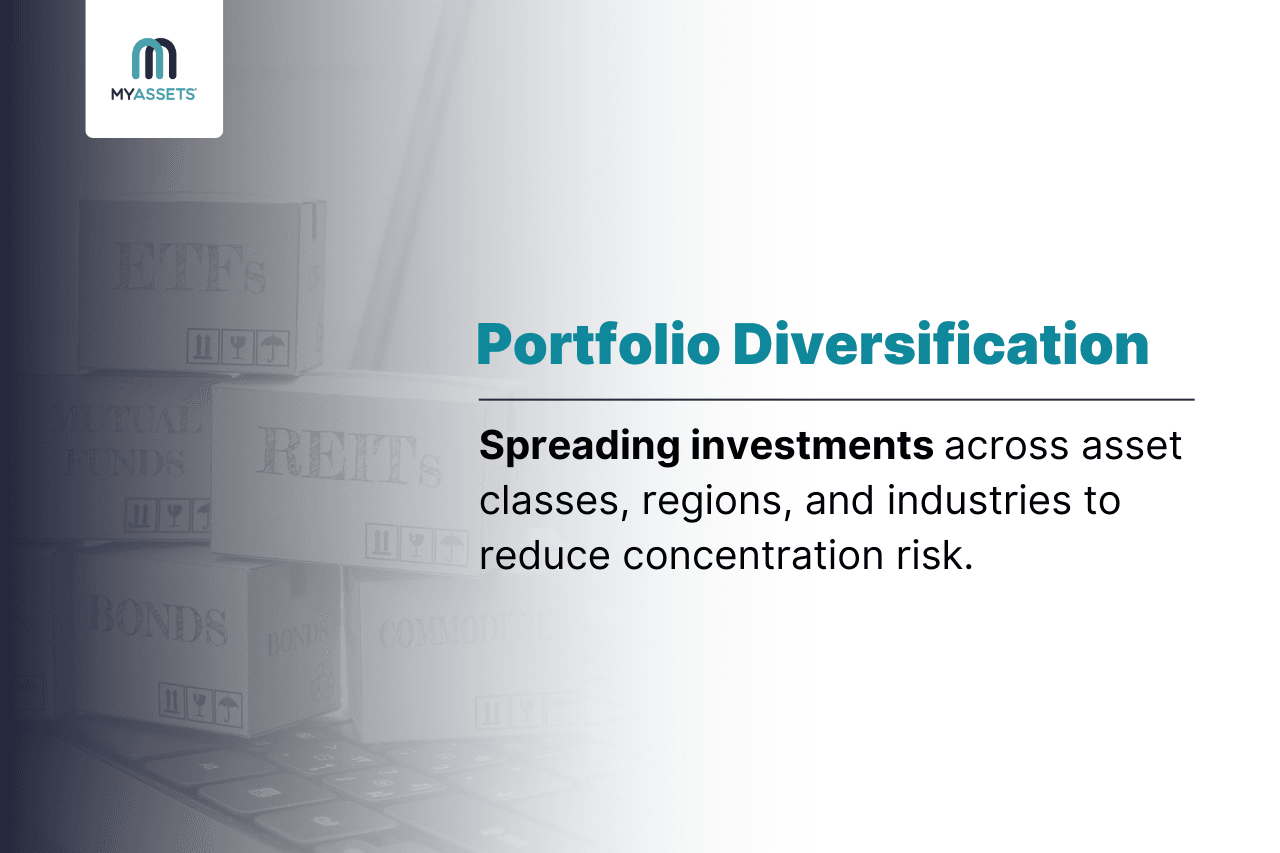
As noted by Connection Capital, this approach helps reduce overall portfolio risk and volatility by limiting the impact of poor performance from any one investment. Over time, gains from stronger-performing assets can help offset losses from weaker ones, resulting in a more balanced portfolio that is better positioned to deliver stable, long-term returns.
How Portfolio Diversification Works
In practice, consider an investor whose portfolio consists entirely of technology stocks. If the technology sector experiences a downturn due to weaker earnings, higher interest rates, or stricter regulations, most of the portfolio could decline in value at the same time.
By diversifying portfolios across sectors, such as healthcare, consumer staples, and utilities, the investor reduces reliance on a single industry. While technology holdings may underperform, gains or stability in other sectors can help offset those losses and lessen the portfolio's overall volatility.
Types of Portfolio Diversification
Portfolio diversification can take many forms, each helping to reduce concentration risk and strengthen a portfolio's long-term resilience. Below are the most common approaches investors use.
Asset Class Diversification
Asset class diversification involves allocating investments across a variety of asset classes, such as:
- Bonds
- Commodities (i.e., gold, crude oil, and agricultural goods)
- Cash and Equivalents
- Real Estate
- Stocks
Since asset classes react differently to economic and market events, diversifying across them helps reduce concentration risk. As a result, the portfolio becomes more resilient to market volatility while supporting more stable long-term performance.

Geographical Diversification
According to Investopedia, geographical diversification is the practice of spreading investments across multiple countries or regions to reduce risk and enhance return potential. Rather than relying on the economic performance of a single market, this diversification strategy provides exposure to economies that may grow or decline at different times.
As a result, geographical diversification helps reduce country-specific risks, such as political instability and currency fluctuations, while allowing investors to benefit from growth opportunities in global markets.
See Also: The Best Places To Buy Property Abroad for Investors
Sector and Industry Diversification
Sector and industry diversification is the strategy of spreading investments across different sectors of the economy, such as technology, healthcare, financials, and consumer goods, while also investing in multiple industries within each sector.
For example:
- Within the healthcare sector, investments may be allocated across biotechnology, pharmaceuticals, and medical devices.
- Within the financial sector, they may include banking, insurance, and asset management.
This approach reduces reliance on the performance of any single sector or industry, helping create a more balanced portfolio.
Time Diversification
Time diversification involves structuring investments around different investment horizons to meet financial objectives over time. As noted by Heritage Financial Consultants, this approach helps investors balance risk and return by selecting investments appropriate to each investment horizon. Generally, it is categorised into:
- Short-Term Diversification: Prioritises lower-risk, liquid investments for goals within one to three years.
- Medium-Term Diversification: Balances growth and income investments for goals three to ten years away
- Long-Term Diversification: For goals beyond ten years into the future, this strategy emphasises growth-focused assets that can withstand market volatility.
5 Examples of Portfolio Diversification Strategies
Wondering how to diversify your portfolio? There are several ways to build a portfolio depending on one’s financial goals and risk tolerance. Below are five portfolio diversification strategies that demonstrate different ways to diversify investments.
1. 60/40 Portfolio
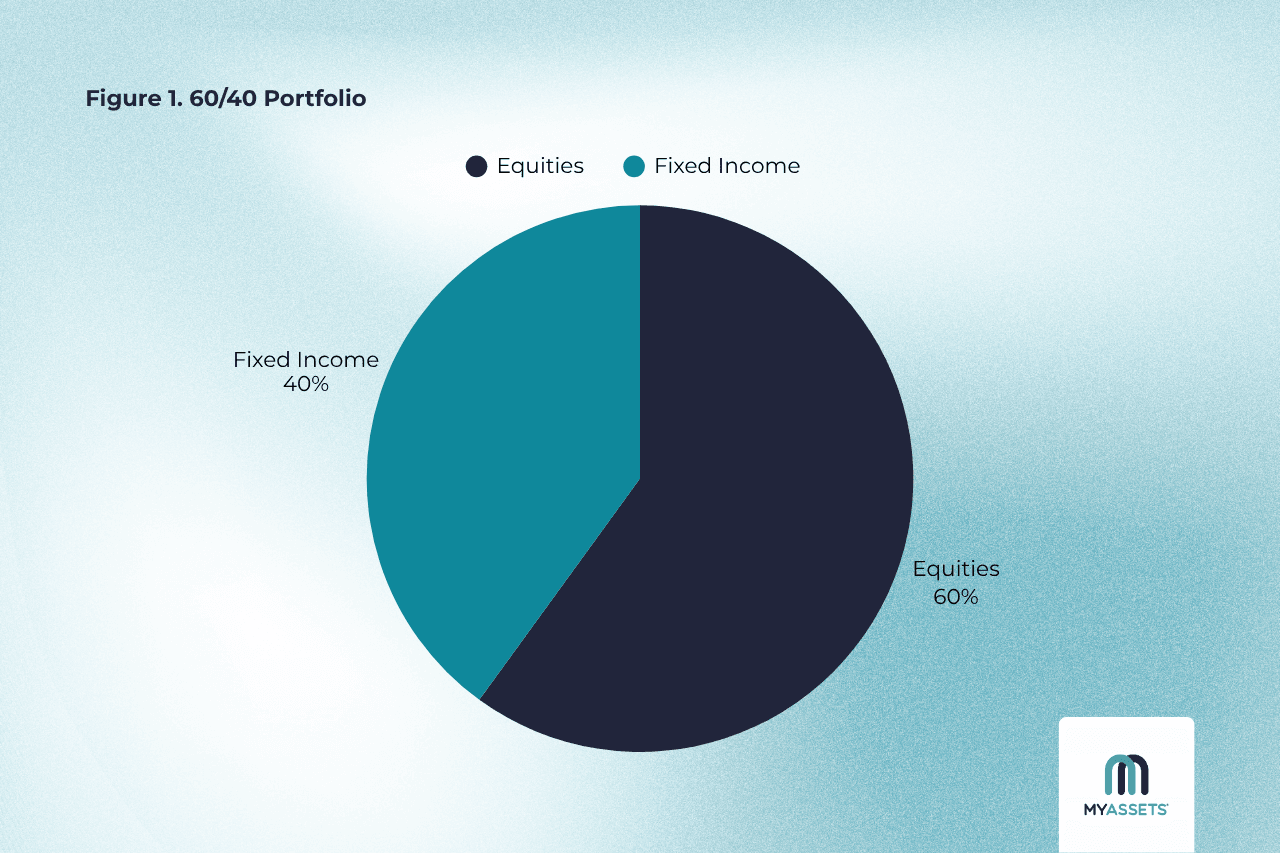
The 60/40 portfolio is an allocation strategy that invests 60% in equities (stocks) and 40% in fixed-income securities (bonds). As noted by Capital Group, an investment management firm, this strategy seeks to capture the long-term growth potential of stocks, while using bonds to provide stability and cushion against market fluctuations.
In practice:
- Equities (60%): A mix of large, mid, and small-cap stocks across multiple sectors to drive long-term growth.
- Fixed Income (40%): A combination of government, corporate, and municipal bonds to generate income and reduce overall portfolio volatility.
Pros
- Combining stocks and bonds balances growth potential with stability, helping reduce portfolio volatility.
- Easy for beginners to set up with an S&P 500 index fund and U.S. Treasury bonds.
Cons
- May generate lower long-term returns than a portfolio invested entirely in stocks.
- May struggle to outpace inflation due to its limited diversification.
Overall, the 60/40 portfolio has historically been valued for balancing growth potential with lower portfolio volatility than an all-stock approach. However, because financial markets and interest rate environments evolve, investors should periodically reassess and adjust their asset allocation to ensure it continues to support their investment goals and risk tolerance.
2. All-Weather Portfolio
The All-Weather portfolio, popularised by Ray Dalio, is an example of a diversified portfolio strategy designed to perform across a variety of economic environments. Instead of predicting market movements, it spreads investments across asset classes that respond differently to economic expansion, recession, inflation, and deflation. By balancing risk rather than capital, the strategy aims to reduce volatility and produce more consistent long-term returns.
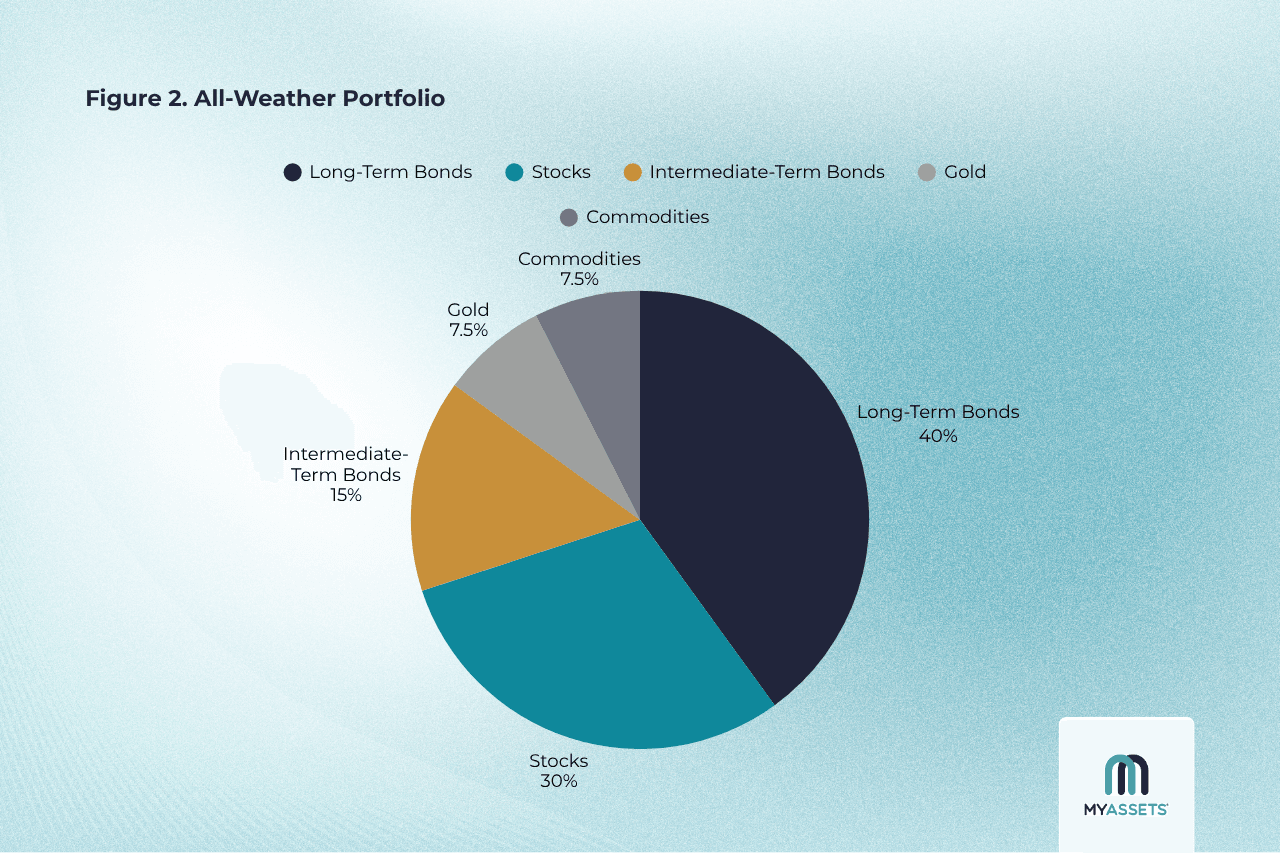
A classic retail-accessible version of the All-Weather portfolio is generally allocated as follows:
- 40% Long-Term Bonds (i.e., iShares 20+ Year Treasury Bond ETF (TLT)) to protect the portfolio during periods of economic slowdown and deflation.
- 30% Stocks (i.e., Vanguard FTSE All-World UCITS ETF (VWRA)) to drive long-term growth potential during periods of economic expansion.
- 15% Intermediate-Term Bonds (i.e., iShares 7-10 Year Treasury ETF (IEF)) to provide stability while reducing exposure to interest rate risk compared with long-term bonds.
- 7.5% Gold (i.e., SPDR Gold MiniShares (GLDM)) to help protect the portfolio against inflation and periods of economic uncertainty.
- 7.5% Commodities (i.e., Invesco DB Commodity Index Tracking Fund (DBC)) to provide protection when inflation rises unexpectedly.
Pros
- A diversified mix of stocks, bonds, commodities, and gold helps minimise portfolio volatility during market downturns.
- Requires minimal trading, helping reduce transaction costs.
Cons
- Heavy exposure to long-term bonds makes the portfolio more sensitive to rising interest rates.
- The 30% stock allocation may reduce growth during periods of strong bull markets.
Essentially, the All-Weather portfolio was originally designed for U.S. investors and reflects the characteristics of the U.S. financial markets. Investors in other countries may need to adjust the allocation to account for differences in tax rules, available investment products, currency exposure, and personal risk tolerance. As a result, the strategy should be viewed as a framework rather than a fixed formula.
Read More: Compound Interest Investments: 5 Best Ways To Grow Wealth
3. Core-Satellite Strategy
The Core-Satellite approach, as described by Saxo Bank, is an investment strategy that combines the stability of low-cost passive investments with the growth potential of actively managed or higher-risk assets. The portfolio is typically structured around two primary components:
- The core. Serves as the portfolio's stable foundation and typically makes up the largest allocation. It consists of low-cost passive investments, such as index funds or ETFs, that track broad market indices to provide diversification, while keeping investment costs relatively low.
- The satellite. Represents a smaller allocation dedicated to higher-growth opportunities. It includes actively managed funds, sector-specific investments, thematic funds, or individual securities that seek to outperform the broader market.
To illustrate how the Core-Satellite approach works in practice, below is an example of a balanced core-satellite portfolio designed to combine broad market returns with selective growth opportunities in high-conviction sectors:
- Core (70%): Vanguard FTSE All-World UCITS ETF (VWRP)
- Satellite (30%):
- 10% - iShares MSCI UK Small Cap UCITS ETF
- 10% - WisdomTree Artificial Intelligence UCITS ETF
- 10% - iShares Healthcare Innovation UCITS ETF
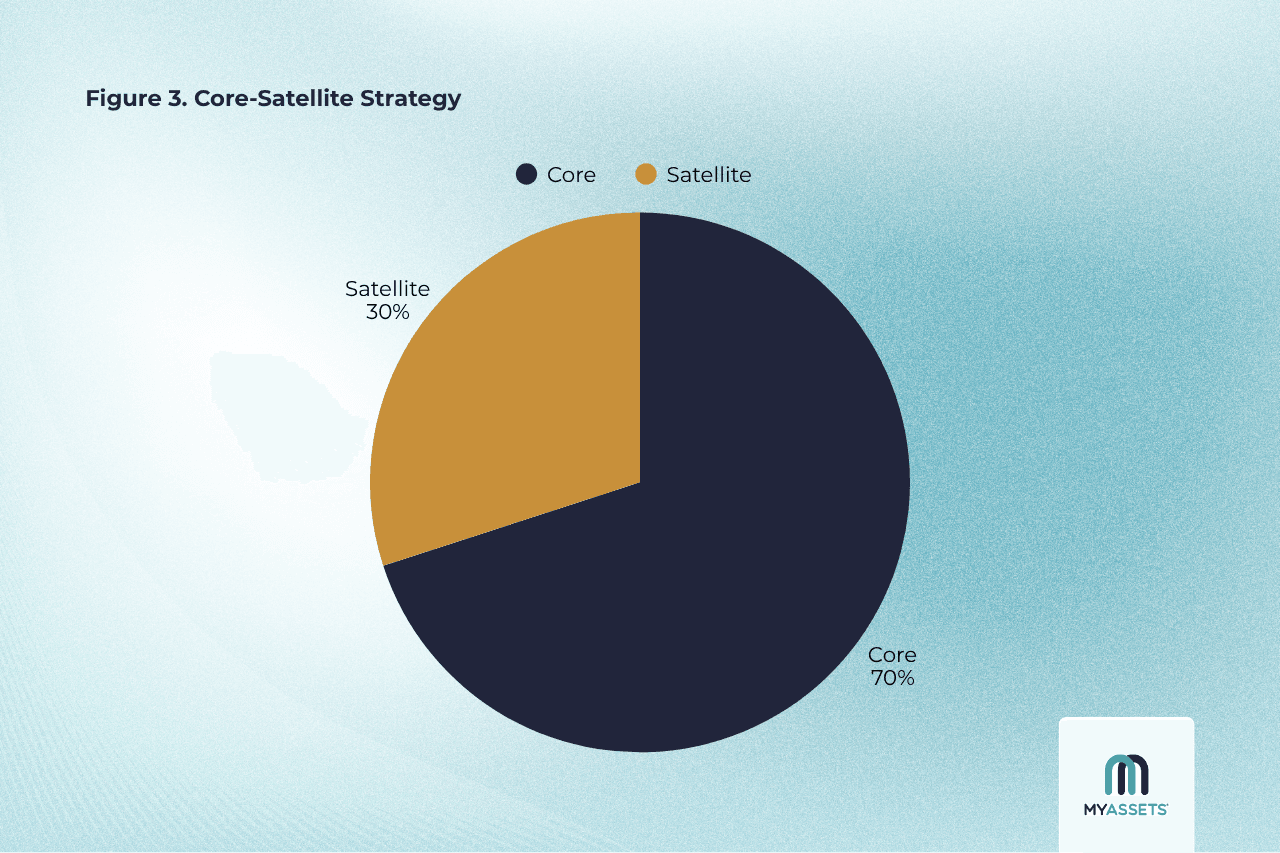
This 70/30 structure allows the majority of the portfolio to benefit from broad market growth while dedicating a controlled portion to higher-conviction investments.
Pros
- Holding most assets in low-fee core funds helps reduce overall investment costs.
- The asset allocation can be adjusted to match the investor’s risk tolerance, from conservative (80/20) to more aggressive (60/40).
Cons
- Satellite investments carry higher risk and may not outperform the core portfolio.
- Satellite investments require regular monitoring and rebalancing, making the strategy more hands-on.
Overall, the core-satellite approach is still highly adaptable, allowing investors to adjust the balance between stability and growth according to their financial objectives.
Whether using a 70/30 (balanced), 60/40 (aggressive), or 80/20 (conservative) allocation, investors can implement the core-satellite approach through a combination of ETFs, mutual funds, stocks, bonds, or separately managed accounts.
4. No Brainer Portfolio
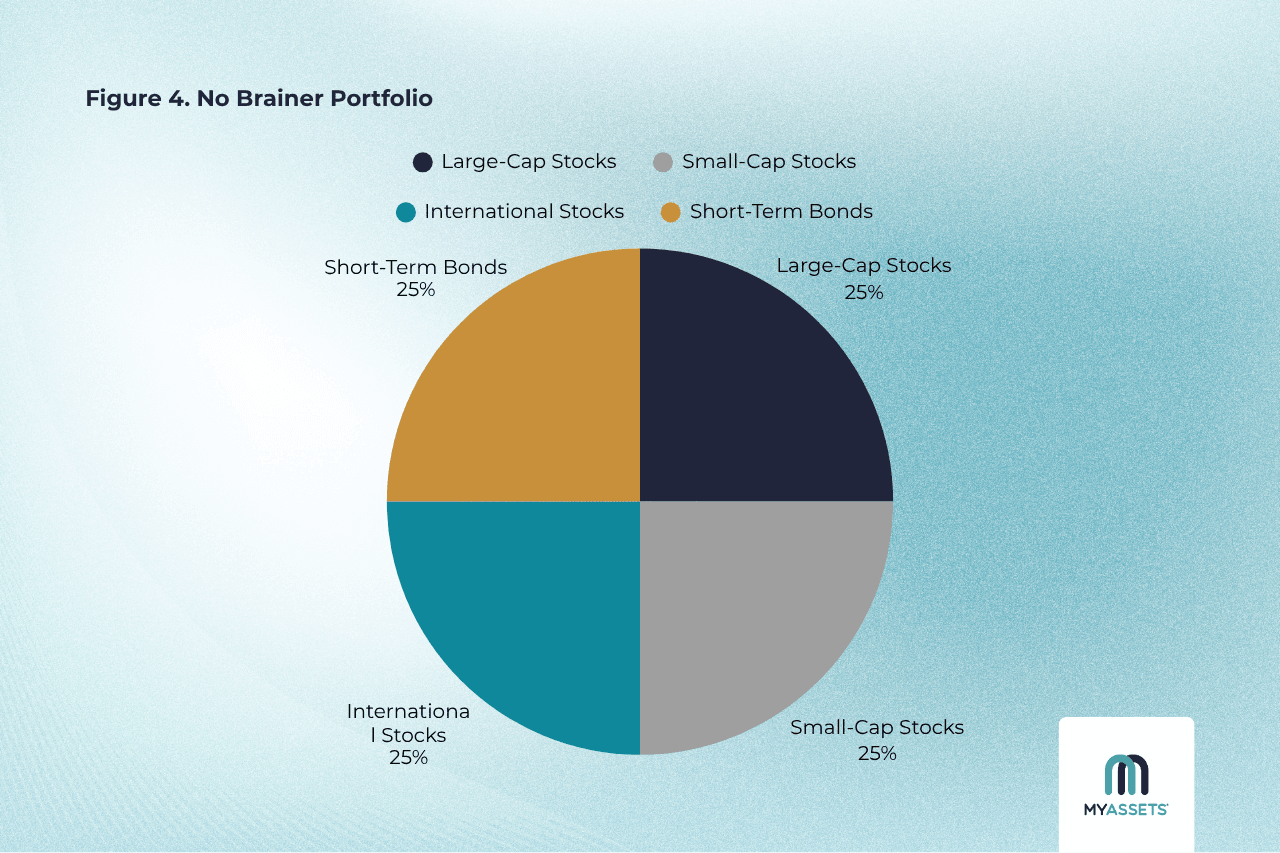
Developed by William Bernstein, the No-Brainer portfolio follows a straightforward investment strategy based on a simple principle: allocating 25% of the portfolio to each of four basic, low-cost index funds or ETFs. This is typically structured as follows:
- 25% Large-Cap Stocks (i.e., Vanguard FTSE 100 UCITS ETF (VUKE)) provides broad market exposure through established companies.
- 25% Small-Cap Stocks (i.e., iShares MSCI World Small Cap UCITS ETF) provides exposure to smaller companies, which have historically delivered stronger long-term growth than large-cap stocks.
- 25% International Stocks (i.e., HSBC MSCI World UCITS ETF) invests in developed international markets to diversify geographic exposure and mitigate the impact of regional economic downturns.
- 25% Short-Term Bonds (i.e., iShares UK Gilts 0–5yr UCITS ETF) provides stability by helping reduce portfolio volatility while preserving liquidity during market downturns.
Pros
- Reduces reliance on large U.S. companies by investing in international and small-cap stocks.
- Simple to manage with just four index funds and annual rebalancing.
Cons
- May underperform the S&P 500 when U.S. large-cap stocks outperform international and small-cap stock.
- The high allocation to stocks can lead to significant losses during market downturns.
Over time, market fluctuations naturally shift the portfolio away from its intended 25% allocation. Periodic rebalancing restores the original asset mix, with William Bernstein recommending an annual review to minimise trading costs and potential tax implications. This straightforward maintenance process makes it one of the strategy's defining features.
5. The Ultimate Buy and Hold Portfolio
The Ultimate Buy and Hold Portfolio is a highly diversified investment strategy developed by Paul Merriman. It divides investments across multiple equity asset classes using low-cost index funds or ETFs. It allocates separate funds to large-cap, small-cap, value, international, and emerging market stocks to achieve broader diversification and enhance long-term return potential.
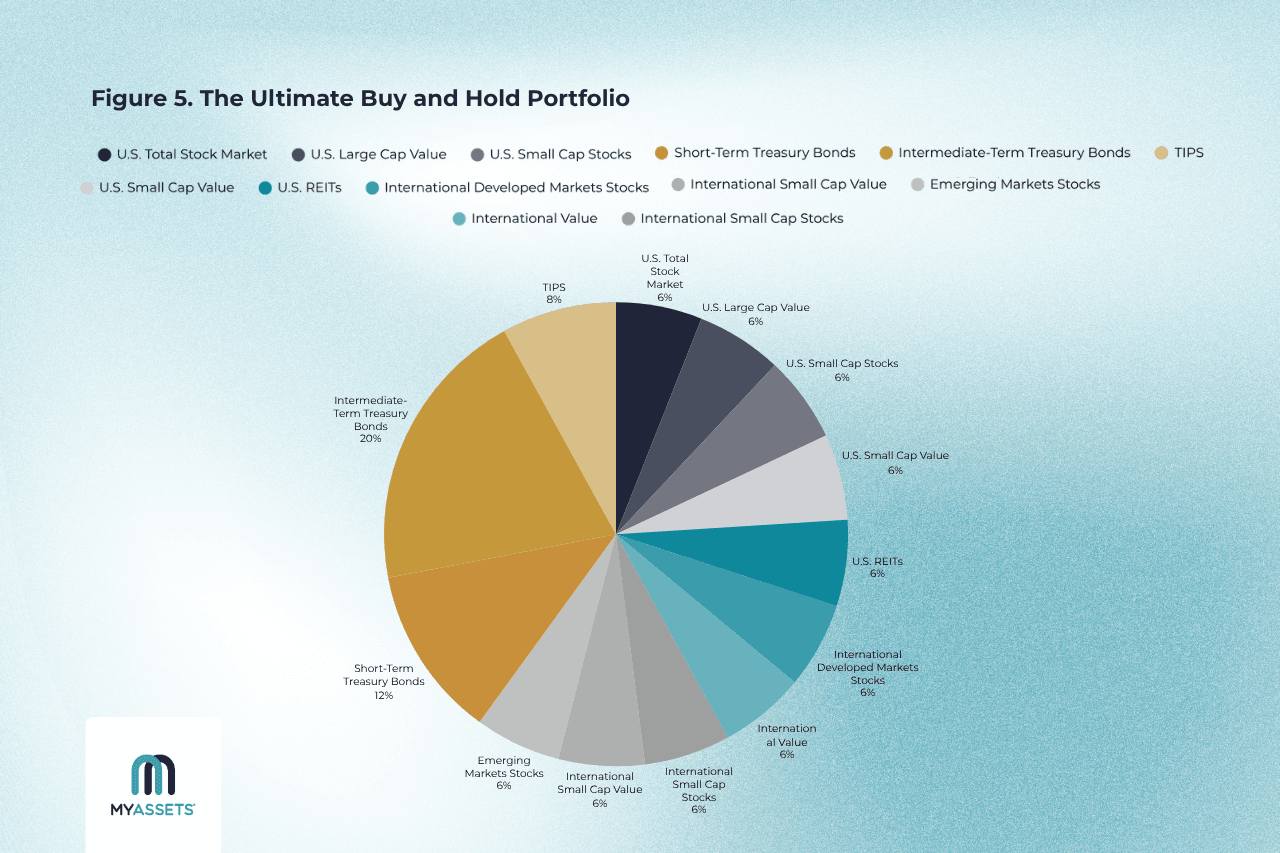
While several versions of Merriman's Ultimate Buy-and-Hold Portfolio have been developed over the years, below is one example presented by Optimized Portfolio:
- 6% U.S. Total Stock Market
- 6% U.S. Large Cap Value
- 6% U.S. Small Cap Stocks
- 6% U.S. Small Cap Value
- 6% U.S. REITs
- 6% International Developed Markets Stocks
- 6% International Value
- 6% International Small Cap Stocks
- 6% International Small Cap Value
- 6% Emerging Markets Stocks
- 12% Short-Term Treasury Bonds
- 20% Intermediate-Term Treasury Bonds
- 8% TIPS
Pros
- Built with low-cost index funds to minimise investment fees.
- Emphasises small-cap and value stocks, which have historically delivered stronger long-term returns.
Cons
- More complex to build and manage than a traditional portfolio due to its multiple fund allocations.
- REITs and some small-cap value funds can generate taxable income, increasing investor’s tax liability.
Overall, the strategy places particular emphasis on value and small-cap value stocks, reflecting Merriman's belief that these market segments have historically delivered stronger long-term returns than the broader market. By combining these with large-cap, international, emerging market, real estate, and fixed-income investments, the portfolio seeks to capture multiple sources of return while reducing concentration risk.
While the Ultimate Buy-and-Hold Portfolio is more comprehensive than many traditional strategies, Merriman also offers simplified four-fund and two-fund versions that follow the same diversification philosophy with fewer holdings.
See More: How To Add Your Investment Portfolios With MyAssets
Choosing the Right Diversification Strategy in Portfolio Management
Diversification in portfolio management is not about owning as many investments as possible; it is about building a portfolio that aligns with an investor's financial goals, investment horizon, and risk tolerance. By diversifying portfolios across asset classes, geographic regions, sectors, industries, and time horizons, investors can reduce concentration risk while creating a stronger foundation for long-term growth.
There is no single strategy that works for every investor. Instead, the right approach depends on individual objectives, whether prioritising stability, maximising growth, or balancing both.
Common portfolio diversification strategies include:
- 60/40 Portfolio – The classic balanced portfolio.
- All-Weather Portfolio – A resilient portfolio for all market conditions.
- Core-Satellite Strategy – A balanced mix of passive and active investing.
- No-Brainer Portfolio – A simple, equal-weighted diversification strategy.
- The Ultimate Buy and Hold Portfolio – A broadly diversified long-term investment strategy.
Ultimately, effective diversification is an ongoing process rather than a one-time decision. As financial goals, market conditions, and personal circumstances evolve, regularly reviewing and adjusting a portfolio helps ensure it remains aligned with an investor's long-term objectives.
Diversification Strategy: Frequently Asked Questions
1. What are the three factors to consider in diversification?
The three foundational factors are risk tolerance (ability to withstand market volatility), time horizon (how long the funds can remain invested), and financial goals (the purpose of the investment).
2. How often should a portfolio be rebalanced?
Rebalancing a portfolio once a year or whenever asset allocations deviate significantly from their target (commonly by ±5%) is considered a practical approach for most investors. This helps them maintain the intended level of risk, keeps the portfolio aligned with long-term financial objectives, and reduces unnecessary trading costs and potential tax implications.
3. What is the 5 diversification rule?
The 5% rule is a risk management guideline that recommends limiting any single stock to no more than 5% of a total investment portfolio. This helps reduce concentration risk and limits the impact of significant losses if one company underperforms.
MyAssets: Keep Every Diversified Investments Organised in One Asset Management Platform
Did you know it's possible to monitor bank accounts, track loans and mortgages, and organise investments from a single platform? While building and managing a diversified portfolio requires careful planning and ongoing decision-making, keeping track of assets across multiple accounts and platforms can make the process even more complex.
That's where MyAssets comes in. By bringing assets and liabilities together in one place, the platform provides a complete view of an individual's financial position, making it efficient to track holdings and make more informed financial decisions.
All Your Investment Details in One Place
MyAssets is an asset management platform that brings all asset information together in one dashboard. From financial accounts and properties to collectables and personal belongings, it provides a centralised place to organise every asset.
For investors, MyAssets also makes it straightforward to record and manage detailed investment information. Users can store key investment details, including:
- Purchase/Acquisition Date
- Units
- Unit Purchase/Acquisition Price
- Total Purchase/Acquisition Price
- Unit Current Value
- Total Current Value
In this way, they can maintain accurate records of their investments, monitor changes in portfolio over time, and gain clear understanding of their overall financial standing –all from a single platform.
A Shared Access to Your Wealth
Managing investment portfolio is rarely a solitary endeavour, yet sharing sensitive financial data often poses a significant security risk. MyAssets addresses this by providing full control over account permissions, with the Delegates feature allowing them to assign who can view, edit, delete, or create entries within their account.
This granular control enables seamless collaboration without compromising total privacy. For example, an individual can grant:
- View-Only Access to a financial advisor to monitor investment performance and provide strategic guidance.
- Edit Permissions to a spouse or partner to ensure household assets and shared liabilities are updated in real-time.
In this way, MyAssets ensures that data remains protected when managing sensitive information with others.
Keep every investment organised, monitored, and accessible. Try MyAssets for free.



