

At its core, the Global Middle Class is characterised by three things — stability, opportunity, and a comfortable standard of living.
While this seems a clear cut definition, a closer look into the middle 40% shows that what’s understood as universal can vary drastically depending on where you are in the world.
This article explores the income and wealth of the Global Middle Class population, as they compare from each corner of the world.
- What is the Global Middle Class?
- What is the Income of the Global Middle Class?
- How Much Wealth Does the Global Middle Class Have?
- Share of Global Wealth Held by the Middle Class
- The Global Middle Class in Summary
- The Global Middle Class: Frequently Asked Questions
What is the Global Middle Class?
The new Global Middle Class is the middle 40% of the world’s wealth percentile. It comprises 2.2 billion adults who earn more than the bottom 50% but remain below the threshold of the economic elite.
This economic group is made of business owners and white collar professionals who have enough financial stability to access basic needs while having some discretionary spending power. They are often categorised by their educational attainment, business endeavors, and social network.
See Also: What It Really Means To Be An Ultra-High-Net-Worth Individual
What is the Income of the Global Middle Class?
The global middle class income is set at $10 to $100 per day (adjusted for purchasing power parity).
By this measure, a household is considered middle class if they meet the following criteria.
- Income Threshold (Entry Point): The minimum annual global middle class income is €11,500
- Average Annual Income: The average global middle class income for an adult is €29,100
- Share of Global Income: The global middle class population accounts for 39% of the world's total income
In Europe, as well as parts of North America and Oceania, this group accounts for 44% - 50% of national income, highlighting their role in national income distribution. There is also the rapid economic growth in Asia, which has significantly increased the growing global middle class’ contribution to global consumption and income generation.
How Much Wealth Does the Global Middle Class Have?
To be considered a part of the middle class in the world, an individual must own the following:
- Wealth Threshold (Entry Point): The Global Middle Class owns a minimum net worth of €29,200
- Average Wealth: Adults in this group own an average wealth of €91,700 (2025 PPP)
While the concept exists worldwide, the middle class definition can vary per country because of wealth disparity.
In high-income countries (such as Japan, Germany, and the United States), middle-class status implies homeownership, retirement accounts, and access to quality healthcare and education. In developing economies (such as India, Indonesia, Nigeria, etc.), it can be more limited or informal, often concentrated in small businesses or land.
The middle class in developing economies may also face structural barriers such as limited job opportunities or weak social safety nets. This can restrict their ability to maintain or improve their economic status.
See More: 5 Powerful Strategies to Increase Your Net Worth
Share of Global Wealth Held by the Middle Class
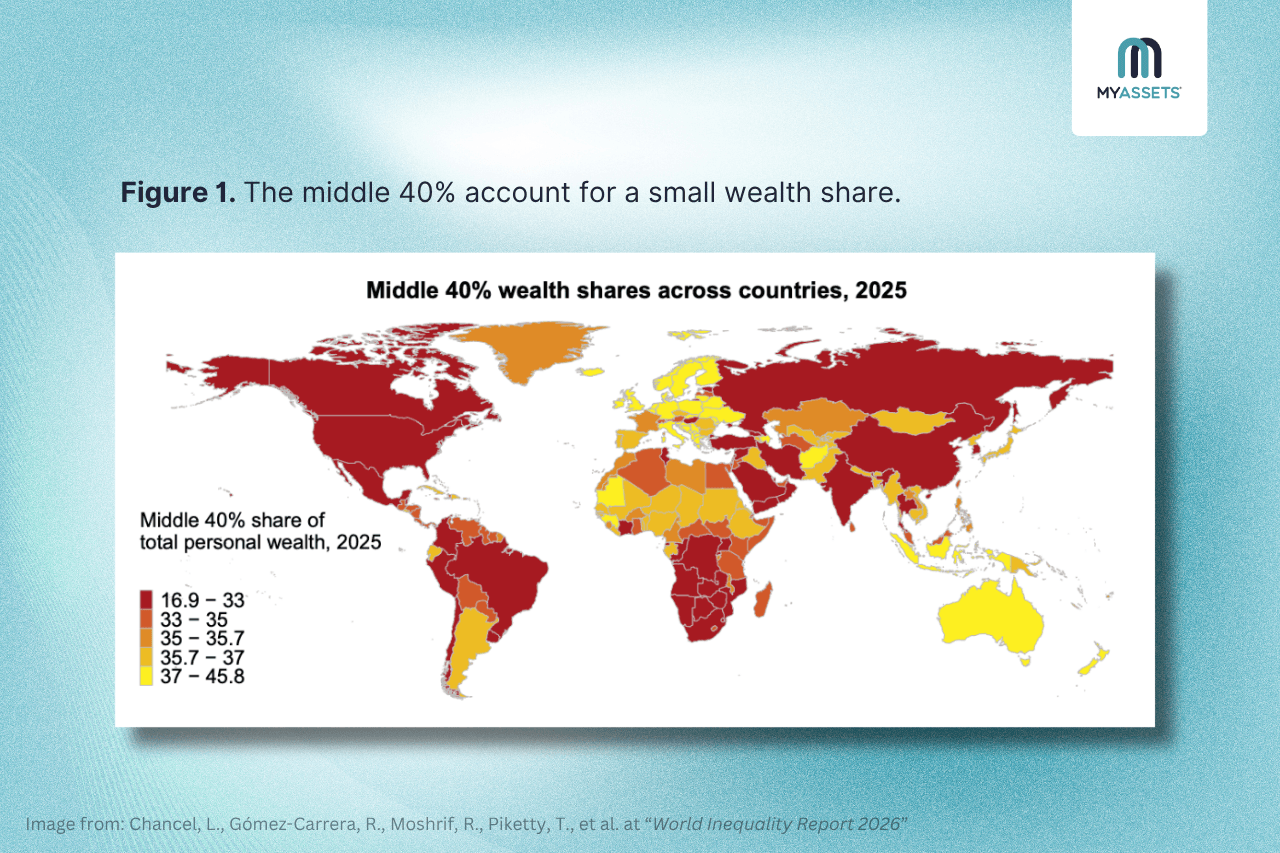
The global middle class holds a modest 24% of the global wealth, but this share varies by country. Figure 1 highlights the distinct bands reflecting the strength of middle class wealth worldwide.
- 16.9% - 33% Range: This lower band includes countries like Colombia, where the middle 40% owns just 27% of wealth, well below their share of the population
- 33% - 35% Range: This middle-tier band represents a more balanced distribution, often found in developing economies with a growing middle-income segment
- 37% - 45.8% Range: This is the highest band, clustered primarily in Europe and Oceania. In these regions, the middle 40% commands a sizeable portion of net worth, such as Norway at 43.9%, which is broadly in line with their population weight
The Global Middle Class in Summary
The new Global Middle Class exists in a complex landscape. While the label suggests a shared socioeconomic status, the reality is far more nuanced. A wide spectrum of experiences can be found in income, wealth, and cost of living.
Understanding these disparities is essential for businesses and individuals navigating an increasingly interconnected global economy.
The Global Middle Class: Frequently Asked Questions
1. How is the global middle class defined?
Currently, the global middle class definition is any individual with income ranging between $10 and $100 per day.
2. Why does global middle class income vary so much across countries?
Global middle class income is adjusted per national context to account for differences in economic development, labor markets, and cost of living.
3. Does being middle class mean the same standard of living everywhere?
Does being middle class mean the same standard of living everywhere? No. A middle class lifestyle in a high income country can differ significantly from one in a developing nation.
MyAssets: Your All-in-One Net Worth Tracker
Knowing where one fits in the global wealth percentile is one thing; having the data to prove it is another.
While the numbers from the World Inequality Report are staggering, they remain abstract until applied to an individual’s own balance sheet. After all, no one can realistically aim for the “stadium” of the top 0.001% without first knowing exactly where they stand.
This is where a net worth tracking tool like MyAssets becomes essential.
Designed to organise, track, and manage assets, MyAssets gives users a full 360-degree view of their wealth by consolidating information from all accounts in one place.
A Single Dashboard to Measure Wealth
It pulls in everything —from bank accounts (checking and savings), investment portfolios (stocks, bonds, and mutual funds), and properties (residential, rental, and commercial), to valuable assets like collectable investments (art, wine, watches, etc.).
It gets better. MyAssets doesn’t just show one’s assets; it also incorporates their liabilities, such as:
- Credit card debts
- Loans
- Mortgages
Imagine having all this information presented in a visually appealing dashboard. With MyAssets, monitoring net worth becomes straightforward as the platform transforms raw numbers into dynamic charts. It offers a breakdown of resources across finances, properties, collectables, and even belongings, making it easier to understand overall wealth.
A System to Manage Relationships Between Assets
Even better, users can manage relationships between assets with its Smart Asset Linking feature. In practice, this means users can connect related items, like the first bought home with its mortgage or the belongings it houses. This helps understand how assets relate to one another and their impact on one’s net worth and portfolio.
Track all your assets and see your true wealth with MyAssets, free for 14 days.



