Building long-term wealth is not about finding a single investment that consistently outperforms every other option. So, how can you successfully build long-term wealth? The first step is understanding how to diversify investments because markets change, economic conditions shift, and different asset classes respond in different ways over time.
In fact, investment diversification remains one of the most important principles of successful long-term investing. Instead of relying on one type of investment to achieve financial goals, diversification focuses on spreading money across a range of assets that can perform differently under changing market conditions.
The reality is that no investment performs well all the time. Stocks may deliver strong returns during periods of economic growth, while bonds can provide greater stability during market downturns. Real estate, commodities, and other asset categories each have their own cycles, making it difficult to predict which investment will lead at any given moment. By creating a diversified portfolio, investors can reduce the impact of poor performance from any single asset and potentially achieve more consistent returns over the long run.
Diversification does not eliminate investment risk entirely, but it is an effective strategy for managing uncertainty. Spreading investments across different asset classes, industries, and geographic regions can help cushion a portfolio against market volatility while positioning it for sustainable growth. For investors just starting to build a balanced investment strategy, building a traditional portfolio can create a strong investment foundation.
In this article, you'll learn why diversification matters, how different asset classes work together and practical ways to build a resilient portfolio. Understanding these core principles empowers you to make informed decisions regarding your long-term financial goals and help your investments grow with greater confidence.
- What Is a Diversified Portfolio?
- Why Investment Diversification Matters
- How to Diversify Your Investments
- Spread Investments Across Asset Classes
- Invest Across Different Industries
- Invest in Different Geographic Markets
- Diversify Within Each Investment Type
- Review and Rebalance Investment Portfolio Regularly
- Diversified Portfolio Strategies for Different Investors
- Does Portfolio Diversification Guarantee Better Returns?
- Diversifying Investments for Beginners: Frequently Asked Questions
What Is a Diversified Portfolio?
A diversified portfolio is a collection of investments spread across different asset classes, industries, sectors, and geographic regions to help balance risk and potential returns. Rather than putting everything into a single investment, portfolio diversification involves allocating capital among assets that tend to perform differently under various market conditions. This is a cornerstone of long-term investing because it aims to reduce the impact of losses from any one investment while providing opportunities for steady growth over time.
How Diversification Reduces Volatility in Unpredictable Financial Markets
Diversification matters because financial markets are unpredictable. Stocks, bonds, real estate, and alternative investments each react differently to economic events, inflation, and changes in interest rates. When one asset class experiences a downturn, another may remain stable or even perform well, helping offset losses within an investor’s portfolio. Although diversification cannot eliminate investment risk, it can reduce volatility and improve the likelihood of achieving more consistent long-term returns.
How Risk and Return Work in Portfolio Diversification
Understanding the relationship between risk and return is also essential. Higher-risk investments often offer the potential for greater rewards but can experience larger price swings. Lower-risk assets may provide more stability but typically generate more modest returns. A well-diversified portfolio seeks to strike the right balance by combining investments with varying levels of risk, allowing investors to pursue growth while helping protect their wealth during periods of market uncertainty.
How Investment Diversification Entails Different Asset Types
It's also important to recognise that owning many investments is not the same as owning diversified investments. For example, holding shares in several companies within the same industry still exposes an investor’s portfolio to similar market risks. True investment diversification means investing across different asset types with varying performance characteristics. Incorporating both traditional and alternative investments can strengthen a portfolio's resilience.
Why Investment Diversification Matters
Rather than relying on a single asset, industry, or region, investors use investment portfolio diversification to spread their capital across a variety of investments, creating a resilient portfolio that can better withstand changing market conditions.
Diversification reduces concentration risk
If an investor allocates most of their funds to technology stocks, a sharp decline in the technology sector could significantly impact their portfolio. However, by holding investments in healthcare, consumer goods, bonds, and international markets, losses in one area may be offset by gains in another.
Diversification helps smooth portfolio performance over time
Markets rarely move in the same direction simultaneously. A property market slowdown, for instance, may affect real estate investments, while other asset classes such as equities or fixed income continue to perform steadily. This balance can reduce volatility and provide greater confidence during periods of uncertainty.
Diversification protects against sector downturns
Economic cycles affect industries differently, making geographical diversification valuable in spreading investments across multiple sectors and regions. International market performance can also provide opportunities when domestic markets underperform.
Recent market trends have highlighted the value of international investing, with global assets delivering strong returns in periods when some domestic markets have lagged. This shows how investment diversification supports long-term investing goals by reducing risk, improving portfolio stability, and positioning investors to benefit from opportunities across different sectors, asset classes, and regions.
Read more: 5 Financial Habits That Are Good For Building Net Worth
How to Diversify Your Investments
Here’s a step-by-step guide to how you can diversify your investment portfolio.
1. Spread Investments Across Asset Classes
Understanding how to diversify investments starts with spreading money across different asset classes. A balanced portfolio may include:
- shares for growth potential
- bonds for steady income
- cash for liquidity
- property for long-term capital appreciation
- alternative investments such as commodities or infrastructure to enhance diversification
Because these asset classes often perform differently under varying market conditions, combining them can help reduce overall portfolio risk while improving long-term stability. Learning about the characteristics of each asset class enables investors to make more informed decisions.
2. Invest Across Different Industries
Allocating funds to a wide range of different sectors helps reduce the impact of poor performance in any single sector.
For example, while technology stocks may experience volatility, healthcare and consumer goods often provide greater stability during economic uncertainty. Likewise, financials and energy can perform well under different market conditions, creating a more balanced portfolio. Diversifying across industries supports long-term financial success while managing risk.
3. Invest in Different Geographic Markets
Allocating funds to a wide range of different sectors helps reduce the impact of poor performance in any single sector.
For example, while technology stocks may experience volatility, healthcare and consumer goods often provide greater stability during economic uncertainty. Likewise, financials and energy can perform well under different market conditions, creating a more balanced portfolio. Diversifying across industries supports long-term financial success while managing risk.
4. Diversify Within Each Investment Type
Diversifying asset allocation within each investment type helps create a more balanced and resilient portfolio because different investments in the same asset class often respond differently to market conditions.
For example, large-cap shares tend to offer greater stability, while small-cap shares may provide higher growth potential. Growth stocks can outperform during expanding markets, whereas value stocks may perform better during periods of uncertainty. Similarly, government bonds are generally considered lower risk, while corporate bonds often offer higher yields. Combining these investments reduces concentration risk, smooths returns over time, and increases the portfolio's ability to withstand changing economic and market conditions.
5. Review and Rebalance Investment Portfolio Regularly
Regularly reviewing and rebalancing investment portfolio helps ensure that investments remain aligned with an investor’s financial goals and risk tolerance. Conducting annual reviews allows investors to assess portfolio performance and determine whether the current asset allocation still reflects the investment strategy.
Significant market movements can cause certain investments to become overweight or underweight, making rebalancing essential to restore an investor’s target allocations. Keeping the portfolio aligned with long-term objectives enables investors to better manage risk and maintain a disciplined investment approach despite changing market conditions.
Discover Tools to Keep Your Investments on Track: Best Portfolio Tracker Apps
Diversified Portfolio Strategies for Different Investors
The right portfolio diversification strategy depends on an investor’s financial goals, experience, and risk tolerance. In the table below, a portfolio consisting of a broad market exchange-traded fund (ETF) and bonds offers a simple way for beginner investors to gain exposure to many companies while adding stability through fixed-income investments.
On the other hand, moderate investors may benefit from a balanced mix of local and international shares, bonds, and property, providing both growth opportunities and protection against market fluctuations. Growth-focused investors typically allocate most of their portfolio to shares because they seek higher long-term returns. However, they still include some defensive assets, such as bonds or cash, to reduce the impact of market downturns.
Investors who are near retirement usually adopt a more conservative approach by increasing their allocation to defensive assets. This strategy helps preserve accumulated wealth and provides more stable income while reducing exposure to market volatility.
| Investor | Possible Strategy |
|---|---|
| Beginner | Broad market ETF + bonds |
| Moderate | Mix of local and international shares, bonds, property |
| Growth | Mostly shares with some defensive assets |
| Near retirement | Higher allocation to defensive assets |
Selecting a portfolio diversification strategy that matches an investor’s objectives and stage of life can improve their chances of achieving long-term financial security while minimizing unnecessary risks.
Does Portfolio Diversification Guarantee Better Returns?
Portfolio diversification is one of the most widely recommended investment strategies, but it does not guarantee better returns. While its primary purpose is to reduce investment risk, it does help drive higher returns over time by creating a more balanced portfolio rather than relying on the performance of a single investment. This means investors are more likely to achieve consistent long-term growth, although individual investments may perform differently.
It’s also important to note that diversified portfolios are still affected by market fluctuations. Economic recessions, inflation, geopolitical events, and changes in interest rates can cause many investments to decline at the same time. As a result, diversification cannot completely eliminate losses or guarantee profits during periods of market volatility. However, because investments do not always move in the same direction, losses in one area may be offset by gains in another, reducing the overall impact on the portfolio.
Royal London explains that diversification improves the balance between risk and potential return by combining different types of investments that respond differently to market conditions. This approach allows investors to manage uncertainty while maintaining opportunities for long-term growth. Rather than focusing on maximizing short-term gains, diversification aims to provide a smoother investment journey with less dramatic swings in portfolio value.
While portfolio diversification does not promise higher returns, it increases the likelihood of achieving more stable and sustainable investment outcomes over time. By reducing unnecessary risk and maintaining exposure to multiple investment opportunities, diversification is a key strategy for investors seeking long-term financial success.
Diversifying Investments for Beginners: Frequently Asked Questions
1. What is a diversified portfolio?
A diversified portfolio is a collection of investments spread across different asset classes, industries, and regions to reduce risk. The goal is to minimise the impact of poor performance from any single investment.
2. What is the difference between diversification and asset allocation?
Asset allocation is the process of deciding how much of your portfolio to invest in different asset classes, such as shares, bonds, and property. Diversification is the practice of spreading investments within those asset classes to reduce risk.
3. How often should I rebalance my portfolio?
Most investors review and rebalance their portfolios every six to twelve months or after significant market movements. Regular rebalancing helps maintain your intended level of risk and keeps your investment strategy aligned with your financial goals.
MyAssets: Your Investment Portfolio Organiser
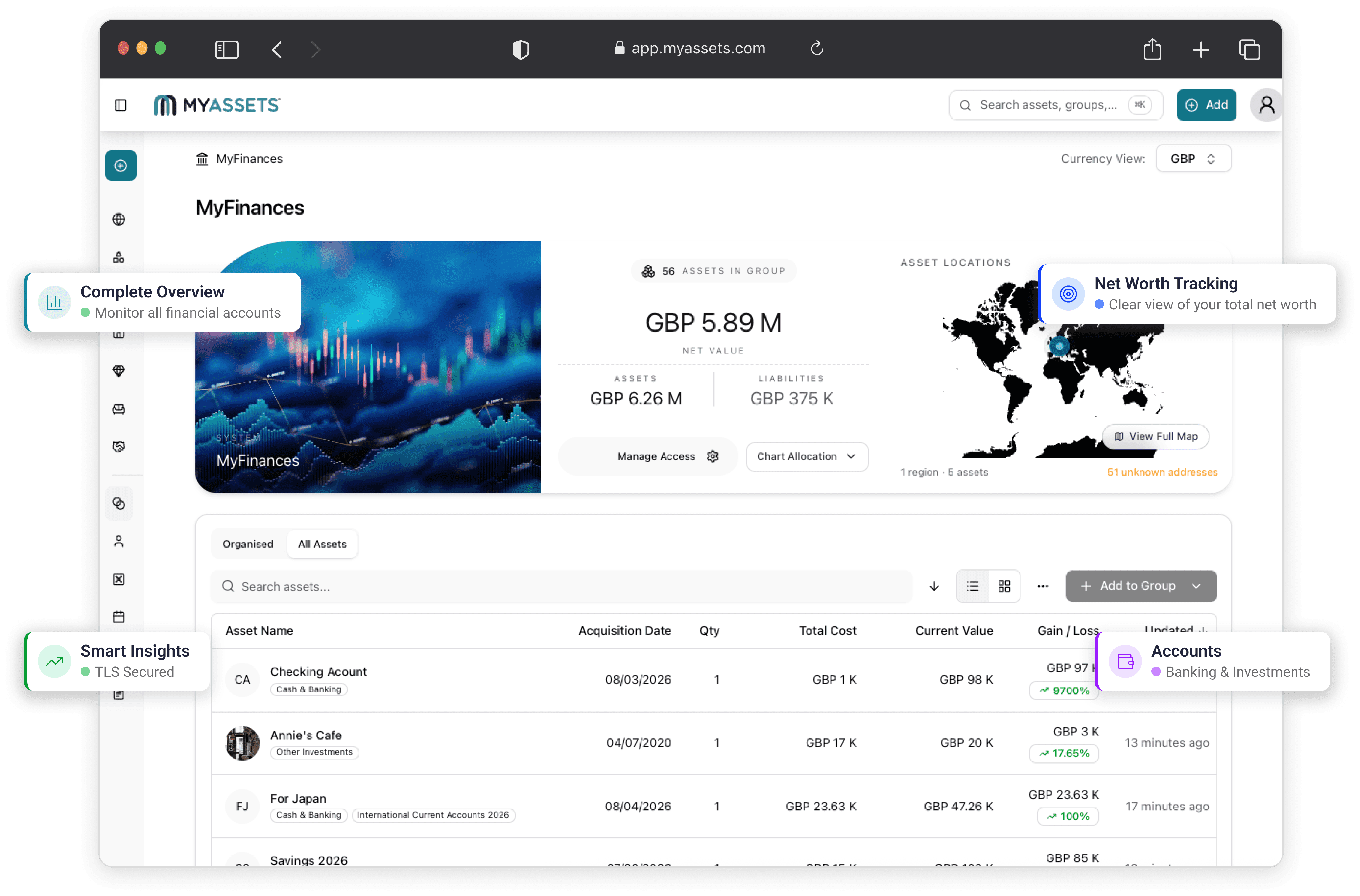
Managing a diversified investment portfolio is easier with MyAssets, an all-in-one platform designed to organise, track, and monitor your assets in one secure location.
Whether you own shares, bonds, property, or other investments, MyAssets provides a central dashboard to help you stay organised, monitor your net worth, securely store important documents, and manage your portfolio with confidence.
Its intuitive features make it simple to keep your investment information up to date while giving you greater visibility over your long-term financial goals. Start for FREE and explore the full MyAssets platform — no credit card required.