


Did you know that it could take more than 50 years of lifetime earnings to match the wealthiest 10% in the United Kingdom (UK)?
The gap between lifetime income and wealth has expanded markedly over time. Findings from the Resolution Foundation show that before the global financial crisis in 2006-2008, a typical worker earning median full-time pay would have needed around 38 years of income to reach the entry point of the top 10% of the wealth distribution. By 2020-2022, this figure had risen sharply to approximately 52 years.
The same report highlights how persistent this divide has become. Over the same periods, the wealth difference between an average individual and someone in the top 10% rose from about £1 million to roughly £1.3 million in real terms.
Given these figures, it proves that wealth inequality in Britain has become so extreme that even a lifetime of saving every penny earned would not be enough for a typical worker to break into the top of the wealth hierarchy, says Molly Broome, senior economist at the foundation and lead author of the report.
Amid these gaps, a more revealing question emerges: how much of an individual’s lifetime earnings is actually translated into wealth accumulation?
Generally, high income does not guarantee personal financial success; rather, how much of that earning is kept and allowed to grow. This is where the Lifetime Wealth Ratio becomes particularly useful, offering a way to measure how income is transformed into accumulated wealth over time, rather than focusing on earnings or net worth in isolation.
To explore this concept further, this article explains what a Lifetime Wealth Ratio is, the underlying drivers behind it, and the data required for calculation. It also outlines how to compute the Lifetime Wealth Ratio and the wealth tools that can support the process.
- What is a Lifetime Wealth Ratio?
- Factors That Influence Lifetime Wealth Ratio
- Data You Need to Calculate Lifetime Wealth
- 4-Step Guide to Calculating Lifetime Wealth Ratio
- Calculate Net Worth
- Determine Total Lifetime Earnings
- Apply the Lifetime Wealth Ratio Formula
- Interpret the Result
- Top Tools to Calculate Wealth
- Lifetime Wealth Ratio: Measuring Wealth Across Your Lifetime
- Lifetime Wealth: Frequently Asked Questions
What is a Lifetime Wealth Ratio?
The Lifetime Wealth Ratio is a financial metric that shows how effectively an individual has converted their total lifetime earnings into accumulated wealth. It compares two important things:
- Income: The total money received from work, investment, business activity, or other sources, reflecting earnings generated throughout an individual’s lifetime
- Net Worth: A person's total financial value, obtained by the difference between their assets and liabilities
In essence, the Lifetime Wealth Ratio brings these two elements together into one formula, showing how efficiently earnings are translated into lasting wealth.

Why Lifetime Wealth Ratio matter?
While the concept is straightforward, its significance becomes clearer when applied to real-life situations:
- Measures wealth-building efficiency. It shifts the focus from how much is earned to how effectively income is transformed into lasting wealth and financial stability
- Reveals long-term financial discipline. Reflects consistent saving, spending, and investing habits over time, not just short-term financial outcomes
- Supports long-term financial planning. Helps individuals assess whether their current financial behaviour is sufficient to achieve future wealth goals or financial independence
How is it different from net worth and income-based measures?
Rather than viewing income and net worth separately, the Lifetime Wealth Ratio links them into a single measure of financial efficiency over time.
- Versus income-based metrics: Income indicates how much is earned within a period, but it does not show how much of that income is saved or accumulated. The ratio addresses this by measuring how total earnings are converted into wealth
- Versus net worth metrics: Net worth shows accumulated wealth at a single point in time, but it does not reveal the income required to build it. The ratio adds context by comparing wealth to total lifetime earnings
Factors That Influence Lifetime Wealth Ratio
Primarily based on two key metrics: net worth and income, the Lifetime Wealth Ratio is also shaped by a range of financial factors, including:
Savings Rate
The Lifetime Wealth Ratio is heavily influenced by the portion of income saved and invested over time. Higher, more consistent savings directly increase net worth while limiting consumption.
Consumption Habits
Keeping expenses under control and avoiding lifestyle creep frees up capital for investment. A disciplined spending habit is essential for maximising the ratio.

Debt Management
High-interest debt reduces net worth growth. Reducing or removing it allows wealth to build up more quickly.
Investment Returns
How financial resources are invested directly affects long-term wealth growth. When investments earn higher returns , the money grows faster over time due to compounding, which increases net worth, especially if returns beat inflation.
Time and Compounding
Early saving allows compound interest to work over a longer period, leading to a greater net worth compared to lifetime earnings.
Data You Need to Calculate Lifetime Wealth
Calculating lifetime wealth is best understood through the Lifetime Wealth Ratio, which requires financial data to measure how income is converted into accumulated wealth over time.
Income Records
The sum of all income earned over time, including:
- Business Income: Net profit derived from owning or operating a business. This reflects income after accounting for expenses, taxes and costs
- Wages and Salaries: Total yearly income from all sources of employment, including bonuses and commissions

Total Net Worth
The current stock of wealth, which is made up of:
- Assets: Resources capable of being converted to cash
- Cash and Cash Equivalents - checking accounts, physical cash, and savings accounts
- Investments - bonds, cryptocurrency, mutual funds, retirement accounts, and stocks
- Real Estate - land, primary residence, rental properties, and vacation homes
- Personal Property - jewellery, cars, art and collectables
- Liabilities: An obligation that remains incomplete or unpaid
- Auto loans, credit card debt, medical bills, mortgage, personal loans, student loans, taxes owed, utility bills, etc.
Learn More: Net Worth vs Credit Score: What Tells the Real Story?
4-Step Guide to Calculating Lifetime Wealth Ratio
Calculating the Lifetime Wealth Ratio offers a clear view of how income becomes long-term wealth, which then supports lifetime wealth management. To get started, here’s a step-by-step guide to calculating the ratio.
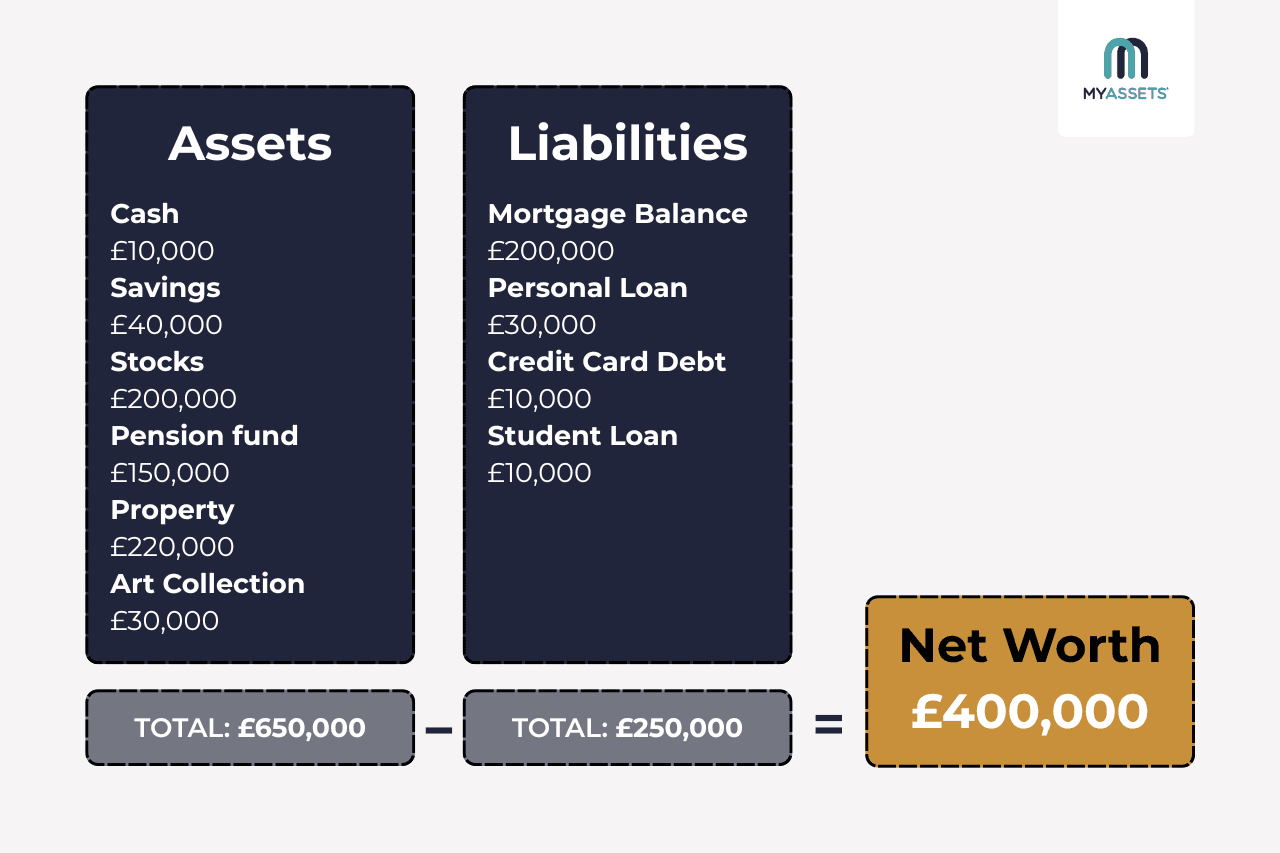
Step 1: Calculate Net Worth
Net worth forms the numerator (top value) in the Lifetime Wealth Ratio formula and represents an individual’s current financial position.
It is calculated using the equation:
Net Worth = Total assets – Total liabilities
Where:
- Total assets are calculated by adding up all asset values across cash, savings, investments, property, and other valuable holdings
- Total liabilities include the sum of all debts, such as credit card balances, loans, mortgages, and other financial obligations
To apply this step accurately, individuals must assign realistic market values to all assets and ensure that all outstanding liabilities are fully accounted for. For greater efficiency, a net worth app can consolidate data, automate calculations, and provide an overview of net worth.
Step 2: Determine Total Lifetime Earnings
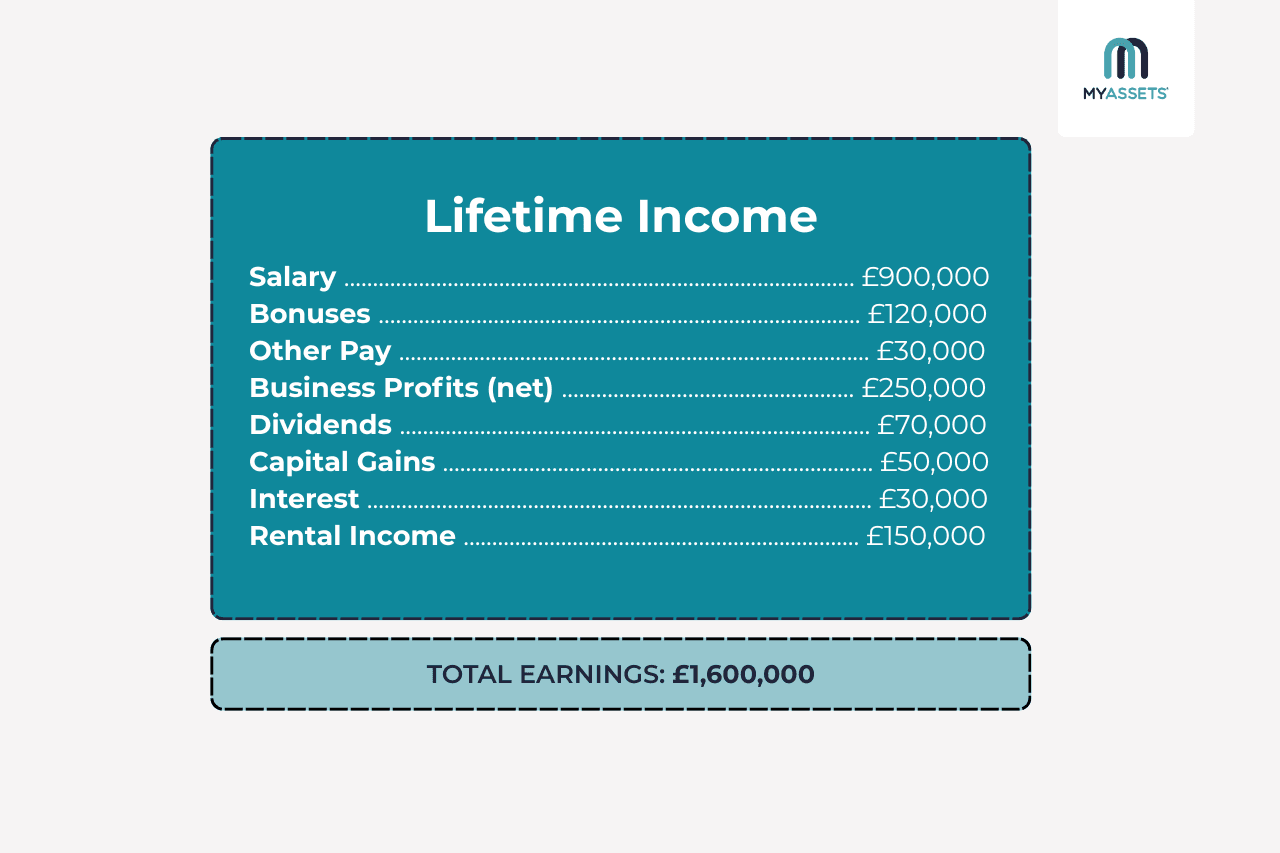
The next step is to determine the denominator (bottom value), which represents an individual’s total lifetime income.
This figure includes all earnings accumulated over time and can be obtained by reviewing the following:
Employment Income Records
These capture income earned through salaried work:
- HM Revenue and Customs (HMRC) Personal Tax Account via GOV.UK
- Central platform for viewing pay-as-you-earn (PAYE) income reported by employers
- PAYE Employment History
- Shows taxable earnings reported by employers through the PAYE system
- P60 Forms
- Official end-of-year document summarising total pay and tax deductions for each tax year
- Available through GOV.UK / HMRC
- Payslips
- Used for verifying monthly income, bonuses, and variable pay (supporting document, not official lifetime record)
Self-Employment and Business Income Records
These reflect earnings from freelance, contract, or business activities:
- Self Assessment Tax Returns (SA100) submitted through HMRC / GOV.UK
- Includes declared income from self-employment, freelancing, rental income, and other taxable sources
- Reflects business profits after allowable expenses
The goal is to capture the full amount of money an individual has earned throughout their working life. Once collected, these figures are added together across all years to determine total lifetime earnings.
Step 3: Apply the Lifetime Wealth Ratio Formula
After calculating net worth and lifetime income separately, these figures are then used to apply the Lifetime Wealth Ratio formula:
Lifetime Wealth Ratio = Net Worth ÷ Total Lifetime Earnings
For example, if an individual has accumulated £400,000 in net worth and earned a total of £1,600,000 in lifetime income, the calculation would be:
£400,000 ÷ £1,600,000 = 0.25
To express this as a percentage, multiply the result (0.25) by 100:
0.25 × 100 = 25%
This means that 25% of total lifetime earnings have been converted into net worth.
Step 4: Interpret the Result
With a Lifetime Wealth Ratio in hand, the next question arises: what constitutes a good Lifetime Wealth Ratio?
Generally, there is no fixed standard for a good Lifetime Wealth Ratio, as it depends on individual circumstances, such as:
- Age
- Income
- Lifestyle
- Long-Term Financial Goals
Even so, experts offer broad ranges that can help interpret financial standing:
0% - 10% – Weak
This range suggests that little wealth has been built relative to earnings. It may indicate overspending, low savings, or financial challenges, signalling a need to improve budgeting, saving, and investing strategies
11% - 25% – Moderate
This reflects a fair level of wealth accumulation relative to earnings. While it suggests saving and investing consistently, it may still require individuals to increase contributions to fully reach long-term financial goals. Improving savings rate, optimising investments, and diversifying income sources can help strengthen this position
26% - 50% – Strong
A ratio in this range shows a good level of wealth accumulation relative to earnings. Individuals are likely moving in the right direction financially, but continued attention is required. Sustaining savings rate, reviewing investments, and protecting income sources support long-term financial success at this level
51% - 100% – Very Strong
At this range, wealth accumulation is exceptionally high relative to one’s earnings. The individual may have achieved or even exceeded their financial goals, along with a strong sense of financial security and freedom. The next step is to enjoy wealth, consider giving or sharing it, and focus on lifetime wealth planning
101% - 1,000% – Excellent
This reflects an exceptional amount of wealth built in relation to earnings. The individual is likely well beyond their financial goals, with significant financial abundance and independence. The emphasis now shifts toward responsible, wise, and generous use of wealth
Top Tools to Calculate Wealth
Given the volume of financial data needed to compute the ratio, lifetime wealth planners are encouraged to use tools that centralise financial data, organise income and net worth, and improve calculation accuracy. Listed below are tools that support this process:
1. Spreadsheets
As Microsoft defines, spreadsheets are digital tools that have transformed how data is organised, calculated, and analysed.
In connection with calculating the Lifetime Wealth Ratio, this tool allows users to take a hands-on approach to perform the following:
- Allows full customisation of formulas to match specific needs
- Enables integration of multiple financial concepts, combining net worth, income, savings rate, and other variables in one framework
- No preset limits, unlike apps with fixed categories or tracking rules
Among the most commonly used spreadsheet tools are:
- Microsoft Excel
- Google Sheets

Learn More: Spreadsheets vs. Wealth Apps: Which One Really Works For Monitoring Your Wealth
2. Net Worth App
A net worth app is a tool that brings together assets such as bank accounts, investments, and real estate, alongside liabilities such as loans and debt, into a single dashboard to calculate overall net worth.
In the context of calculating the Lifetime Wealth Ratio, this type of app is useful as it:
- Automatically calculates net worth by updating assets and liabilities
- Provides financial visibility through dashboards that clearly show assets, liabilities, and net worth value
- Tracks wealth over time to show how financial position changes month to month or year to year
To discover some of the net worth calculators available, here are some options to consider:
- Empower
- MyAssets
- Kubera

See Also: 7 Wealth Aggregation Platforms For A More Connected Portfolio
3. Budgeting App
A budgeting app is another financial tool that helps users track and manage income and expenses. It typically connects to bank accounts to capture income and expenses, while categorising spending to provide a clear view of cash flow.
But what makes a budgeting app relevant when calculating the Lifetime Wealth Ratio? While sourcing lifetime income data from records such as personal tax accounts and payslips seems sufficient at first, a budgeting app adds deeper value by:
- Categorising expenses to identify spending patterns that impact wealth accumulation
- Providing an income history that can be used to estimate cumulative lifetime earnings
- Reducing manual tracking errors with automated syncing and categorisation
Looking for a budgeting app? Below are some useful options worth exploring.
- You Need A Budget (YNAB)
- NerdWallet
- PocketGuard
Lifetime Wealth Ratio: Measuring Wealth Across Your Lifetime
The Lifetime Wealth Ratio provides a clear way to understand how effectively income is converted into long-term wealth. It compares total net worth with lifetime earnings by following a structured approach of:
- Calculating net worth
- Determining lifetime earnings
- Applying the formula
- Interpreting the result
Through this process, individuals gain a more meaningful view of their financial progress beyond income alone.
While calculating the Lifetime Wealth Ratio may seem straightforward, using the right tools can streamline the process. Net worth apps help provide an accurate view of total wealth, budgeting apps support consistent tracking of income and spending over time, and spreadsheets offer the most flexible option, allowing users to fully customise calculations and analysis according to their own financial framework.
Together, these elements make the Lifetime Wealth Ratio a useful framework for evaluating long-term financial efficiency and wealth-building success.
Lifetime Wealth: Frequently Asked Questions
1. Are windfalls included in the Lifetime Wealth Ratio?
Windfalls are typically included in net worth but excluded from lifetime earnings to ensure the ratio reflects income-driven wealth accumulation.
2. What is a good Lifetime Wealth Ratio at different ages?
The Lifetime Wealth Ratio varies across age groups, reflecting how wealth is progressively built over a working life.
- 18-30: 0% - 10% – Early career stage with limited savings and asset accumulation, resulting in a low ratio
- 30-40: 10% - 30% – Rising earnings, early property ownership, and initial investments begin to increase wealth accumulation
- 40-55: 30%–60% – Higher income levels, stronger investing activity, and growing home equity drive faster wealth building
- 55-65: 60% - 100% – Debt levels typically decline while pensions and accumulated assets peak, significantly improving the ratio
- 65+: 100% and above – Net worth may equal or exceed lifetime earnings, though the ratio may stabilise or fluctuate during retirement depending on withdrawals and spending
3. How often should the Lifetime Wealth Ratio be calculated?
It can be reviewed periodically, such as annually, to track long-term financial progress and wealth-building efficiency.
MyAssets: Your Net Worth Tracker for Life
The Lifetime Wealth Ratio is simple in concept, but ensuring accurate calculation can be challenging when financial data is fragmented across various sources. This is where tools like MyAssets become essential, helping users consolidate information and maintain a clear overview of their net worth.
Cash at one bank, debt at another?
When money is spread across various banks and brokerages, it is easy to lose sight of the bigger picture. MyAssets addresses this by providing a 360-degree view of an individual's wealth, consolidating disparate data into a single platform.
It brings everything together:
- Bank accounts (checking and savings)
- Investment portfolios (stocks, bonds, and mutual funds)
- Properties (residential, rental, and commercial)
- Valuable assets (art and collectables)
Even liabilities are included –mortgages, loans, and credit card debts –because net worth isn’t just about assets. MyAssets provides a single source of truth, offering a complete, accurate picture of an individual’s financial health.
What’s more? All this information is neatly organised in a Global Dashboard, allowing users to see their entire financial picture at a glance. Raw numbers are transformed into intuitive graphs, and assets are clearly categorised, making it straightforward to understand where money is allocated, track progress, and make informed financial decisions.
Want to collaborate on money matters safely?
Managing wealth is rarely a solitary endeavour, yet sharing sensitive financial data often poses a significant security risk. MyAssets addresses with the Delegates feature, allowing users to assign who can view, edit, delete, or create entries within their portfolio.
This granular control enables seamless collaboration without compromising total privacy. For example, an individual can grant:
- View-Only Access to a financial advisor to monitor investment performance and provide strategic guidance
- Edit Permissions to a spouse or partner to ensure household assets and shared liabilities are updated in real-time
In this way, MyAssets ensures that data remains protected when managing sensitive information with others.
Track your net worth, understand your lifetime wealth with MyAssets, free for 14 days.



