


How can you tell if someone is rich? For many, it’s the familiar image of a Lamborghini, designer clothes, and jet-setting across the world. These are the loudest signals of wealth –the ones that draw attention. Yet, as the saying goes, wealth is what you don’t see.
The truth is, wealth works silently in the background:
- Capital invested in stocks and shares
- Money saved in banks
- Ownership of appreciating assets, such as property and businesses
- Retirement funds compounding over time
Many of these assets remain hidden in plain sight; however, they can shape a person’s financial position, making someone far wealthier than they appear.
Measuring wealth, therefore, offers a more reliable approach than surface-level observation. It involves assessing total assets, accounting for liabilities, and calculating net worth. In doing so, individuals can move beyond perception and objectively determine their true financial position.
So, how rich are you? To find out, this article outlines the process of determining how rich you are in the world through calculating net worth and reviewing the global wealth percentile. It also introduces tools, from net worth apps to how rich am I calculators, that streamline understanding where you stand financially.
- What Does it Mean to be Rich?
- How to Calculate How Rich You Are in the World
- List Your Assets
- Calculate Total Assets
- List Your Liabilities
- Calculate Total Liabilities
- Compute Your Total Net Worth
- Compare Net Worth to Global Wealth Percentiles
- Top Tools to Measure How Rich You Are
- How Rich Am I by Net Worth: A Global Perspective
- How to Know if You are Rich: Frequently Asked Questions
What Does it Mean to be Rich?
Generally, being rich means possessing an abundance of financial assets, a high income, or material possessions that far exceed basic needs.
This financial surplus typically manifests as:
- Abundant Assets: Possessing substantial money, property, or investments
- Comfortable Lifestyle: The capacity to live above the average worker, affording necessities and discretionary spending without financial pressure
- Financial Independence: Generating passive income enough to sustain living costs, while building wealth above inflation rates
While these markers offer a clear-cut definition, the true measure of richness is found in the hard data. When subjectivity is removed and wealth is defined by the numbers, the global benchmark becomes the top 1%.
The Top 1%
What does it mean to be in the top 1%? In the context of wealth, being in the top 1% means an individual has a net worth higher than 99% of the population. Put simply, if the global population were represented by a room of 100 people, that individual (1%) would be the richest person present.
This status places them at the very top of the wealth distribution, where only a very small share of people hold more wealth, while the vast majority fall below this threshold.
When translated into real-world data, the scale of inequality becomes even more striking. The World Inequality Report 2026 states that the top 1%, around 56 million adults, control 37% of global wealth. To put this into perspective, this is nearly eighteen times the wealth held by the world’s poorest 2.8 billion people.
Overall, how wealthy is wealthy can extend as far as owning more wealth than the majority of the global population. Yet because wealth is relative and shaped by geography, comparison, and context, it cannot be understood through perception alone. It must be measured.
This is where net worth and global wealth percentiles become essential, revealing not just whether someone is rich, but how rich they are in a global context.

How to Calculate How Rich You Are in the World
Considering that rich is a relative term, numbers provide a more definitive way to assess true financial standing. One way to do this is by calculating how rich you are. That said, this article guides you through the process, from computing net worth to comparing it against global wealth benchmarks.
1. List Your Assets
According to Investopedia, assets are anything of value that can be converted into cash and may either generate income or appreciate before being realised. It is a key component of personal wealth, representing what is owned by an individual.
The process begins by identifying all personal assets. Examples of qualifying assets include:
Cash and Cash Equivalents
- Checking Accounts
- Physical Cash
- Savings Accounts
Investments
- Bonds
- Cryptocurrency
- Exchange-Traded Funds (ETFs)
- Mutual Funds
- Retirement Accounts
- Stocks
Real Estate
- Land
- Primary Residence
- Rental Properties
- Vacation Homes
Personal Property
- Art and Collectables
- Electronics and Appliances
- Jewellery
- Vehicles (cars, boats, motorcycles)
- Watches
- Luxury Items
Beyond listing them, assign each asset its current market value, as this will be used in the next step. A net worth spreadsheet is a good way to ensure all assets are fully recorded.

2. Calculate Total Assets
To calculate total assets, take the current market values of all assets identified in step 1 and add them together.
Consider the following assets as an example:
- A cash worth £2,000
- A savings account holding £5,000
- A vehicle with a current market value of £25,000
- Bonds worth £8,000
- Property appraised at £200,000.
- Shares valued at £15,000
Total assets from adding all these values (£1,500 + £5,000 + £25,000 + £8,000 + £200,000 + £15,000) is £255,000.
3. List Your Liabilities
To obtain a complete financial picture, individuals must also account for the liabilities associated with acquiring those assets.
So, what are liabilities? Liabilities are financial obligations that have yet to be paid or settled between parties. This represents the money owed on assets that typically depreciate or carry ongoing costs.
These financial obligations or debts typically include the following:
- Auto Loans
- Credit Card Debt
- Mortgage
- Outstanding Insurance Premiums
- Personal Loans
- Student Loans
- Taxes Owed
Listing liabilities should also include recording their respective values, which will be used in the next step of the calculation.
Read More: 10 Money Habits That Are Hurting Your Finances
4. Calculate Total Liabilities
Calculating total liabilities follows the same method used for total assets, summing all listed values, but this time focuses on liabilities.
A sample liability is shown below, resulting in the total amount owed.
- Credit Card Debt: £4,000
- Car Loan: £12,000
- Mortgage: £180,000
- Personal Loan: £7,000
- Utility Bills: £1,000
The sum of the listed liabilities (£3,500 + £12,000 + £180,000 + £7,000 + £1,000 ) equals £204,000.
5. Compute Your Total Net Worth
After determining total assets and total liabilities, the next step is to calculate net worth, which represents an individual’s overall financial value. This is done by finding the difference between total assets and total liabilities, using the formula:
Total assets – Total Liabilities = Total Net Worth
Applying the values above:
£255,000 (Total Assets) – £204,000 (Total Liabilities) = £51,000 (Total Net Worth)
To interpret the result:
- A positive net worth indicates that assets exceed liabilities, which is generally a sign of financial stability and good financial health
- A negative net worth means liabilities outweigh assets, often creating financial pressure driven by high loan balances, high-interest debt, or a lack of liquid savings
6. Compare Net Worth to Global Wealth Percentiles
After getting your net worth, the question remains: how rich are you compared to the world? This is where global wealth percentiles come in, a statistical measure that ranks an individual’s financial standing relative to the rest of the global population.
Using data from the World Inequality Report 2026, the following breakdown outlines global wealth tiers and the approximate thresholds required to enter each level:
| Percentile | Wealth Threshold |
|---|---|
| Bottom 50% | €0 (£0) |
| Middle 40% | €29,200 (£25,300) |
| Top 10% | €265,600 (£230,124) |
| Top 1% | €2 million (£1.7 million) |
| Top 0.1% | €7 million (£6 million) |
| Top 0.01% | €38 million (£32.9 million) |
| Top 0.001% | €254 million (£220 million) |
| Top 0.0001% | €1 billion (£866.4 billion) |
| Top 0.00001% | €4 billion (£3.46 billion) |
| Top 0.000001% | €22 billion (£19 billion) |
For example, a net worth of £51,000 would place an individual in the middle 40%, with an entry threshold of approximately €29,200 (£25,300). This indicates a position above the lower half of the global population, yet still below the thresholds of the top wealth tiers.
Top Tools to Measure How Rich You Are
Calculating someone’s wealth can be a time-consuming process, especially when aiming for an accurate result. To make this process more efficient, dedicated tools can help calculate net worth and determine global standing.
1. Net Worth App
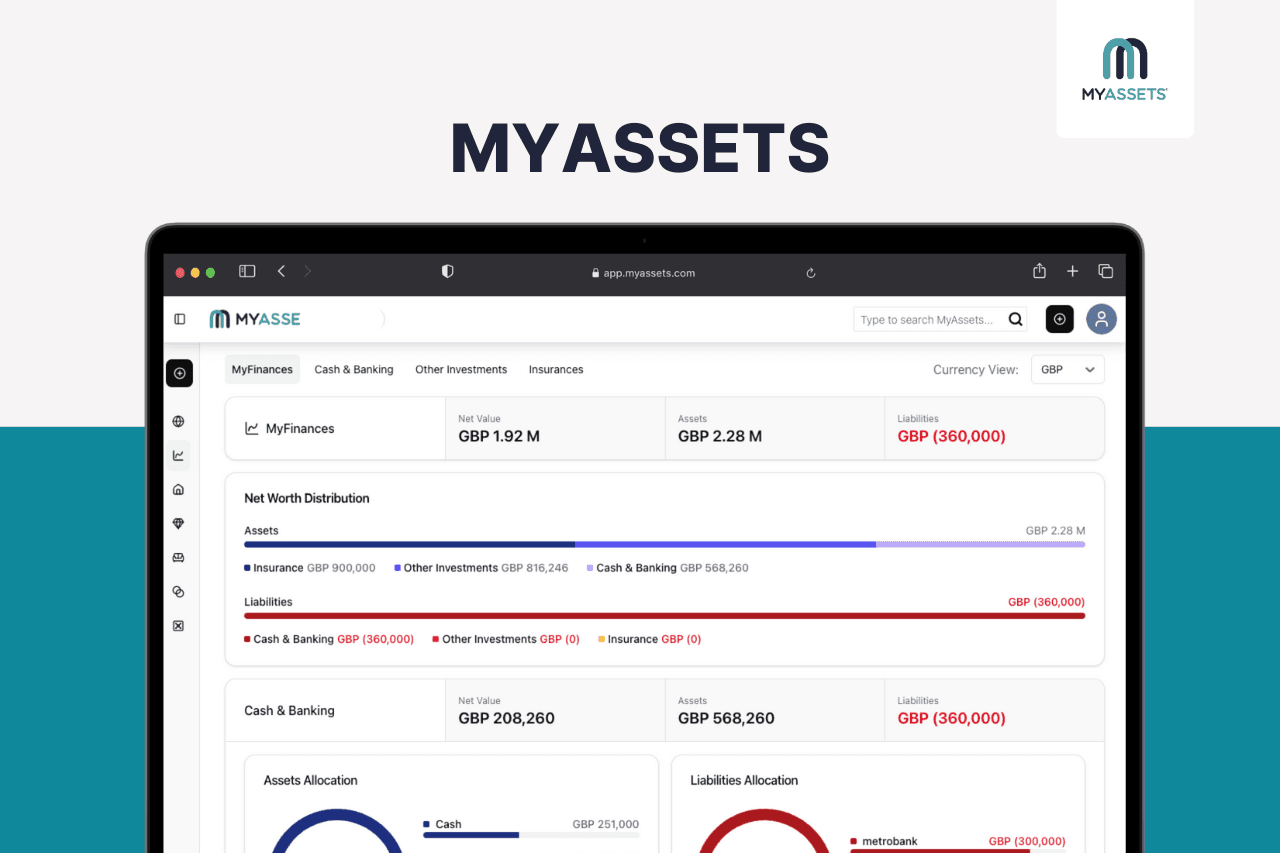
A net worth app is a digital tool that provides a comprehensive snapshot of an individual’s financial health. By aggregating assets, such as cash, investments, property, alongside liabilities like mortgages and loans, these tools automatically calculates net worth and presents it into one dashboard.
While these apps focus on calculating net worth rather than wealth percentiles, they provide an accurate net worth figure that serves as a strong foundation for global comparison.
Primary Features
To understand how a net worth calculator can assist in calculating net worth, below are its key features:
- Wealth Aggregation: Consolidate wealth from different accounts and asset types, including cash and banks, investment portfolios, alternative investments, and real estate
- Currency Conversion: Support multiple currencies for users with international holdings
- Liability Tracking: Monitor all liabilities, including loans, credit card debt, and mortgages
- Net Worth Calculation: Calculates and displays net worth based on aggregated asset and liability data
Top Net Worth Tracking Apps
For a clear and current view of overall finances, consider using the following net worth apps:
- Empower
- Kubera
- MyAssets
See Also: 7 Best Wealth Tracking Apps to Monitor Investments with Ease
2. How Rich Am I Calculator
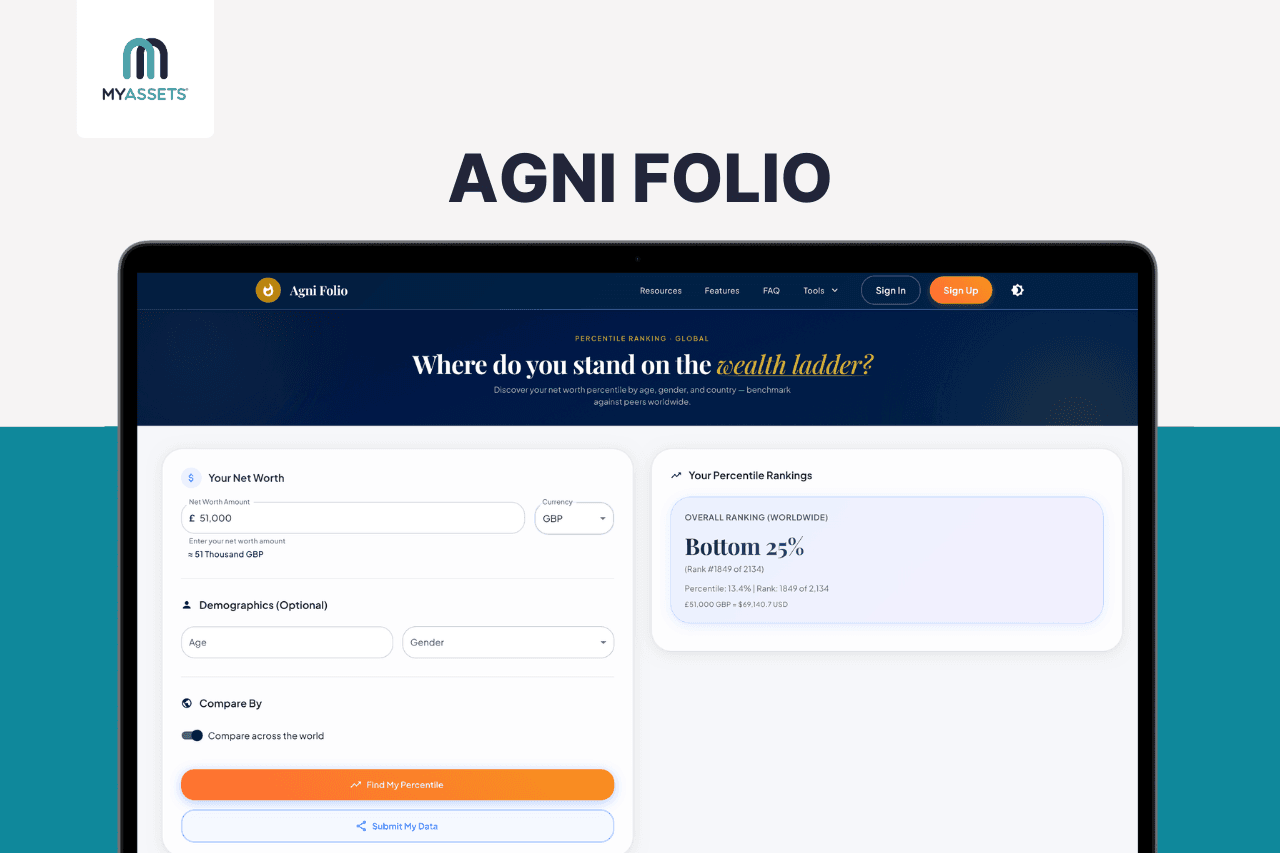
How rich am I calculator is an online tool that compares an individual’s net worth against national or global wealth distributions. By entering data such as total net worth, it estimates the user’s percentile ranking, revealing where they stand in the world or a particular nation.
Primary Features
Explore how this calculator can help determine your wealth ranking through these key features:
- Global Benchmarking Data: Uses external wealth datasets to estimate relative financial standing
- Real-Time Estimation: Provides instant results based on the net worth figure provided
- Wealth Tier Classification: Categorises users into percentile groups (i.e., middle class, top 10%, top 1%)
Top How Rich Am I Calculators
Listed below are recommended how rich are you calculators:
- Agni Folio - Net Worth Ranking Finder
- ChatEurope - Calculate your position on the world wealth scale
- Giving What We Can - How Rich Am I Calculator
How Rich Am I by Net Worth: A Global Perspective
In summary, net worth is the definitive metric for measuring wealth, offering a data-driven view of an individual’s financial position. This involves:
- Listing assets and calculating their total asset value
- Accounting for liabilities and summing their total
- Calculating the difference between the two
Once determined, this figure becomes the foundation for benchmarking against global wealth percentiles. Through this lens, individuals can better understand where they stand relative to the rest of the world in terms of financial wealth.
How to Know if You are Rich: Frequently Asked Questions
1. What net worth puts you at 1% and 10%?
Globally, entering the top 1% requires a net worth of at least €7 million (£6 million), the top 10% about €265,600 (£230,124).
2. How much of the world is rich?
Only a small share of the world's population is considered rich by global standards, typically the top 10% (556 million adults), who command a 74% share of global wealth. Within this group, the top 1%, about 56 million adults, control approximately 37% of the world’s total wealth, making it the most concentrated wealth tier.
3. How do I calculate how rich I am in the world?
To start, calculate your net worth by subtracting total liabilities from total assets, then compare the result with global wealth percentile data to understand your financial position relative to the rest of the world.
MyAssets: The All-in-One Net Worth Tracker for Real Wealth Insight
When financial data is scattered across different accounts, individuals may struggle to form an accurate net worth. Introducing MyAssets, a net worth tracking app that consolidates assets and liabilities in a single platform.
A Single Dashboard to Measure Wealth
It pulls in everything:
- Bank accounts (checking and savings)
- Collectable investments (art, wine, watches, etc.)
- Investment portfolios (stocks, bonds, and mutual funds)
- Properties (residential, rental, and commercial)
It gets better. MyAssets doesn’t just show one’s assets; it also incorporates their liabilities, such as:
- Credit card debts
- Loans
- Mortgages
Imagine having all this information presented in a visually appealing dashboard. With MyAssets, monitoring net worth becomes straightforward as the platform transforms raw numbers into dynamic charts. It offers a breakdown of resources across finances, properties, collectables, and even belongings, making it easier to understand overall wealth.
A System to Manage Relationships Between Assets
Even better, users can manage relationships between assets with its Smart Asset Linking feature. In practice, this means users can connect related items, like the first bought home with its mortgage or the belongings it houses. This helps understand how assets relate to one another and their impact on one’s net worth and portfolio.
Track all your assets and see where you stand financially with MyAssets, free for 14 days.



